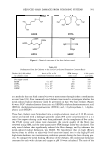
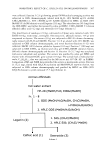
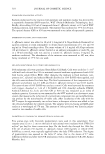
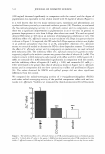
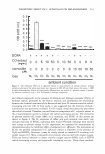
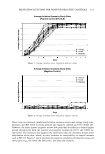
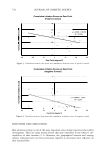
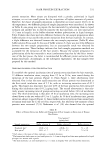
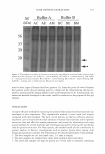
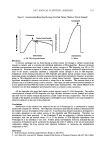
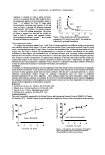
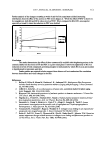
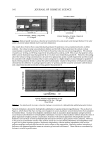
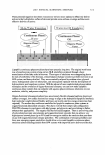
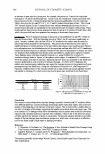
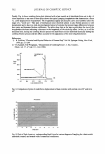
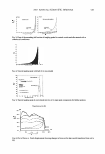
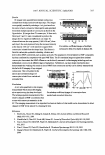
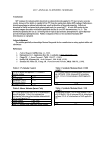
566 JOURNAL OF COSMETIC SCIENCE Intrinsic Viscosity ~ 25dUg (1 /[ri]~0.04) C*~ 0.04g/dl Corbopol900(pll�7)0J!l!,NaCI Intrinsic Viscosity~ 2.5dUg (1/[T\]~0.4) C*~ 0.4g/dl Figure 3: Reduced specific viscosity as a function of concentration for a poly (acrylic acid) microgel thickener Bin water and in o.8 percent sodium chloride at pH 7 and room temperature. Our results show that for these cross-linked polyacrylates the polymers exist as isolated molecules in dilute solution. The critical overlap concentration is distinct and for both of these polymers the critical overlap concentration is essentially identical to the Einstein theoretical value for non-interacting spheres. The intrinsic viscosities are 10 dl/ g and 25 dl/ g respectively for poly(acrylic acids) A and B. This means that polymer A has either a lower molecular mass than polymer B, or it is more cross-linked than polymer B. However, the scaling above the critical overlap concentration is 40 and 13 for poly(acrylic acids) A and B respectively and this would be consistent with a higher modulus (that would correspond to a higher degree of cross-linking) for polymer A. Each of these polymers shrinks to about the same hydrodynamic volume in the presence of 0.8 percent sodium chloride but the difference in scaling exponents above C* persists, and this would be consistent with the shear and compression moduli of polymer a being greater than polymer B. Logof� Ce Intrinsic Viscosity =[ri]=0.5Antilog of -0.3) C*= 0.3(Antilog of -0.5) Ce~ 1-25 g/dl 1 /[ri]=1 /0.5=2 Figure 4: The reduced specific viscosity as a function of polymer concentration for a hydrophobically modified polyacrylate thickener. Network formation is favored by hydrophobic substitution of a polyacrylate microgel thickener. This is shown in Figure 4, which shows that chain overlap and entanglement occurs at polymer concentrations below that calculated by Einstein theory. Increase in hydrophobic substitution leads to associative phase-separation and gel syneresis occurs beyond a threshold level of hydrophobic substitution. Increase in chain backbone stiffness delays the onset of phase-separation to higher polymer concentration. Polymers with random placement of hydrophobes and stiff backbones are less likely to form hydrophobically-associated networks in pure polymer-water solutions. However, in the presence of surfactant micelles many of these trends are reversed blocky substitution of hydrophobes tends to give rise to phase-separated polymer/ surfactant compositions, whereas random substitution tends to favor polymer-surfactant networks that traverse the entire volume of the composition. Similarly, random interaction of polymers with dispersed particles causes an extensive gel network to be formed. These effects are exacerbated by increase in micelle or particle sizes.

2007 ANNUAL SCIENTIFIC SEMINAR 567 Conclusions: The discovery and development of stimuli responsive hydrogels will be accelerated by the application of rapid methods of analysis that give insight into the hydrodynamic volumes of the micrograph and also methods that indicate the extent of microgel- microgel interaction as a function of concentration and physical conditions. We have shown that we can gain significant insight into then molecular mind parameter by straightforward measurement of the specific reduced viscosity, identification of the critical overlap concentration, the critical entanglement concentration, and the scaling exponents of reduced specific viscosity as a function of polymer concentration. References 1 Lochhead, R.Y. "Stimuli-Responsive Polymer Systems: A review of thermo-associative thickening", Cosmetics and Toiletries, 2 Suares Alan J. , Zhang Joanna H., 'Thickened cosmetic compositions', United States Patent 6,986,895, January 17, 2006, assigned to Unilever Home & Personal Care USA division of Conopco . 3 Ron Eyal S. Bromberg Lev Temchenko Marina End modified thermal responsive hydrogels United States Patent 6,316,011, November 13, 2001 assigned to Madash LLC 4 Olivieri Laetitia Ron Eyal S. Thermally reversible water in oil in water emulsions United States Patent 6,995,209 February 7, 2006 , assigned to Madash LLC 5 L'Alloret, Florence "Polymer comprising water-soluble units and lest units, and aqueous composition comprising same" United States Patent Application 20040214913 October 28, 2004 6 L'Alloret, Florence "Polymer comprising water-soluble units and LCST units, and aqueous composition comprising it" United States Patent Application 20060111518 May 25, 2006. 7 L'Alloret Florence "Heat-induced gelling foaming composition and foam obtained" United States Patent 6,878,754 April 12, 2005 assigned to L'Oreal. 8 Zhang, Yanjie Furyk Steven Bergbreiter David E Cramer, Paul S "Specific ion effects on the water solubility of macromolecules", J. Amer. Chem. Soc. 2005, 127, 14505 9 Sarrazin-Cartalas ,A. Iliopoulos, I. Audebert, R Olsson, U. "Association and thermal gelation in mixtures of hydrophobically modified polyelectrolytes and nonionic surfactants", Langmuir, 1994, 10, 1421. 10 Panai, S .Prud'homme, R.K Peiffer D.G. Colloids & Surfaces, 147, (1999), 3. 11 Loyen, K. Iliopoulos, I. Audebert, R Olsson, U. "Reversible thermal gelation in polymer/ surfactant system" Langmuir, 1995, 11, 1053. 12 Cameron, A N.S. . Corbierre, M.K and Eisenberg, A, 'Symmetric amphiphilic block copolymers in solution: A morphological wonderland", Can. J. Chem.,77: 1311-1326 (1999) 13 Dubie£, Claude Nicolas Morgantini, Luc Bernard Anne-Laure, Simonet, Frederic "Use of a combination of at least one associated polymer and at least one amphiphilic diblock copolymer for thickening cosmetic compositions" United States Patent Application 20060140898 June 29, 2006 14 Lochhead, R.Y Smith, V. "Polymers in Skin Care", HAPP!, April 2007. 15 Huang, X. Wu.Y. Wang, H "Peptide-based conditioners and colorants for hair, skin and nails", US Patent Application 20070048236 A1, March 1 , 2007. E.I. Du Pont De Nemours. 16 Ulijn, R.V. Bibi, N. Jayawarna, V. Thornton, P. Todd, S. Mart, R.J. .Smith, AM. Gough,J.E. "Bioresponsive hydrogels", Materials Today, 2007, 10, 40. 17 Kujawa, P. . Audibert-Hayet, A. Selb, J. Candau, F.: Macromolecules 2006, 39, 384.
Purchased for the exclusive use of nofirst nolast (unknown)
From: SCC Media Library & Resource Center (library.scconline.org)