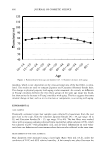
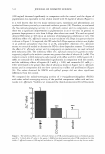
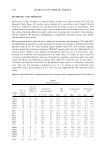
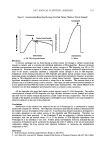
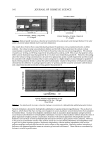
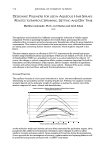
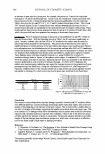
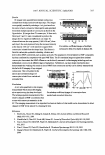
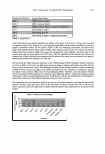
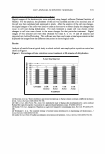
570 JOURNAL OF COSMETIC SCIENCE DESIGNING POLYMERS FOR USE IN AQUEOUS HAIR SPRAYS ROUTES TO IMPROVE SPRAYING, SETTING AND DR Y TIME Matthias Laubender, Ph.D., Joel Basilan and Gerd Schuh BASF The regulatory trend initiated in California concerning the reduction of volatile organic compounds (VOCs) is spreading throughout the United States, generating the need to understand how to prepare aerosol and pump spray formulations within the given legislative requirements. This seems to have become even more important since additional discussions are taking place concerning further emission reductions, which might be required in the future. The most common practice in adhering to 55% VOC requirements for aerosol hair sprays, besides using hydrofluorocarbons as propellants (which are not defined as VOCs), is the use of dimethylether (DME) as a propellant and water as a partial substitute for ethanol. Of course, this change in solvent composition affects various parameters important for both the formulation and the performance of hair sprays, like for example: solubility of ingredients, viscosity and surface tension of the solution, spray pattern, foaming of the spray, wetting and adhesion to the hair fibers and lastly the drying behavior on hair. Spraying Properties The capillary viscosity of a hair spray formulation is, by far, the most influential parameter determining its sprayability and the resulting droplet size. Whereas, the capillary viscosity strongly depends on the molecular weight of a polymer as well as the solvent ratio of the mixture composed of: water, ethanol and dimethylether. Capillary Viscosity of Aqueous Polymer Solution at Different Etanol Contents (5% polymer solution at 25 °C) 10 20 ' ' Ethanol Content in Aqueous Polymer Solution rt,] As the molecular weight and solvent ratio are often constrained by application targets, other parameters like additives or formulation techniques can be changed in order to adjust capillary viscosity and spray pattern. Some examples will be given during the presentation. A new approach for the investigation of viscosity, surface tension and spraying behavior will be presented using results produced with a CaBER® instrument.

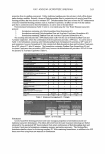
2007 ANNUAL SCIENTIFIC SEMINAR 571 Setting and Hold In general, high stiffness and strong hold in styling aids can be achieved by using high molecular weight polymers or high amounts of lower molecular weight polymers. Both these solutions lead to high viscosity and coarse spray pattern, especially in aqueous hair spray formulations. To overcome this problem polymers with low molecular weight, that are capable of forming rigid films with high E·moduli, are the preferred design for aqueous hair spray formulations. It was shown that polymers bearing a rigid backbone have properties suitable to fit this requirement. Furthermore, our investigation revealed that changing the functionality of a polymer chain, by different chemical modifications, can have surprising positive influence on setting results. The key in forming a strong bond with the hair surface is to have both, cohesion of the polymer film, as well as adhesion to the keratin surface. Drying behavior The two main challenges in finishing a hairstyle with a water-containing hair spray are curl droop and prolonged dry time. There are only limited ways to accelerate the evaporation of water. One is by the reduction of droplet size, another by using azeotropic mixtures of water and acetone. Therefore, within given rules other techniques have been investigated to prevent curly hairstyles from sagging and provide fast-drying properties to aqueous hair sprays.
Purchased for the exclusive use of nofirst nolast (unknown)
From: SCC Media Library & Resource Center (library.scconline.org)