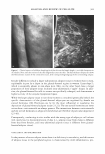
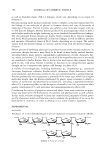
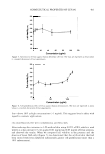
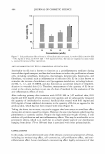
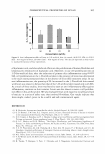
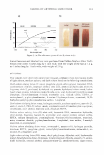
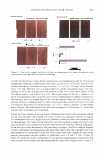
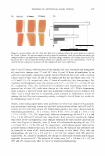
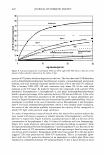
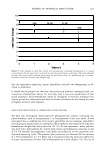
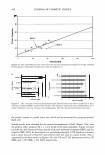
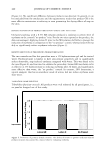
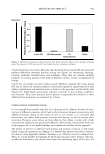
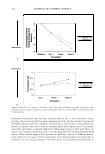
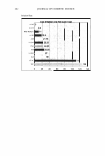
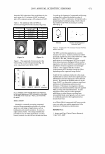
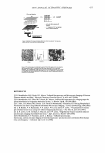
COSMECEUTICAL PROPERTIES OF LEVAN 80 �----------------------, - 70 8 60 QJ r/) ca � 50 tS I �l [ I J (a) r--1 I r - I I 1 (b) (c) (d) Concentration (w/v%) 405 Figure 8. Anti-inflammation effect of levan in 3-D artificial skin: (a) control (b) 0.05% SDS (c) 0.05% SDS + 0.01 mg/ml of levan (d) 0.05% SDS + 0.05 mg/ml of levan. The data are expressed as mean values (± standard deviations) of four experiments. of hyaluronic acid, and also exhibited effects on the proliferation of human fibroblast and keratinocytes reminiscent of hyaluronic acid. Moreover, in our cell proliferation test on 3-D bio-artificial skin, after the induction of primary skin inflammation using 0.05% SLS, cell proliferation on the 3-D artificial skin in the presence of levan was determined to be much more pronounced than in the absence of levan (SLS treatment only). In our anti-inflammation test, the quantity of IL-la. secreted in the 3-D artificial skin treated with levan was shown to be less than that of the 3-D artificial skin treated only with SLS. As a result of these studies, levan was found to exert an anti-inflammatory effect against inflammatory reactions to skin irritants. Levan was also shown to exert a cell prolifera tion effect in bio-artificial skin. We also evaluated levan with regard to its safety and lack of toxicity in a series of safety tests that involved fibroblasts. Our results indicate that levan might, indeed, prove to be a useful and safe cosmeceutical agent. REFERENCES (1) R. Dedonder, Levansucrase from Bacillus subtiliJ, Methods Enzymol., 8, 500-505 (1966). (2) G. D. Bonnett, I. M. Sims, R. J. Simpson, and A. J. Cairns, Structural diversity of fructan in relation to the taxonomy of the Poaceae, New Phytologist, 136, 11-17 (1997). (3) N. C. Carpita, J. Kanabus, and T. L. Housley, Linkage structure of fructan and fructan oligomers from Triticum aestivum and Festuca arundinacea leaves,]. Plant Physiol., 134, 162-168 (1989). (4) G. A. F. Hendry and R. K. Wallace, "The Origin, Distribution, and Evolutionary Significance of Fructan," in Science and Technology of Fructans, M. Suzuki and N. J. Chatterton, Eds. (CRC Press, Boca Raton, FL, 1993), pp. 119-139. (5) E. A.H. Pilon-Smits, M. J.M. Ebskamp, M. J. Paul, M. J. W. Jeucen, P. J. Weisbeek, and S. C. M. Smeekens, Improved performance of transgenic fructan-accumulating tobacco under drought stress, Plant Physiol., 107, 125-130 (1995). (6) M. J. Pabst, Levan and levansucrase of Actinomyces viscosus, Infect. Immun,, 15, 518-526 (1977). (7) T. N. Warner and C.H.Miller, Cell-associated levan of Actinomyces viscosus, Infect. Immun., 19, 711-719 (1978). (8) K. Tanaka, T. Karigane, S. Fujii, T. Chinzaka, and S. Niagamura, Intermolecular fruccosyl and

406 JOURNAL OF COSMETIC SCIENCE levanbiosyl transfers by levan fructotransferase of Arthrobacter ureafaciens,]. Biochern. (Tokyo), 97, 1679-1688 (1985). (9) R. Dedonder and C. Peaud-Lenoel, Studies on the levansucrase of Bacillus subtilis. I. Production of levans and levansucrase (levan-succharotransfructosidase) by cultures of Bacillus subtilis, Bull. Soc. Chim. Biol. (Paris), 39, 483--497 (1957). (10) A. Fuchs, Synthesis of levan by pseudomonads, Nature (London), l 78, 921 (1956). (11) R. Lesher, Levan production by Rothia dentocariosa and its biological activity (Ph.D. Thesis, West Virginia University, 1976). (12) J.C. C. Ribeiro, W. V. Guimaraes, A. C. Borges, D. 0. Silva, and C. D. Cruz, Levan and ethanol production by Zyrnornonas rnobilis CP4 mutants during sucrose fermentation, Rev. Microbial., 19, 196- 202 (1988). (13) H. H. Schlubach and J. Berndt, Uber Die Durch Azotobacter Chroococcurn Aus Saccharose Gebildeten Oligo- Und Polysaccharide, Liebigs Ann. Chern., 677, 172-176 (1964). (14) T. Tanaka, S. Yamamoto, S. Oi, and T. Yamamoto, Structures of heterooligosaccharides synthesized by levansucrase,J. Biochern. (Tokyo), 90, 521-526 (1981). (15) Y. Yamamoto, Y. Takahashi, M. Kawano, M. Iizuka, S. Saeki, and H. Yamaguchi, In vitro digest ibility and fermentability of levan and its hypocholesterolemic effects in rats,]. Nutr. Biochern., 10, 13-18 (1999). (16) A. Ohta, N. Osakabe, K. Yamada, Y. Saito, and H.J. Hidaka, Effect of fructooligosuccharides and other saccharides on Ca, Mg, and P absorption in rats,]. Jap. Soc. Nutr. Food Sci., 46, 123-129 (1993). (17) M. B. Roberfroid, G. R. Gibson, and N. Delzenne, The biochemistry of oligofructose, a nondigestible fiber: An approach to calculate its caloric value, Nutr. Rev., 51, 137-146 (1993). (18) G. M. T. Calazans, C. E. Lopez, R. M. 0. C. Lima, and F. P. Franca, Antitumour activities of levans produced by Zyrnornonas rnobilis strains, Biotech. Lett., 19, 19-21 (1997). (19) M. Beakers, J. Shvinka, L. Pankova, M. Laivenieks, and I. Mezhbarde, Simultaneous sucrose biocon version into ethanol and levan by Zyrnornonas mobilis, Appl. Biochem. Biotechnol., 24125, 265-274 (1990) (20) W. Hartmeier, M. Reiss, M. Heidel, and S. Marx, Biochemical and economical aspects of levan synthesis by Zymornonas rnobilis, Biocatalysis, 10, 131-136 (1994) (21) A. D. French, Chemical and physical properties of fructans,J. Plant Physiol., 134, 125-136 (1989). (22) Y. W. Han, Levan production by Bacillus polyrnyxa,]. Ind. Microbial., 4, 447-452 (1989). (23) J. Levin and H. Maibach, The correlation between transepidermal water loss and percutaneous ab sorption: An overview,]. Controlled Release, 105, 291-299 (2005). (24) G. R. Leonardi, L. R. Gaspar, and P. M. Maia Campos, Application of a non-invasive method to study the moisturizing effect of formulations containing vitamins A or E or ceramide on human skin,]. Cosmetic Sci., 53, 263-268 (2002). (25) T. Mosmann, Rapid colorimetric assay for cellular growth and survival: Application to proliferation and cytotoxicity assays,]. Imrnunol. Methods, 65, 55-63 (1983). (26) L. P. Kamolz, M. Luegmair et al., The Viennese culture method: Cultured human epithelium obtained on a dermal matrix based on fibroblast containing fibrin glue gels, Burns, 31, 25-29 (2005). (27) M. Ponec and J. Kempenaar, Use of human skin recombinants as an in vitro model for testing the irritation potential of cutaneous irritants, Skin Pharrnacol., 8, 49-59 (1995). (28) R. A. Demel, E. Dorrepaal, M. J. M. Ebskamp, J. C. M. Smeekens, and B. D. Kruijff, Fructans interact strongly with model membranes, Biochirn. Biophys. Acta, 1375, 36--42 (1998). (29) I. J. Vereyken, V. Chupin, R. A. Demel, S. C. M. Smeekens, and B. D. Kruijff, Fructans insert between the head groups of phospholipids, Biochim. Biophys. Acta, 1510, 307-320 (2001). (30) I. K. Cohen, R. F. Diegelmann, and W. J. Lindblad, "Wound Healing: Biochemical and Clinical Aspects" (W. B. Saunders, Philadelphia, 1992). (31) P. J. Dykes, M. J. Edwards, 0. V. Merrett, H. E. Morgan, and R. Marks, In vitro reconstruction of human skin: The use of skin equivalents as potential indicators of cutaneous toxicity, Toxic. In Vitro, 5, 1-8 (1991).
Purchased for the exclusive use of nofirst nolast (unknown)
From: SCC Media Library & Resource Center (library.scconline.org)