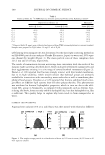
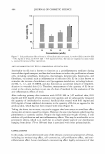
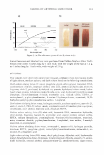
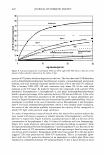
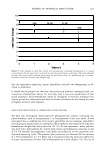
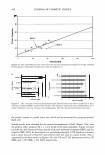
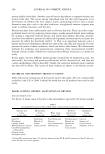
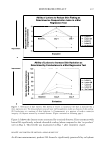
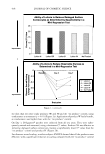
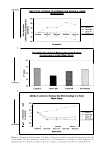
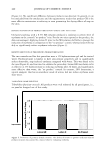
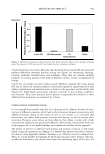
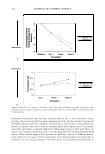
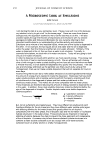
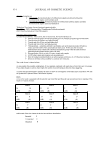
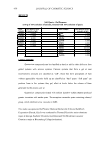
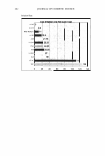
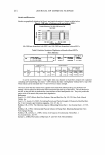
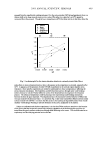
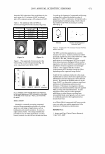
464 JOURNAL OF COSMETIC SCIENCE Results and Discussion Results are graphically displayed in figure I and statistical analysis is shown in tables below. Figurel: JSR index of lighteners with and without SEO's Powder Bleaches FN 190-1288 versus FN 190-128D 1.00 : 0.80 "Cl .5 0.60 a:: 0.40 � 0.20 0.00 ..._ _________.____...._____ FN 190-1288 FN 190-128D Powder Bleaches 190-128B was formulated with SEO's and 190-128D was formulated without SEO's Tablet Statistical Analysis of lighteners with and without SEO's Basic Statistics Std. Error N 2 = FN 190-128D Levene's Test for t-test for Equalijy rl C_,_,._, � '35% Interval of Sid. Diflerenc Equal I s;g 12-tailedJ MAAn Difference Sig. ... OiffArflflr. ,�, u-• ISR assume 1 279 .260 4.722 138 .000 .07364 015595 .042805 , .104478 Equal not 4.874 137 40 .000 07364 015109 .043765 .103518 It can be seen from figure l that higher index was obtained on hair fibers treated with Lightener containing self-emulsifying oils (Index = 0.89) whereas the index with lightener without SEO's was 0.787. These indices can be translated into 11 % and 21 % loss in elastic strength. The results show that hair treated with Lightener formulated with self-emulsifying oils showed a low damage. The oils plasticize the protein matrix and protect the elasticity of the matrix. The oils moisturize the hair, as they are able to penetrate the cortex because of their small particle size. They also protect the amino acids of the matrix and prevent their degradation. References Syed, A. N., (1997). Ethnic Hair Care Products. Hair and Hair Care. Pp. 235-259. New York: Marcel Dekker. Inc. Syed, A. N., Ayoub, H., (2002). Correlating Porosity and Tensile Strength of Chemically Modified Hair. Pp. 57-64. Cosmetics and Toiletries magazine., Vol. 117, No. 11. Robbins, C.R., (1971). The Chemical Aspects of Bleaching Human Hair. J. Soc.Cosmet.Chem., 22: 339- 348. Robbins, C.R., (1994). Chemical and Physical behavior of Human Hair. Bleaching Human Hair. New York: Spriger-Verlag. Robbins, C.R., & Kelly, C., (1969). Amino Acid Analysis of Cosmetically Altered Hair. J. Soc.Cosmet.Chem., 20: 555. Zaviak, C., (1986). The Science of Hair Care. P. 229, New York: Mercel Dekker.

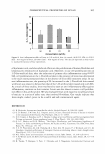
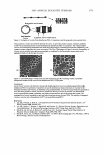
2005 ANNUAL SCIENTIFIC SEMINAR HAIR & SKIN EVALUATION BY IMAGE ANALYSIS Janusz J achowicz, Ph.D. and Roger McMullen International Specialty Products, Wayne, NJ 07470 Image analysis has found numerous applications in cosmetic science for characterization of skin and hair and for quantification of the effectiveness of cosmetic treatments. In skin research, image analysis techniques are used in combination with profilometry, topography analysis, scanning electron microscopy (SEM), and stereomicroscopy, which are all used for cutaneous microrelief analysis as well as for quantification of the effects of moisturization, anti-aging, exfoliation, and "peeling" of various products [1,2]. These techniques can be employed to visualize and quantify the skin surface in various regions such as lips, aging spots, thinning cellulite, wrinkles, etc. Quantitative parameterization includes depth and peak distributions, hole analysis, Fourier analysis, power spectrum analysis, angle measurements, distance measurements, etc. [ 1-3]. Similarly, image analysis can also be employed for hair research in combination with photography, optical microscopy, SEM, scanning probe microscopy (SPM), and color analysis. Specific problems, which can be solved by using image analysis measurements, include quantification of hair luster on both idealized geometrically arranged straight hair as well as on free hanging frizzy or curly hair tresses [ 4,5]. By varying the illumination conditions one can obtain hair images for quantitative characterization of hair surface deposits such as styling polymer films (flakes), micronized and non- micronized inorganic sunscreens, pigments, etc. For idealized geometrical conditions of fiber arrangement and illumination, one can perform color analysis by quantitative measurements of image histograms, which can provide information about color shifts as a result of styling treatments, dye deposition, as well as color distribution in hair fiber assemblies. An important area of hair evaluation is the characterization of hair damage. Image analysis can be employed in visualization, and both qualitative and quantitative characterization of hair damage based on optical, SEM, and SPM micrographs. Finally, optical micrographs can be used for the characterization of fiber organization in hair fiber assemblies. The paper will review both published and previously unpublished data References: [I] K. Miyamoto, G. Hillebrand, The beauty imaging system: for the objective evaluation of skin condition, J. Cosmet. Sci., 53, 62 (2002). [2] www.digitalsurf com [3] H. Zahouani, R. Vargiolu, Ph. Humbert, 3D morphological tree representation of the skin relief A new approach of skin imaging characterization, Proceedings of XXth IFSCC Congress, Cannes 1998, Vol.3, p.69. [4] T. Maeda, T. Hara, M. Okada, and H. Watanabe, Measurements of hair luster by color image analysis, Proceedings of 16th JFSCC Congress, New York, 1990, Vol. I, p. 127. [5] R. McMullen and J. Jachowicz, Optical properties of hair: effect of treatments on luster as quantified by image analysis, J. Cosmet. Sci., 54, 335 (2003). 465
Purchased for the exclusive use of nofirst nolast (unknown)
From: SCC Media Library & Resource Center (library.scconline.org)