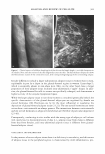
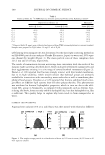
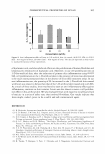
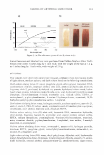
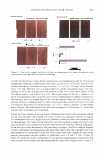
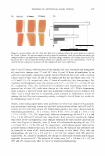
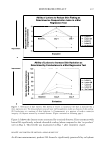
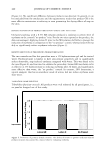
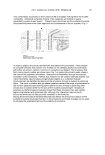
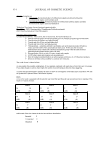
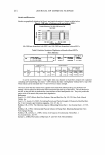
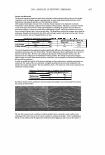
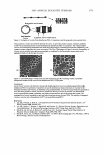
470 JOURNAL OF COSMETIC SCIENCE THE ANTI-ANGIOGENIC AND ANTI-INFLAMMATORY ACTION OF MENTHOL PROPYLENEGLYCOL CARBONATE (MPC) IN EXPERIMENTAL MODELS Johnathan R. Matias, Ph.D. Poseidon Sciences Group, 122 East 42nd Street, Suite 1700, New York, NY 10168 INTRODUCTION Active research in the use of naturally-occurring biochemicals for application as topical medication is motivated in part, by growing public concern on the possible health risks associated with products that contain new synthetic active agents. Skin inflammation as a result of dermatitis, psoriasis and eczema remain among the major applications of novel anti-inflammatory research efforts. Menthol has been in human use for almost a century in a wide range of applications including treatment for inflammation of the skin. However, this inherent anti-inflammatory effect is limited by its low biological activity. By studying structure-activity relationships, specific menthol analogues possessing strong biological activities suitable for practical use were identified. The addition of a propyleneglycol carbonate moiety on the menthol structure results in a cooling agent known by its common name, menthol propyleneglycol carbonate (MPC), a compound listed as a FEMA GRAS compound since 1999. This paper describes the anti-angiogenic and anti-inflammatory effect of MPC in experimental models. MATERIALS AND METHODS The antiangiogenic effect of MPC was studied by culturing aortic explants in three-dimensional matrix gels according to the procedure of Kruger and Figg (I). Thoracic aortas were excised from 8- week-old male Sprague Dawley rats and the fibroadipose tissue removed. The aortas were sectioned into I-mm cross-sections, rinsed with Human Endothelial-SFM (GIBCO), placed on the Matrigel-coated wells, covered with an additional 50 µl Matrigel, and allowed to gel for more than 30 min at 37°C, 5% CO2, All the rings were cultured in Human Endothelial-SFM (GIBCO), supplemented with 200µ1/ml of ECGS (Endothelial Cell Growth Supplement, Sigma) as an angiogenesis inducer. MPC, diluted with ethanol, was added to the culture medium at final concentrations of I µM, IOµM, and I00µM. Ethanol alone (1%) was added to the culture medium as vehicle control. The area of angiogenic sprouting was calculated using Image-Pro Plus software (Media Cybernetics). Microvessel densities are reported in square pixels. All assays were performed using 5 aortic rings per sample and were photographed on day 10. The anti-inflammatory effect of MPC was evaluated using tetradecanoylphorbol ester (TPA) induced edema in the mouse ear. The mouse ear edema model is a standard animal test procedure to document the anti-inflammatory effect of an agent. In this test, edema was induced in mice through the topical application of 10µ1 of TPA in acetone (2.5µg/ear) to both the inner and outer surface of one ear of each mouse. Each test compound, diluted with acetone to a concentration of 10%, was applied topically to the inflamed mouse ear immediately after TPA application, so as to deliver 2.5 mg/ear. The reference drug, indomethacin (0.5mg/ear), was administered as a positive control. The thickness of each ear was measured before treatment and 4 hours after induction of inflammation, using a micrometer (Mitutoyo Co.). Anti-inflammatory effect was expressed as the reduction in ear thickness with respect to the control group. RESULTS The data in Table I and Figure I show that MPC exerted significant anti-angiogenic activity in a dose-dependent manner. When MPC was added to cultured rat aortic explants, there was a dose dependent inhibition of the formation of new microvessels. This inhibition of microvessel "sprouting" was not due to cytotoxic effects, since Ha-CaT and HUYE (human umbilical vein endothelial cells) cell lines were not affected by the same doses used in the angiogenesis assay. The inhibitory effect on the inflammatory response was tested by the topical application of MPC (referred to in the graph as HR-008) at 2% and 10% on the mouse ear. The results of the experiment are presented in Figure 2. The study

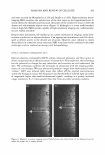
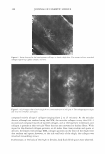
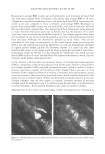
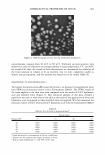
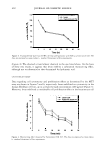
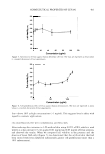
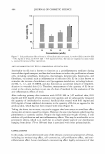
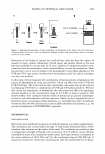
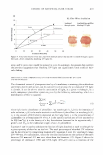
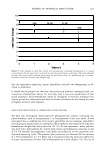
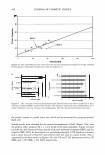
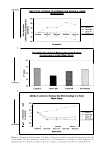
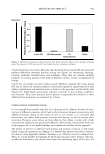
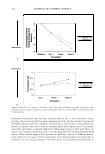
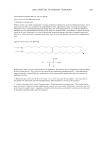
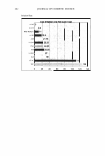
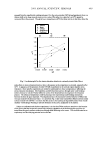
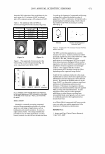
2005 ANNUAL SCIENTIFIC SEMINAR showed a 30% reduction of the ear thickness by the application of a 2% solution of MPC in ethanol, and a 50% reduction using a 10% solution ofMPC. Table I. The inhibitory effect ofMPC on microvessel outgrowth in the rat aortic ring assay. Concentration Microvessel Density ¾ Inhibition (pixel' + SDI 0 15.8+4.0 0 I 13.4+4.l 15 10 12.2+2.5 22 100 10.6 + 3.8 33 Figure la Figure lb Figure I . The outgrowth of microvessel in the Control (Fig la) and in Experimental (Fig. I b) aortic ring treated with I 0µM of MPC. 200 T 100 1 50 l ! 0 -1--- Control HR008 2% HR008 10% lndorrethacin Fig. 2. Inhibition of TPA induced edema (ear thickening) by the topical application of MPC (referred to in this graph as HR-008) on the mouse ear. Mean ± SD of 5 animals per group. DISCUSSION Menthol is a naturally occurring compound extracted from peppermint and used as a cooling agent in a wide range of applications, such as toothpastes and cosmetic products. It occurs in eight isomeric forms. The strong menthol odor precludes its use in wider applications. For this reason, research over the last two decades had been focused on development of compounds with strong cooling effect without the distinctive odor of peppermint. MPC is a derivative of menthol with a propyleneglycol carbonate group, which reduced the menthol smell while increasing its cooling effect (Fig. 3). Menthol Menthol propyleneglycol carbonate, MPC Figure 3. Comparison of the chemical structure between menthol and MPC. The MPC used in this application is a racemic mixture of D- and L- isomers and listed as GRAS (generally regarded as safe) under FEMA No. 3B06 and JEFCA No. 444. Besides its known applications as a cooling agent, MPC has recently been shown to possess biological effects in other organisms, such insect repellency and inhibition of attachment of marine organisms on submerged surfaces. This suggests that this versatile compound may have multiple biological effects depending on the organisms being studied. Under the test conditions employed in this study, menthol and its isomers showed no si gn ificant anti inflammatory and anti-angiogenic effect (data not shown). By altering the menthol molecule in the form ofMPC, we were able to observe significant inhibition of inflammation and microvessel formation. Preliminary investigation in human volunteers also demonstrated that topically applied MPC prevents itch and inflammation. Its anti angiogenic effect may have other potential applications in other diseases resulting from uncontrolled blood vessel growth, such as cancer. A worldwide patent for these applications has already been filed. As a FEMA GRAS compound, MPC may provide a new use and a new market opportunity in the treatment of inflammatory skin diseases. REFERENCE: I. Kruger and Figg. Clinical Cancer Research, 7: 1867-1 B72, 200 I. 471
Purchased for the exclusive use of nofirst nolast (unknown)
From: SCC Media Library & Resource Center (library.scconline.org)