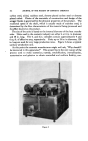
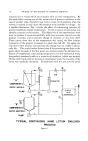
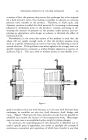
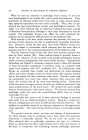
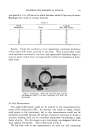
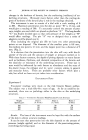
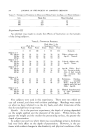
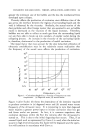
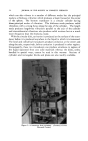
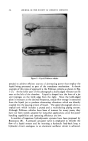
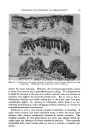
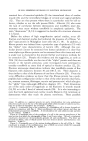
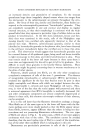
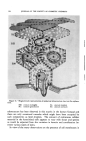
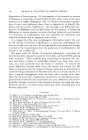
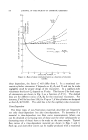
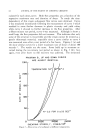
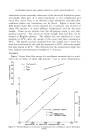
PROCESSING PRODUCTS IN VOTATOR APPARATUS 519 a matter of fact, the pressure drop across this exchanger has to be imposed by a back pressure valve, thus making it possible to operate at a process pressure most suitable to the product. Therefore, to shaft r.p.m. and diameter variation is added the third potential for increasing or decreasing physical or mechanical work on the product namely, increasing or de- creasing the amount of pressure on the product under process and em- ploying an appropriate valve design to enhance or diminish the effect of mechanical work. Nevertheless, in the event the nature of the product is such that the above will not supply enough work, or that the product requires more work at a specific temperature at more or less time, the following is one of several solutions. If the problem is one where agitation for a longer time at a specific temperature is necessary, a worker-blender apparatus is used as an auxiliary, Fig. 6. This unit, with or without jacket, is very flexible in re- Figure 6 gard to residence time and work because, as is the case with the basic heat exchanger, its variables are also size, shaft diameter, shaft design, and r.p.m. Figure 7 illustrates the basic operation set-ups that are possible to establish and control the factors of time-temperature-work. Rearrange- ment in most cases is accomplished rather simply by piping changes. In summary, the underlying goal of this discussion is definitely not to extol a specific piece of apparatus, but rather to spotlight the concept of continuous, economical unit operations of which heat transfer is one that

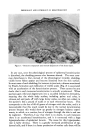
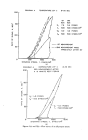
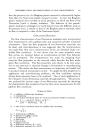
520 JOURNAL OF THE SOCIETY OF COSMETIC CHEMISTS has to be dealt with daily and without which extremely few, if any, proc- esses would be possible. Therefore, it is only reasonable for a manufac- turer to scrutinize this portion of an existing or intended production line to determine: ••._l• e-- WATER IMMISCIBLE • • i HEATING i WATER MISClBLE I I - i WORKING AT T 2 COOLING i , i i I I i I I ' I• OLDING AT T?' , 11• T• i i i AND COOLING , WORKING BASIC CONTINUOUS PROCESSING Figure 7 1. If it is a batch operation, would converting to a continuous procedure release valuable floor space, reduce scrap, labor, personnel training and supervision, ease the quality and production control load and make the working area more comfortable.• 2. If it is a batch operation, is there any reason, other than the con- viction that the present method is the only method, why it cannot be con- verted to a continuous operation easily supervised, readily learned, in- strument controlled and a technically engineered procedure rather than an art .• 3. Is the most e•cient and economical use being made of the steam produced by the boiler or the refrigeration supplied by the water or the ammonia compressor? For example, in the heating operation, how much of the total steam required is actually going into the process and how much is being radiated into the surrounding room.•
Purchased for the exclusive use of nofirst nolast (unknown)
From: SCC Media Library & Resource Center (library.scconline.org)