568 JOURNAL OF THE SOCIETY OF COSMETIC CHEMISTS of course, stable in time and do not produce useful forces normally asso- ciated with effects produced by cavitation. As the pressure amplitude of the ultrasonic wave is increased to 1.25 atmospheres a condition is reached where a large number of oscillating gas bubbles are produced. Since a gas volume enclosed by an elastic membrane represents a me- chanically resonant system, bubbles that happen to be resonant at the fundamental or harmonics of the frequency of the applied sound wave can be set into oscillation. These bubbles do not have long term stability and collapse to produce useful forces, which are estimated at thousands of atmospheres. As the sound pressure is increased further, small va- porous bubbles rupture in an explosive fashion. This has been ascribed to the breakdown of small superheated regions. If Pt represents the internal pressure in a void, P0 the hydrostatic pres- sure in the surrounding liquid, v the interfacial tension and R the bubble radius, for equilibrium to attain we must have P• = It can be seen that as the radius of the bubble decreases, the internal pressure increases. Therefore, as a bubble gets small, we would ex- pect that the vapor or gas filling the bubble would diffuse through the interface due to the high internal pressure. Therefore, under ordinary circumstances, it would appear that as a bubble decreases in size the rate of decrease would be accelerated leading to rapid annihilation. Since the wealth of experimental evidence indicates that microscopic bubbles are present in liquids unless special precautions are taken in their preparation, it is currently felt that the small bubbles are stabilized by the presence of small dust particles which serve as nuclei since gas can be trapped in the cracks existing on surfaces of such suspended solids plus the possibility that gas bubbles are surrounded by impermeable skins of organic impurities. Thus, current theories of cavitation are based on the assumption that microscopic gas bubbles do exist. In general, physical properties of the liquid greatly affect both the onset of cavitation and the actual effects that the cavitation when pro- duced may have. The three principal properties of a liquid that influence cavitation are surface tension, vapor pressure and viscosity. The greater the surface tension the greater the potential energy stored in the inter- facial membrane for a given bubble size. Consequently, upon collapse the greater the surface tension the greater the energy concentrated into the small volume and the greater the mechanical forces developed. On the other hand, greater vapor pressure increases the minimum size upon collapse since the gas comprising the bubble acts as a cushion against which the bubble walls push. Thus, the greater the vapor pressure the

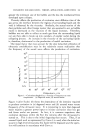
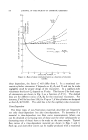
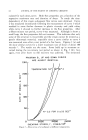
ULTRASONIC EMULSIFICATION: THEORY, APPLICATIONS, LIMITATIONS 569 greater the minimum size of the bubble and the less the mechanical force developed upon collapse. Viscosity affects the production of cavitation since diffusion time of the gas across the interface between the regions of surrounding liquid and the void is influenced by the viscosity. Similarly, the actual motion of the dust particles and other foreign matter that are assumed to act as bubble nuclei is decreased as the viscosity of the liquid increases. Therefore, bubbles are not able to collect as much gas from the surrounding liquid nor are they able to break up into numbers of smaller nuclei during the collapsing process. An increase in the viscosity of the cavitating liquids is, therefore, detrimental to the production of useful cavitation. One major factor that may account for the slow industrial utilization of ultrasonic emulsification may be the relatively recent realization that the frequency of the sound wave affects the production of cavitation. 10 6 IO 5 I0 • • i0 • • I0 0.1 I0 I0 • I0 • I0 '• I0 • I0 • I0 • F'REQU E NC.Y, Cp5 Figure 1.--Cavitation threshold as a function of frequency at room temperature. (a) Degassed water, (b) aerated water. Figure 1 (after Esche) (6) shows the dependence of the intensity required to produce cavitation in (a) degassed water and (b) aerated water versus frequency of the ultrasonic wave. It is interesting to note that degassed water requires a greater power input to initiate cavitation since less gas and fewer nuclei are present. In fact, it is common experience that cavitation decreases within the first few minutes after the ultrasound is turned on. This is due to the initial degassing that occurs. Thus, if an aerated liquid such as represented by Curve b is used, after the initial ex- posure to high level ultrasound, this liquid will be degassed and the opera- tion will continue in accordance with Curve a.
Purchased for the exclusive use of nofirst nolast (unknown)
From: SCC Media Library & Resource Center (library.scconline.org)