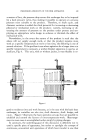
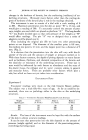
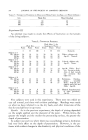
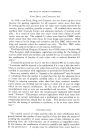
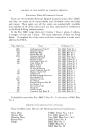
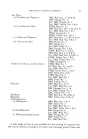
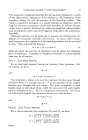
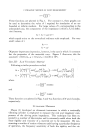
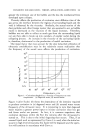
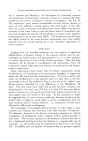
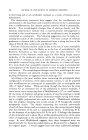
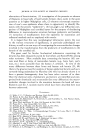
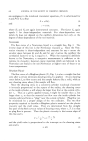
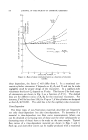
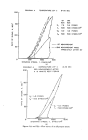
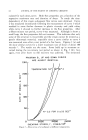
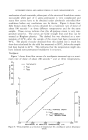
INTERPRETATIONS AND APPLICATIONS OF FLOW MEASUREMENTS 617 flow the pressure loss of a Bingham plastic material is substantially higher than that of a NewtonJan liquid of equal viscosity. In fact the Bingham plastic material does not flow at all at pressures at which the flow of the Newtonian liquid is already turbulent. The behavior of the pseudo- plastic toothpaste, although it is much heavier (note the different scale on the pressure axis), is similar to that of the Bingham plastic material, when its flow is compared to that of the NewtonJan liquid. CONCLUDINO REM^P. KS The flow characteristics of non-Newtonian materials were interpretated From measurements with capillary-tube and concentric-cylinder rotational viscometers. Since the flow properties of non-Newtonian materials can be shear- and time-dependent, it was suggested that the interpretations are made from flow curve measurements which are obtained under con- trolled flow conditions. It was shown that for some materials many flow curves are required before an interpretation of their flow behavior can be attempted. The interpretation was made by assigning char- acteristic flow properties to the material which describe the flow under given flow conditions. The flow properties were shown to be very sensi- tive to any physical or chemical change in formulation or manufacturing process. This makes the flow measurement an important and useful tool in product research and product control. To apply the flow properties to application and manufacturing problems, the flow conditions existing during those processes have to be analyzed. One of such applications is the transport of non-Newtonian materials through pipelines. This process was analyzed for various types of non-Newtonian materials by obtaining the characteristic flow properties from the flow curve measurements for the pipeline flow conditions. SYMBOLS USED B = coefficient of thixotropic breakdown c -- concentration C = rate of shear correlation factor for rotational concentric-cylinder viscometer, r' 1 - (R•,/R•) •v 1F,• + ½ = LN•I m- (•]__IL• J Cv = rate of shear correlation factor for capillary-tube viscometer, 4 Cv-N+ 3 CL = transitionAoss coefficient D = diameter of capillary or pipe d = any diameter • D f = yield value G = rate of shear h -- height of annulus K• = instrument constant, K• = D/8 K2 = instrument constant, K2 = 4LID

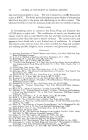
618 JOURNAL OF THE SOCIETY OF COSMETIC CHEMISTS k • k 2 • instrument constant, k = kl/k2 instrument constant, kt (Rb + Re)2 [ 1 - 16,r Rb 2 /•c i instrument constant, •h L P = AP= r T = U = 0 = r/ instrument constant, 1 ka = •,, /•i•/4•rh in (RR--•) length of capillary or pipe coefficient of thixotropic breakdown structure number material constant rotational speed applied pressure pressure loss radius of inner cylinder radius of outer cylinder any radius between R• and R, torque plastic viscosity mean velocity (from flow rate) time interval apparent viscosity NewtonJan viscosity density shearing stress friction factor Subscripts: 0 = intercept G = shear dependent t = time dependent REFEKENCES (1) Weltmann, Ruth N., N. At.C.At. TN 3397, February (1955). (2) Bingham, E. C., "Fluidity and Plasticity," New York, McGraw-Hill Book Co., Inc. (1922), p. 217. (3) Buckingham, E., Proc. At.S.T.M., 21, 1154 (1921). (4) Farrow, F. D., Lowe, G. M., and Neale, S. M., y. TextileInst., 19, T18 (1928). (5) Weltmann, Ruth N., and Kuhns, Perry W., N. At.C. At. TN 3510, August (1955). (6) Weltmann, Ruth N., and Kuhns, Perry W., Lubrication Eng., 12, Nov.-Dec. (1956). (7) Green, H., and Weltmann, R. N., "Thixotropy," Vol. VI of "Colloid Chemistry," J. Alexander, editor, New York, Reinhold Publishing Corp. (1946), pp. 328-347. (8) Andrade, E. N., daC., Nature, 125, 309, 582 (1930). (9) Arrhenius, S., Z. Physik. Chem., 1, 285 (1887). (10) Traxler, R. N., Schweyer, H. E., and Moffatt, L. R., Ind. Eng. Chem., 29, 489 (1937). (11) Weltmann, R. N., and Green, H., y. Atpplied Phys., 14, 11 (1943). (12) Fischer, E. K., "Colloidal Dispersions," New York, John Wiley & Sons, Inc. (1950). (13) Weltmann, R. N., and Keller, T. A., N. At.C. At. TN 3889 (1956). (14) Weltmann, R. N., Ind. Eng. Chem., 48, 1386 (1956). (15) Rouse, H., and Howe, J. W., "Basic Mechanics of Fluids," New York, John Wiley & Sons, Inc. (1953). (16) Hedstr6m, B. O. A., Ind. Eng. Chem., 44, 651 (1952). (17) Reiner, M., "Deformation and Flow," London, H. K. I.ewis & Co. (1949). (18) Goodeve, C. F., and Whitfield, G. W., Trans. Faraday Soc., 34, 511 (1938).
Purchased for the exclusive use of nofirst nolast (unknown)
From: SCC Media Library & Resource Center (library.scconline.org)