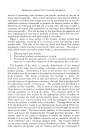
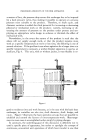
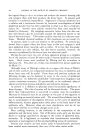
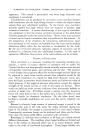
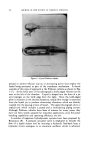
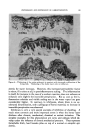
PHYSIOLOGY AND PATHOLOGY OF KERATINIZATION* By STEPHEN ROTHMAN, M.D. University of Chicago, Chicago, IlL OwE ov T•E important features of epidermal keratinization in man and in other mammals is that horny material is cast off steadily in invisible tiny dry particles (1). This steady process, going on day and night, has been called "insensible desquamation" meaning unnoticeable scaling. This is in contrast to the grossly visible periodical shedding of the skin of such reptiles as the snake. The details of how and why in mammals the originally continuous horny sheets of the horny layer break up into in- visible small particles, probably into single horny cells, are largely unknown. Histological evidence indicates that in the lower parts of the horny layer, the dead horny cells are tightly bound to each other while in the higher layers the sheets are loosened. Correspondingly, the anatomists talk of a stratum compactum and a stratum disjunctum of the horny layer (Fig. 1). The material which holds the cells together in the stratum compacturn, if there is any such material, is unknown. The noncornified epidermis seems to contain some mucoid substance, precipitable with weak acetic acid, and it was hypothesized that this material is present in the inter- cellular spaces, between the cells, and may be responsible for holding the cells together in continuous sheets. Blank (2) has dealt with this possi- bility and tentatively assumed that this substance may be tightly held in the stratum compactum and that removal of this substance may decrease its waterholding capacity. Ever since 1929, my idea has been (3) that the disintegration of the horny cell sheets which leads to the insensible shedding must have something to do with the dehy•.ration which the keratinizing cells undergo. While the living cells from which horn is formed contain 70 per cent water, horny structures have only a few per cent, hardly ever more than 10 per cent. If there is an intercellular mucoid substance, the rapid, formidable loss of water will shrink this ma- terial and alter its sticking qualities. Or, if there is no such substance be- tween the cells, the cells themselves will shrink and such shrinkage may well account for the disintegration. * Presented at the October 4, 1956, Seminar, New York City. 576

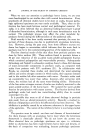
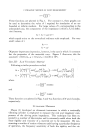
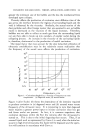
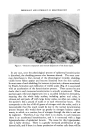
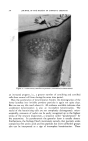
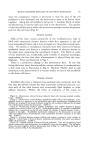
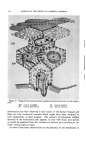
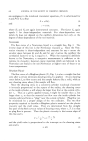
PHYSIOLOGY AND PATHOLOGY OF KERATINIZATION 577 •i•_-' * - • ,* ..q.•. •*e . • '•- Z-:o . -. . .•% • - .6:- - .•'.-':: :• T"•., .•' ..• •- : •--'" ' :" • c.' , - * ß '* .:•"' *' '.•.--.' -:• "•- • Figure 1.•Stratum compacturn and stratum disjunctum of the horny layer. In any case, once the physiological process of epidermal keratinization is disturbed, the shedding process also becomes altered. The most com- mon disturbance is that, instead of the physiological invisible shedding, visible horny flakes appear and become detached from the skin surface. In most cases of such shedding, for instance in psoriasis, a disease mentioned by Flesch, formation and exfoliation of visible scales (Fig. 2) is associated with an acceleration of the keratinization process. There cannot be any doubt that in such instances keratinization is actually accelerated. When psoriasis goes wild and degenerates into a so-called exfoliative dermatitis, meaning that the whole body surface, including palms and soles, is crimson-red and peels off with large horny scales, we often can collect in the patient's bed a pound of scales or so each twenty-four hours. This corresponds to the loss of 60-65 grams of nitrogen with the scales, and it is inconceivable that this much would be lost in the normal keratinization process because this would show up grossly in nitrogen balance experi- ments, in which, as a routine, loss of nitrogen through the skin is and can be neglected. Therefore, I say that there is no doubt, in such instances there is an accelerated keratinization, and it is connected with a huge hyperproduction of epidermal keratin. The cause for this hyperproduc- tion is fairly obvious. There is a greatly increased proliferation of epi- dermal cells, and if there is a faster production of mother cells there will be
Purchased for the exclusive use of nofirst nolast (unknown)
From: SCC Media Library & Resource Center (library.scconline.org)