ULTRASONIC METHOD OF FLOW MEASUREMENT* By WILFRED ROTH Roth Laboratory for Physical Research, Hartford, Conn. THE COSMETIC industry is concerned with flow properties of ma- terials for two basic reasons. First, they affect the ways in which the ma- terials can be handled during manufacture, e.g., mixing and pumping and second, the flow properties of the final products influence the ways in which the user may employ them, e.g., spreadability and stability. Since ultrasonic methods of flow measurement have assumed commercial importance in the last five years, we wish to discuss the basic theory be- hind the use of ultrasound to measure flow properties as well as instrumen- tation for this purpose. WAVE PROPAGATION Propagation of elastic waves in liquids and liquid-like substances is dependent upon the viscosity and shear rigidity of the material. Trans- verse waves are critically affected by these properties. Since transverse waves include all forms of vibration in which the direction of particle vibration is normal to the direction of energy flow, the discussion will include both shear modes as well as torsional modes of vibration. Little is known about the true viscoelastic behavior of the huge number of industrially important non-Newtonian materials including emulsions, colloids, suspensions, slurties, high polymers and the like, particularly as regards the variations of theological characteristics over a wide frequency spectrum. A viewpoint must be adopted that will enable us to proceed despite our limited understanding of the constitution of the materials to be measured. We will therefore consider the problem from a phenom- enological point of view. We will arbitrarily interpret all strains in the material that are in time phase with the applied stress as resulting from a single over-all rigidity coefficient function, and all strains that are 90 ø out of time phase with the applied stress as resulting from a single over-all viscosity coefficient function. Because any steady-state alternating strain can be resolved into these two time phase components, this ap- proach does not reduce the generality of the analysis. * Presented at the October 4, 1956, Seminar, New York City. 553

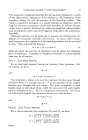
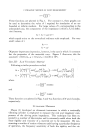
554 JOURNAL OF THE SOCIETY OF COSMETIC CHEMISTS In the general case, the particular rigidity and viscosity coefficients that can be used to describe the behavior of a viscoelastic material at one fre- quency differ from those at any other frequency. It follows, therefore, that the coefficients are functions of frequency. As we will treat opera- tion over a limited frequency range, in order to simplify notation, indica- tion of this functional dependence on frequency will be omitted. Wave EO•UA*XON ANt) PROPER*XES OF I*S Sonu*•o• In accordance with this point of view, the shear stress, Y•, produced in a viscoelastic medium by a transverse elastic wave of frequency w traveling in the y direction is related to the shear strain by where g = g(w) shear rigidity coe•cient Gnction, n =n(w) shear viscosity coe•cient function and • particle displacement in x direction. Since b• bY• • bt • - by where p is the density of the viscoelastic material, we obtain the wave equa- tion governing shear wave propagation in a general viscoelastic material p • = g 6• + . 6t6y • (1) In order to solve this equation for the particle displacement correspond- ing to a particular frequency of particle vibration, we assume in the usual way •(y, t) =erye i•t, where r is the propagation function. It follows by straightforward substitution that r = • [, j•p • j/j•j (2) • = [•e ry + Bery]eJ•t (3) and Yx = r(g + jwn) [--Afe-ry 4- Bery]eJ•t (4) Here the displacement • is represented as the summation of a wave traveling in the positive y direction and one traveling in the negativey direction with amplitude coefficients z/and B, respectively. If no discontinuities are present in the medium so that waves, once excited, propagate outward from the source without being reflected, equation (3) becomes, • = •oe-ryd •t (5) where •0 is the displacement amplitude at y--0. By resolving P into its real and imaginary components, equation (5) becomes
Purchased for the exclusive use of nofirst nolast (unknown)
From: SCC Media Library & Resource Center (library.scconline.org)