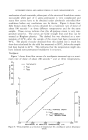
UI.'I'RASONIC METHOD OF FLOW MEASUREMENT 563 The difference between zero frequency flow properties and the flow-. properties when measured under high frequencies of shear are particularly marked when dealing with high polymers. Under unidirectional flow conditions, in order to shear the liquid, bonds between molecules must be broken when flow is established. On the other hand, since the amplitudes of vibration of the ultrasonic viscometer are in the order of a wavelength of green light, no bonds need be broken to establish the alternating shear set up during the measuring procedure. Consequently, much lower re- sistance to the alternating probe will be measured than if a continuously rotating cylinder or the like had been introduced. It is normally [Bund that the viscosity of high polymers as measured with the ultrasonic viscometer are appreciably below the normal flow viscosities as measured with unidirectional flow instruments. Usually, the higher the molecular weight the greater the difference between the zero frequency and ultrasonic frequency measurements. However, for process control purposes, once correlation can be established between the two types of measurements, it is entirely possible to use the high frequency data as an indication of the zero frequency characteristics of the material in process. The cosmetic industry is faced with other applications that to date have introduced difficulties for the ultrasonic viscometer. For many materials, rheograms in which viscosity versus rate of shear is plotted as the rate of shear is increased from zero to some maximum and then de- creased back to zero again are commonly prepared. For materials that exhibit hysteresis characteristics, the ascending portions of such a curve differ from the descending portions. With the classical types of vis- cometers, relative velocities of moving parts can be controlled in order to obtain this type of curve. However, the ultrasonic viscometer is nor- mally supplied to operate at one particular frequency and at an amplitude that varies during each particular measuring period of approximately 1/100 of a second from a maximum of about a wavelength of light to zero. Consequently, there is nothing in the instrument that is analogous to the variation in speed of an element of the conventional instrument. The difference can be made somewhat clearer if we consider the func- tions that are performed by the two types of instruments. The unidirec- tional instrument such as a rotating cylinder is sensitive to the flow prop- erties of the material but, at the same time, does gross work on the ma- terial which can alter its properties unless it is Newtonion. Consequently, the conventional instrument measures but, at the same time, in a sense it processes the material being measured. On the other hand, the ultrasonic instrument performs only the measuring function since the mechanical work done on the material is completely negligible. It follows, therefore, that hysteresis characteristics cannot be obtained with the ultrasonic in-

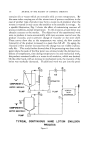
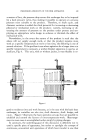
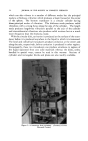
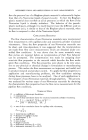
564 JOURNAL OF THE SOCIETY OF COSMETIC CHEMISTS strument since it does no appreciable work or processing of the material being measured. By setting forth the basic conceptual differences between conventional instruments and the ultrasonic viscometer in this way, it becomes clear that the processing function of the measuring instrument which is lacking in the ultrasonic case can readily be introduced by some external means, such as a pump, for example. If an ultrasonic viscosimeter probe is in- stalled in a closed system in which a variable speed pump forces material being measured around a closed circuit, the flow properties of the material can be measured by the ultrasonic instrument for different speeds of the pump. Thus, ultrasonically obtained flow information can be plotted against the speed of the processing member, in this case a variable speed pump, and rheograms somewhat different in nature, perhaps, but possibly of considerable value can be obtained. Therefore, although the ultra- sonic method c•nnot be used in a manner similar to conventional instru- ments to study many important properties of non-Newtonian materials, by suitable combination of the ultrasonic viscometer with other auxiliary devices, important information may be obtained. The major point to note regarding these unusual uses of the ultrasonic viscometer is that by itself the instrument performs only a measuring function--it does no processing of the material and does not change the structure or constitution of the material being measured. Another major distinction between conventional flow measuring de- vices and the ultrasonic viscometer is important when multiphase ma- terials such as emulsions, mixtures and the like are dealt with. In such cases, a rotating cup viscometer will measure a gross volume average flow property whereas the ultrasonic viscometer may or may not be sensitive to all components in a multiphase material depending upon the concentration and sizes of the particular phases. If the ultrasonic probe is immersed in a rather coarse emulsion of oil-in-water, it is probable that the viscosity of water alone will be measured. This follows from the fact that the skin depth in water, about 10 -3 cm., approximates an infinite volume. Consequently, unless a droplet of oil is closer to the metal strip than this, the probe will not be aware of its presence and the likelihood for this condition to exist is extremely small. On the other hand, as the emulsion is made finer and finer, the probability for oil droplets to ap- proach the blade closer, then the skin depth increases and the effect of the oil droplets will be noted. Unless the oil droplets are packed extremely close together, communication from one droplet to the next will be poor and the viscosity will be far lower than it would be with more concentrated emulsions. Thus, if average properties of such an emulsion are to be measured, it is advisable to introduce stirring so that all phases present in the ma-
Purchased for the exclusive use of nofirst nolast (unknown)
From: SCC Media Library & Resource Center (library.scconline.org)