570 JOURNAL OF THE SOCIETY OF COSMETIC CHEMISTS Until the middle 1940's, it was uncommon for workers in ultrasonics to employ generators that operated at frequencies lower than about 500 kc. per second. Many workers operated in the megacycle region since quartz piezoelectric transducers could be obtained readily for operation in this higher frequency region. Therefore, the greater ease of producing strong cavitation which occurs in the lower frequency region was not commonly appreciated. Major strides have been made in the past decade in the development of commercial high-power ultrasonic generators that operate in the 20 to 100 kc. per second range so the more effective fre- quencies can now be employed. TYPICAL COMMERCIAL APPARATUS Many mechanisms for producing intense ultrasonic energy have been described in the literature (7). However, there are at present three major types of apparatus that are important. These are magnetostric- tire, piezoelectric and hydrodynamic mechanisms. Magnetostriction transducers employ the characteristic that a number of metals such as nickel exhibit a change in physical size accompanying a change in magnetic induction. Thus, if a stack of nickel laminations is placed in an alter- nating magnetic field with a superimposed static magnetic field, the length of the nickel laminations will vary at a frequency equal to that of the applied alternating magnetic field and with an amplitude that is a func- tion of the alternating induction amplitude. Magnetostrictive trans- ducers can be obtained to operate at an efficiency in the order of 70 per cent up to a frequency of approximately 100 kc. per second. Such transducers are rugged and have long life if properly designed and operated. Since magnetostrictive elements are made of metal, they ca'n usually be joined to apparatus by soldering, brazing and the like. Commercial equipment manufactured by a number of firms employs magnetostrictive laminated stacks attached to resonant diaphragms which form the bottom of treat- ment chambers. Extremely high intensity levels can be achieved in these cups but, to date no commercial magnetostrictive equipment is available to handle large quantities of liquids requiring power levels of several kilowatts or more. Piezoelectric ultrasonic transducers outnumber bv far any other trans- ducer classification. Piezoelectric behavior is exhibited by many natural crystals such as quartz and rochelle salt, and is the effect whereby the di- mensions of such a material vary upon the application of an electric fie]& If an alternating voltage is applied to a piece of quartz, the dimensions of the quartz will vary at a frequency identical to that of the applied volt- age and with an amplitude varying in accordance with the amplitude of the applied voltage. Quartz is used largely in the megacycle ultrasonic region for nondestructive testing and other ultrasonic measuring in-

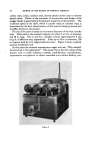
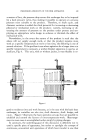
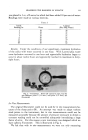
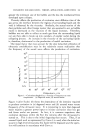
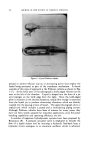
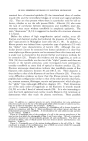
ULTRASONIC EMULSIFICATION: THEORY, APPLICATIONS, LIMITATIONS 571 struments, but because of its high cost and its mechanical inflexibility, it has not found much use in the lower, more usetiff emulsification fre- quency range. Polycrystalline barium titanate is a ceramic material that is fabricated by conventional ceramic techniques. This material, when polarized, also exhibits a change in dimension upon the application of an alternating voltage but, for reasons beyond the scope of this paper, the effect is strictly an electrostriction effect rather than a piezoelectric effect. Barium titanate transducers are cheap and have been widely adopted primarily because they can be readily fabricated in a number of shapes. Figure 2.--Barium titanate transducers. (Courtesy Clevite Research Center, Cleveland, Ohio.) Figure 2 (7) shows three types of barium titanate transducers. The arrows indicate the various modes of vibration. The upper transducer is a simple circular disk that can vibrate in the thickness direction as well as the radial direction. The latter is a very much lower frequency mode than the thickness mode. The middle transducer is a section of a sphere
Purchased for the exclusive use of nofirst nolast (unknown)
From: SCC Media Library & Resource Center (library.scconline.org)