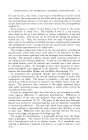
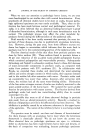
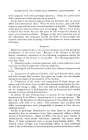
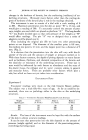
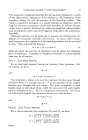
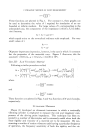
ULTRASONIC METHOD OF FLOW MEASUREMENT 557 This expression completely describes the driving point impedance in terms of the characteristic impedance of the medium z0, the impedance of the boundary surface ZR and the position of the bounding surface. This result is completely analogous to a similar well-known expression used in long line electrical transmission theory and, therefore, its solution for par- ticular cases is greatly facilitated by employing graphical representations such as impedance charts and circle diagrams long used in the communica- tions field. Ultrasonic methods can be employed to measure the driving point im- pedance of viscoelastic materials conveniently. In many cases of prac- tical importance, the impedance of the bounding medium can be set equal to zero. Thus, equation (8) becomes Zo = Ro q-jXo = zo tan h LI (9) where R0 equals the real part of impedance and X0 equals the imaginary part of impedance. Examples of impedance functions in several specific cases may be of interest. Case L' Zo of Rigid Maierial For an ideal rigid material having no viscosity, from equations (7a), (2) and (9), we have, R0--0 and Xo = (og)l/2 tan [col(•/g)l/2] The resistance is always zero and the reactance function goes through excursions from -I- oo through zero to - oo as the argument of the tangent function goes through odd •r/4 values. The poles correspond to path lengths equal to odd values of Xg/4 while the zeros occur for path lengths equal to multiples of Xg/2. This is a simple case of resonance. Of course, for infinite path lengths, the resonances do not occur and we have Ro = (pg)'/= = pco and Case II: Zo of I/iscous Material For a viscous material, from equations (7b) and (2), we have, Xo = 5 kcos = 0 + sinh a OA where

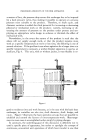
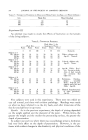
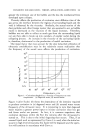
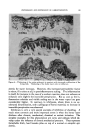
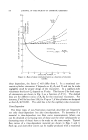
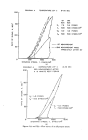
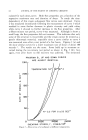
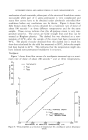
o o.i/r o.z//- o.•/7- O47/' o •'/'/" Q• Figure 1.--Driving point impedance of viscous film rs. thick- ness in skin depths: g = O. I0 o I0 •' I0 •1 I0 • Fig. ure 2.--Driving point impedance of viscous liquid rs. vis- cosity: l = 0.01 cm, p = 1.Og/cc, coo= 1.88 105rad/sec, g = 0.
Purchased for the exclusive use of nofirst nolast (unknown)
From: SCC Media Library & Resource Center (library.scconline.org)