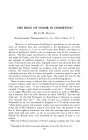
PHYSIOLOGICAl. AND PATHOLOGICAL EPIDERMAl, KERATINIZATION 521 4. How easy is it to maintain day-to-day, hour-to-hour control of the desired characteristics such as texture, color, odor, viscosity, density, crystal size, emulsion stability, etc., as operators are changed ? 5. Would closed continuous processing make the operation less hazard- ous or less noxious ? 6. Finally, how well does the system lend itself to sanitation where time, labor, ease of cleaning and minimum product loss are important considera- tions? In every field of endeavor there is a never ending effort to bring about improvements by producing more economically, creating new products and processes and making old products by new methods. Laboratories and pilot plants have a vital role in this effort. The availability of such pilot plant facilities has helped to develop the type of equipment discussed here and, with the cooperation of manufacturers, to apply it to hundreds of processes. Time has permitted only a scant mention of many possibilities and a few of the processes already in commercial use. With continued cooperation between the manufacturer and the equipment engineer, there are undoubtedly many more interesting possibilities. BIOCHEMICAL DATA ON PHYSIOLOGICAL AND PATHOLOGICAL EPIDERMAL KERATINIZATION*• By PETER FLESC•, M.D., P•.D. Department of Dermatology, University of Pennsylvania School of Medicine, Philadelphia, Pa. THE BIOCHEMISTRY of epidermal keratinization is less well under- stood than other forms of keratinization, such as the growth of hair or development of wool. The reason for this lies mainly in experimental difficulties. The epidermis is about as thin as onion skin paper. Yet, within the space of a few hundred microns an amazing variety of physical and chemi- cal changes take place. Among these, keratinization, the formation of a dead scleroprotein from the living cells of the Malpighian layer, is only one. This brings us to the definition of the term "epidermal keratinization." Presented at the October 4, 1956, Seminar, New York City. Work supported by National Institutes of Health, U.S.P.H.S. Grant #RG-4257.

PHYSIOLOGICAl. AND PATHOLOGICAL EPIDERMAl, KERATINIZATION 521 4. How easy is it to maintain day-to-day, hour-to-hour control of the desired characteristics such as texture, color, odor, viscosity, density, crystal size, emulsion stability, etc., as operators are changed ? 5. Would closed continuous processing make the operation less hazard- ous or less noxious ? 6. Finally, how well does the system lend itself to sanitation where time, labor, ease of cleaning and minimum product loss are important considera- tions? In every field of endeavor there is a never ending effort to bring about improvements by producing more economically, creating new products and processes and making old products by new methods. Laboratories and pilot plants have a vital role in this effort. The availability of such pilot plant facilities has helped to develop the type of equipment discussed here and, with the cooperation of manufacturers, to apply it to hundreds of processes. Time has permitted only a scant mention of many possibilities and a few of the processes already in commercial use. With continued cooperation between the manufacturer and the equipment engineer, there are undoubtedly many more interesting possibilities. BIOCHEMICAL DATA ON PHYSIOLOGICAL AND PATHOLOGICAL EPIDERMAL KERATINIZATION*• By PETER FLESC•, M.D., P•.D. Department of Dermatology, University of Pennsylvania School of Medicine, Philadelphia, Pa. THE BIOCHEMISTRY of epidermal keratinization is less well under- stood than other forms of keratinization, such as the growth of hair or development of wool. The reason for this lies mainly in experimental difficulties. The epidermis is about as thin as onion skin paper. Yet, within the space of a few hundred microns an amazing variety of physical and chemi- cal changes take place. Among these, keratinization, the formation of a dead scleroprotein from the living cells of the Malpighian layer, is only one. This brings us to the definition of the term "epidermal keratinization." Presented at the October 4, 1956, Seminar, New York City. Work supported by National Institutes of Health, U.S.P.H.S. Grant #RG-4257.
Purchased for the exclusive use of nofirst nolast (unknown)
From: SCC Media Library & Resource Center (library.scconline.org)