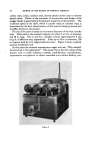
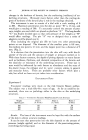
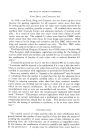
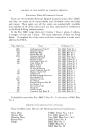
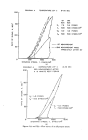
MEASURING THE HARDNESS OF KERATIN 533 When such specimens were removed they were extremely hard and non- flexible. If the sections were longer than 1 cm. and an attempt at flexion was made, they usually broke. Constant Durometer readings on such tissue of 80 were obtained, the same as that of glass. EXPER•ME•T^L P^RT Experiment 1--Effect of the Addition of tFater to Dehydrated Tissue Completely dehydrated tissue was placed in tap water. TABLE 1--DUROMETER READINGS Initial reading ................................. 80 60 rain ........................................ 58 120 rain ....................................... 58 Subsequent hourly readings showed no appreciable change. Experiment II--Effects of I/arious Chemicals on Hardness of Keratin in Absence of tf ater Tissue: 25/1000 of an inch thick. Source: heels and balls of feet obtained six hours after death. Dehydrated for seventy-two hours. Histology The epidermis showed a full thickness of keratin. There were focal areas of epidermis of about six prickle cell layers in thickness here and there in the section. In each instance, a piece of tissue 2 X 3 cm. was immersed in a small covered ointment jar in 5 cc. of liquid. In the case of the anhydrous lanolin it was thoroughly covered with a thick layer of material. Read- ings were made at several points on the surface after preliminary wiping. TABLE 2--EXPERIMENT II Durometer After Various Readings, Exposures, 48 hr. 144 hr. Control 80 80 Water 55, 65, 60 60 Mineral Oil 78, 78, 80 80 Lantrol* 80, 78, 80 80 U.S.P. Anhydrous Lanolin 80, 80, 80 80 Glycerin 80, 80, 80 80 Soy Oil 80, 80, 80 80 * A "Dewaxed" fat-soluble fraction of lanolin manufactured by Maimstrom Chemical Corporation. Results. It can be seen from Table 2 that there was no softening of the

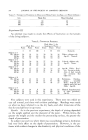
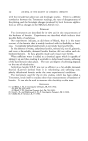
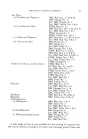
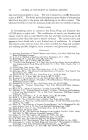
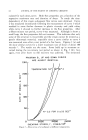
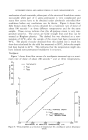
534 JOURNAL OF THE SOCIETY OF COSMETIC CHEMISTS keratin as far as could be judged with the Durometer with any of the ma- 'terials except water itself. Experiment Ill--The Effect of the ?lddition of l/Fater to Farious Chemicals on the Hardness of Keratin To each 4 cc. of material 0.1 cc. of tap water was added and thoroughly mixed. The dehydrated tissue was then placed in an ointment .jar as previously. . T•,BL• 3 48 hr. Control 80 Water 60 Lantrol 70 Anhydrous Lanolin 80 Glycerin 80* * Seemed more brittle than control. Results. Apparently in forty-eight hours the addition of a small amount of water to the Lantrol was able to soften the keratin to some degree. 'Anhydrous lanolin with the same amount of water added resulted in no decrease in hardness. Glycerin plus water not only resulted in no de- crease in brittleness, but in fact the specimen seemed harder (more brittle) than the control. . Experiment IF--The Effect of Simple !later-in-Oil Emulsions on Hardness of Dehydrated Keratin To 1.5 cc. of Lantrol, 0.1 cc. of water was added and then thoroughly mixed with 3.5 cc. of mineral oil. Dehydrated callus 25/1000 of an inch thick, 2 X 3 cm. in size was immersed in this emulsion and Durometer readings made as follows: TABLE 0 hr. 48 hr. 120 hr. 192 hr. Control . 80 80 80 80 Lantrol Emulsion 80 75, 75, 70 70, 70.70 65, 65, 65 Under the conditions of our experiment, Lantrol was apparently able to make the water in such a mineral oil mixture slowly available to the keratin. Experiment I•--The Rate of Increased Flexibility of Dehydrated Keratin in Mixtures of Lantrol and I/Fater -A piece of dehydrated callus, 25/x000 of an inch thick, 2 X 3 cm. in size,
Purchased for the exclusive use of nofirst nolast (unknown)
From: SCC Media Library & Resource Center (library.scconline.org)