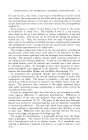
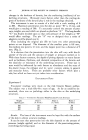
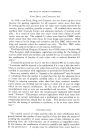
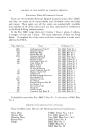
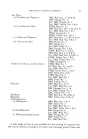
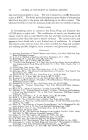
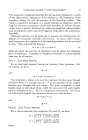
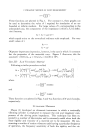
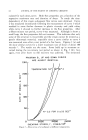
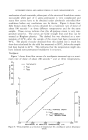
ULTRASONIC METHOD OF FLOW MEASUREMENT 555 •= •oexp l_ (g2CO492 '•'/4 (tan q_co2n2] sin 12cøn/g) y i X exp ljco •t--(g2 P2 '•l/'cos(tan t2cøn/g)•y f (6) The first exponential factor, the attenuation term, clearly shows frequency dependence of the attenuation, while the second factor shows dispersive phase velocity when viscosity is present--velocity being a function of frequency. An important quantity is the skin depth b of the shear wave. We define b as the path length for the amplitude to fall to 1/e (38.8 per cent) of its initial value--it thus becomes analogous to a similar quantity widely used in electromagnetic theory. In the general case, • = •g2 +w2n2•t/•csc•an •n/g)• The phase velocity c can also be readily obtained from equation (6). We have = + [tan ½• j •/• sec In purely rigid materials n=O, these expressions reduce to the simple [•Fm• These will be recognized as the familiar expressions for propagation of plane shear waves in rigid solids. Similarly, for purely viscous materials •(=0, we obtain• Nwp/ This special solution for viscous liquids was first studied •y Rayleigh (1). The wavelength for these two special cases is simply o•tained 5y use of the general relation X= 2rc/•. and For the viscous case, the extremely rapid attenuation per wavelength can •e seen •rom the last result. Only 0.187 per cent of the i•itia] amplitude remains one wavelength from the source of excitation. ]t follows also

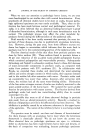
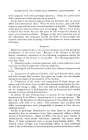
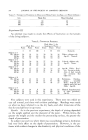
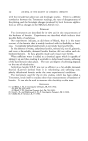
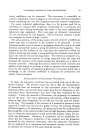
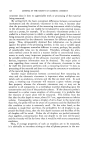
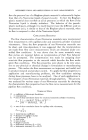
556 JOURNAL OF THE SOCIETY OF COSMETIC CHEMISTS that all particle vibration of any significant amplitude takes place well within 1/•. wavelength from the source of excitation and phase shifts greater than 180 ø are of no practical importance. If the viscosity coefficient of a material is negligible compared to rigidity, any elastic disturbance in which the particle vibration is perpendicular to the direction of propagation proceeds from the source of excitation with- out attenuation due to the propagating medium. If the shear rigidity is negligible compared to viscosity, the disturbance is rapidly attenuated since energy is extracted from the elastic wave by the viscous mechanism of the material. IMPEDANCE CONCEPT The flow properties of materials can be characterized conveniently by determining the ratio of stress to particle velocity when either an outgoing wave or an incoming wave is considered acting alone. This quantity is known as the characteristic acoustic wave impedance. By letting B=0 and A=0 in turn in equations (3) and (4) and by dif- ferentiating equation (3), we have -- Y• 4- •icop (n-i--- (7) Zo b•/bt jw /_l where the positive sign is to be chosen for propagation in the positive direction, and the negative sign for propagation in the negative direction. For rigid materials, zo, o = 4-(•og)'/2 = 4-•oc• while for viscous materials, we obtain z0, • -- 4-(co•n/2)1/• (1 +j) (7b) We note that for rigid materials the characteristic impedance is real and independent of frequency, so that the particle velocity is always in phase with the stress for a wave propagating either outward or inward. In viscous materials, the phase shift between these two components is 45 ø , while the magnitude increases as the 1/•. power of the frequency. In the general viscoelastic medium, the phase shift can have any value between zero and 45 ø depending on the ratio oon/g. In many cases of practical importance, both outgoing and incoming waves are present at the same time. It is shown in a previous paper (2) that if a liquid is terminated by a boundary having an acoustic impedance ZR spaced a distance l away from the source of elastic vibration, the actual impedance that the source sees, the so-called driving point impedance Z0, is given by ['1_ --}- (zo/ZR) tan _h FI 7 Zo zo L (zo/Z•) -t- tan h rl _[ (8)
Purchased for the exclusive use of nofirst nolast (unknown)
From: SCC Media Library & Resource Center (library.scconline.org)