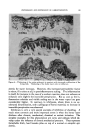
582 JOURNAL OF THE SOCIETY OF COSMETIC CHEMISTS In the 1930's Miescher (9) showed that repeated ultraviolet irradiations of the skin lead to a measurable thickening of the horny layer. We found that the same happened when we rubbed the skin daily for fifteen minutes over a period of thirty days (10). This reaction may serve a useful purpose insofar as it protects the skin from repeated injury. Many factory workers when they start working with caustic or irritating chemicals suffer cutaneous reactions but later are able to work with the same material in the same strength without punishment. They say, their skin has "hardened" this is because their horny layer has thickened and has become more compact. Sometimes, however, this reaction is a dangerous sign of incipient, so-called ana- plasia of the epithelial cells which in the long run may lead to malignant degeneration (1). What happens here is an alteration of the living epidermal cells with the result that, instead of a shedding soft horny layer, they will produce a harder, thicker nonshedding layer reminiscent of hairs and nails. I proposed the term "superkeratinization" for this anomaly (1). In any case, both types of scaling anomalies, the loose flakes due to accelerated keratinization and the superkeratinized, rough, uneven, usually darkened patches as they often occur in the face and on the backs of hands in elderly persons, particularly after excessive chronic exposure to sunshine, are cosmetically certainly not desirable. They look just plain ugly. Loose flakes on the skin can be masked with oiling or greasing of any kind. For such masking plain greases such as lard and vegetable oils are better than cold creams (water-in-oil emulsions) but in turn, cold creams are still much better than water-washable bases. Postinflamma- tory scaling, of course, cannot be prevented by such greasing but it seems there is an easier separation of loose scales if the skin is ointed. Possibly this is partly a mechanical effect of rubbing or massage during the greasing process. However, there is also the possibility that greases forcing the surface to hold back water improve the hydration of the horny layer and thereby counteract to some degree the increased loss of water. Superkeratinized structures may also be kept relatively soft by plain greases. But in my clinical experience in such lesions as well as in ichthyo- sis the effect of greasing is greatly and beneficially enhanced if low con- centrations of salicylic acid are added to the grease. One to two per cent salicylic acid definitely counteracts the piling-up of a thickened horny layer, much more than straight greases. I often wonder whether the cosmetic industry knows about this soothing effect of harmless concen- trations of salicylic acid. Of course, in the case of very thick and hard lesions such as corns and calluses, much higher concentrations of salicylic acid are required to exert the so-called keratolytic or horn-dissolving effect.

PHYSIOLOGY AND PATHOLOGY OF KERATINIZATION 583 Most commercial "corn-cures" are based on this effect of salicylic acid. Finally I would like to say a few words about hydration of the horny layer in the normal skin. There is a steady loss of water vapor from the horny layer to the outside if the relative humidity of the air is not above a certain critical value. In a cold and dry atmosphere the surface horny layer will break rather easily because of excessive dehydration. Such "chapping" can be counteracted by application of greases and, to a lesser degree, by cold creams, presumably because they hinder water evapora- tion. In hot humid weather or by excessive use of hot water or by cover- ing the skin with water-impermeable materials the opposite phenomenon occurs. The horny layer takes up so much water that it swells, becomes unevenly wrinkled, white and macerated. This is disadvantageous not only cosmetically but also clinically because a macerated horny layer is more susceptible to bacterial and fungal infections. There obviously must be an optimal hydration of the horny layer but we have no numerical data on that important optimum, and it will meet great experimental difficulties to establish it. Indeed, this optimum of hydration will be an important subject because the beauty of the skin depends to a considerable degree on the right amount of horny layer hydration. My discussion, today, I believe, has clearly shown that our knowledge in this field is still very spotty, and much basic physiological research is needed to secure a sound scientific foundation for experimental work in the field of cosmetics. REFEKENCES (1) Rothman, S., "Physiology and Biochemistry of the Skin," Chicago, University of Chicago Press (1954). (2) Blank, I., 5 t. Investigative Dermatol., 21, 259 (1953). (3) Rothman, S., and Schaaf, F., "Chemie der Haut," Jadassohn's Handb. d. Haut-u. Geschlechtskr., Berlin, J. Springer (1929), T/s, 161-377. (4) Szakall, A., drch. Klin. u. exper. Dermatol., 201, 331 (1955). (5) Paschoud, J. M., and Schmidli, B., Dermatologica, 110, 323 (1955). (6) Flesch, P., and Jackson, E. C., Nature, 178, 211 (1956). (7) Blank, I., 5 t. Investigative DermatoL, 18, 433 (1952). (8) Rothman, S., and Felsher, Z., Proc. Soc. Exp. BioL Med., 56, 139 (1944). See also 7. Investigative Dermatol., 6, 271 (1945). (9) Miescher, G., Strahlentherapie, 35, 403 (1930). (10) Rubin, L., 55 Investigative DermatoL, 13, 313 (1949).
Purchased for the exclusive use of nofirst nolast (unknown)
From: SCC Media Library & Resource Center (library.scconline.org)