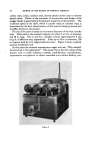
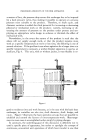
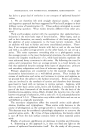
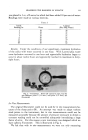
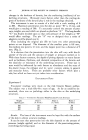
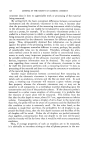
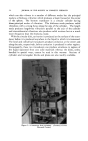
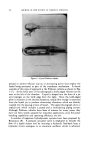
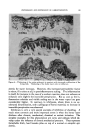
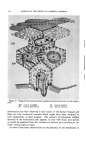
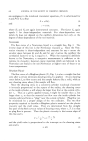
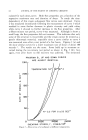
574 JOURNAL OF 2'HE SOCIETY O1,' COSMETIC CHEMISTS Figure 5.--Liquid Pohlman whistle. pended to achieve efficient sources of alternating power that employ the liquid being processed as part of the transducer mechanism. A classic example of this type of approach is the Pohlman whistle as shown in Fig. $ (7). At the lower part of this photograph a knife-edged vibrator can be seen at the left of the chamber. Liquid is shaped into the form of a jet and impinges on the knife edge from the right. Since the knife-edged plate is resonant at the desired frequency• steady flow energy is extracted from the liquid jet to produce alternating vibrations which are directly coupled into the passing stream of liquid. The upper photograph shows a typical unit which includes a pump and a recirculating piping system. Although Pohlman whistles have been of interest for many years• they have not been widely adopted for industrial applications since the power handling capabilities and operating efficiency are low. A number of ingenious hydrodynamic systems have been proposed by Bouyoucos (8). A pressure actuated valve-is employed to throttle the flow of a liquid stream and by inserting a hydraulic feed-back loop, a hydraulic circuit analogous to an electronic oscillator circuit is achieved.

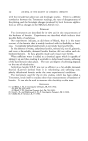
ULTRASONIC EMULSIFICATION: THEORY, APPLICATIONS, I.IMITATIONS 575 Input flow energy is converted to alternating acoustic energy directly in the liquid. A portion of this energy is required to operate the pressure actuated valve while the remainder can be dissipated in a number of ways to produce useful amounts of ultrasonic energy for processing purposes. Although this work is still in the experimental stages, it shows promise for large scale applications in the liquid processing field and should be par- ticularly suitable for future continuous flow emulsification applications. CONCLUSION The use of ultrasonic irradiation to produce emulsification on an in- dustrial scale is still faced with many practical difficulties. Some of these relate to the technical aspects of the problem while others relate to eco- nomic factors. Many emulsions have high viscosity. This is undesirable because cavitation is fundamentally difficult to produce in such media. Furthermore, reliable proved ultrasonic generating equipment suffi- ciently large for production use is still not available. There has been marked activity in the past decade in the ultrasonic field, but this has largely been directed toward the development of equip- ment suitable for metal cleaning and degreasing applications. Much of this work can, however, be applied also to emulsification applications. The next decade will undoubtedly witness activity along these lines. At the present time, however, ultrasonic emulsification is primarily a lab- oratory procedure and much intensive effort by both equipment manu- facturers and equipment users will be required to extend its utilization to the production floor. REFERENCES (1) Richards, W. T., and Loomis, A. L., dr. zfm. Chem. Soc., 49, 3086 (1927). (2) SolInet, K., Trans. Faraday Soc., 32, 1537 (1936). (3) Sollner, K., Chem. Rev., 34, 371 (1944). Marinesco, N., Chimie & •ndustrie, 55, 263 (1946). Alexander, P., Mfg. Chem., 22, 5 (1951). Beal, H. M., and Skauen, D. M., J. •tm. Pharm. •tssoc., 44, 487 (1955). (4) Hueter, T., and Bolt, R., "Sonics," New York, John Wiley & Sons. Strasberg, M., Dissertation, Catholic University of America Press, Washington, D.C. (1956). (5) Rosenberg, M.D., Tech. Memo 25, Harvard Univ. Acoustics Res. Lab. (195:2). (6) Esche, R., •tcustica, 2 •tkust. Beih. (1952), AB 208. (7) Mattiat, 0., dr. •tcoust. Soc. •tmer., 25, 291 (1953). (8) Bouyoucos, J., Tech. Mere. 36, Harvard Univ. Acoustics Res. Lab. (1955).
Purchased for the exclusive use of nofirst nolast (unknown)
From: SCC Media Library & Resource Center (library.scconline.org)