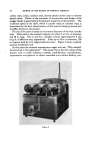
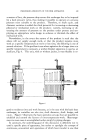
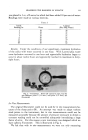
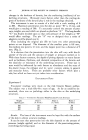
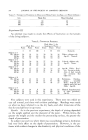
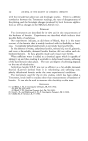
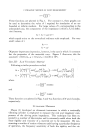
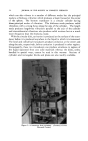
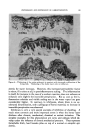
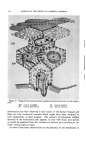
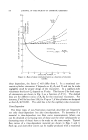
MEASURING THE HARDNESS OF KERATIN 535 was placed in 5 c½. of Lantrol to which had been added 10 per cent of water. Readings were made at various intervals. TalLy. 5 Initial Lantrol Reading, hr. Water (Plus 10% Water) 1 58 78 2 58 75 3 58 75 5 58 75 6 58 75 12 58 70 24 58 65 48 58 60 Results. Under the conditions of our experiment, maximum hydration of the callus with water occurred in one hour. With Lantrol plus water some hydration occurred in one hour and appreciable hydration began to occur in about twelve hours and apparently reached its maximum in forty- eight hours. Fig. 2.--Tonometer. Point (B) cannot be seen, but the two adapters point 2 (1.5 min.) and point 3 (2 min.) are ill ustrated. In l/ira Measurements The original Durometer could not be used for in vivo measurements be- cause of the sharp point (B). An attempt was made to adapt various sized points to the instrument, but in viva measurements could not be measured accuray.ely because the amount of pressure necessary to obtain a- constant reading could not be controlled adequately introducing a large factor of error. For this reason a new instrument was designed which we have called a Tonometer. This is illustrated in Fig. 2. We felt that with in viva measurements we were not 0nly measuring

536 JOURNAL OF THE SOCIETY OF COSMETIC CHEMISTS changes in the hardness of keratin, but the cushioning (resilience) of un- derlying structures. Obviously many factors other than the varying de- grees of hardness of the keratin play a role in the readings obtained. The instrument is seen to consist of a dial with a scale reading of 0 to 300. Maximum penetration into the skin at point "B" is 15 mm. and would give a reading of 300. To accurately control the amount of pres- sure, weights are used which are placed on platform "A." The long handle "C" was finally decided upon so that only pressure of the weights at "B" would effect readings. The pin "A" was so designed that a series of adapters could be placed over it. Thus including the original pin (B) we have two other penetrating points at our disposal. The diameter of the smallest point is 0.8 mm., the medium size point is 1.5 mm. and the largest point has a diameter of 2 mm. (Fig. 2). It is obvious that the penetration into the skin will vary with the di- ameter of the pin and the amount of weight or pressure exerted on it. With these factors constant, the depth of pitting depends on many factors such as hardness, thickness, and chemical composition of the keratin and the elasticity or resistance of the underlying structures. These last in turn would be influenced by such factors as abundance and the state of the elastic tissue, the collagen and its water content, edema in general and muscular forces. There are probably other factors which play a role, but which we have not yet taken into consideration. EXPER•UF. ST Experiment I Tonometer readings were made on the mid forearm flexure surface. The subject was a male fifty-five years of age. As far as could be de- termined, there was no pathology either in the skin or the underlying structures. TABLE 6--ToNOMETEI• READING MID-FoKEAI•M FLEXOK SUKFAOE Weight Point 1 Point 2 Point 3 Applied, gm. (0.8 mrn.) (1.Smrn.) (2mm.) 100 110 90 80 200 150 140 110 400 200 190 180 Results. The base of the instrument must be kept flat with the surface of the skin to obtain accurate readings. It can be seen that penetration into the skin depends on the amount of pressure (weight applied) and on the diameter of the penetrating points, everything else being equal.
Purchased for the exclusive use of nofirst nolast (unknown)
From: SCC Media Library & Resource Center (library.scconline.org)