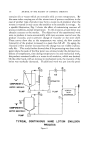
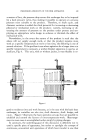
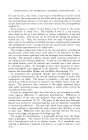
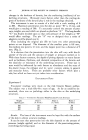
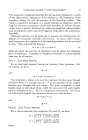
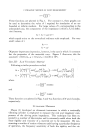
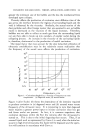
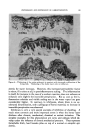
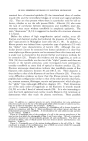
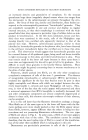
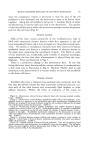
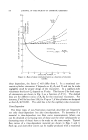
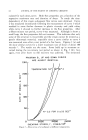
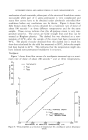
PROCESSING PRODUCTS IN VOTATOR APPARATUS 517 TEMPERATURE,'F 200 150 I00 I I I HEAT TRANSFER EFFICIENCY rs. FILM REMOVAL $0 GALLON MIXING TANK CORN SYRUP {200 lbs.) COOLING WATER: 50 øF $$ R. RM. DRAWING No.: 42768 U=17 SINGLE AGITATION U=20 DOUBLE AGITATION U=30 DOUBLE AGITATION AND SCRAPING I [ IO 20 30 40 50 TIME,MINUTES Figure 5 Summarizing the above, the efficiency of heat flow is related to: 1. The removal or reduction of the product film at the heat transfer wall. 2. The degree and the nature of the agitation and turbulence adminis- tered during processing. 3. The quantity and quality of the heat exchange metal surface. 4. The thermal conductivity of all ingredients involved plus the result- ing combinations of compounds formed during processing. 5. The viscosity and viscosity change of the ingredients during process- ing. 6. The judicious and practical application of insulation, to eliminate or greatly reduce losses due to radiation. The practical application of these fundamental principles has resulted in the design of the continuous scraped surface heat exchange and mixing apparatus under consideration. From the description of the apparatus given, it will be noted that the basic points of heat transfer were actually made an integral part of the apparatus. The design is such that the ap- paratus is a tool to perform the specific unit operation of continuous heat transfer regardless of the industry it might serve, being equally suitable for the production of cosmetics, margarine, marshmallow, starch, jelly, gum drops, infant foods, creamed mushroom soup, lubricating grease or pie fillings. The manipulation of the time-temperature-physical work relationship of any specific process and the ability to control and coordinate this trio of functions are made possible by the following characteristics of:

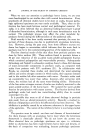
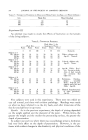
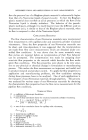
518 JOURNAL OF THE SOCIETY OF COSMETIC CHEMISTS 1. Temperature: This apparatus offers a high ratio of surface to the volume of material treated. (a) First example: In a commercial gelation operation of a slurry containing 20 to 23 per cent water, heating in an apparatus from 160 to 285øF., at a rate of 4000 lb./hr. is necessary. The amount of product applied to the 12 sq. ft. of the heat transfer surface of this apparatus is approximately 25 lb. or 2 lb. per square foot. In another 6 sq. ft. of heat transfer area, the gelled product is cooled from 280 to 285øF., to 200 to 210øF. This complete gelation operation requires 18 sq. ft. of heat transfer surface or a three-cylinder 6-inch sanitary unit. Eighteen square feet of metal jacketed for steam or water would make a kettle of approximately 20 gallons capacity. In one hour, how many pounds of any type of shaving cream, tooth paste, hand cream or emulsion lotion could be processed in a 20-gallon kettle ? (b) Second example: An ingredient of a compound being processed at the rate of 2500 lb. per hour must be cooled from 115 to 85øF., to obtain uniform crystallization. Equipment necessary to achieve this is one 6-in. cylinder that offers approximately 6 sq. ft. of heat transfer surface. This is .. a piece 'of chrome plated nickel 18 in. wide and 4:8 in. long. A kettle fabri- cated from this amount of metal would have a capacity of about six gallons. Mayb• large enough for an experimental laboratory, but woefully small for any production line. 2. Time and Physical 1Fork or Atgitation: In addition to a high ratio of surt•ace to volume, there is also available simultaneously a high ratio of agitation to volume being processed. In the first example--obtaining gelation at 4000 lb. per hour--it takes 4:0 seconds to raise the temperature from 160 to 280øF. During these 4:0 seconds, each shaft with pins and scraper blades spins 450 times through 25 lb. or three gallons of product in a confined I/2 in. of moving film. 3. •igitation or Physical I/Fork: Due to the great variety of products that are or may have to be processed, the amount of physical work necessary varies widely. To compensate or provide for this varying contingency, there are three relatively simple expedients or equipment modifications that are successfully used. They are: (a) Shaft r.p.m.: More or less work is obtained by increasing or de- creasing shaft r.p.m. (b) Shaft diameter: An increase in the amount of work on the product is easily gained by reducing the shaft diameter. This also increases the time the product resides in the annular processing section. (c) Pressure: Turbulence in this type of apparatus is created by the revolving shaft and blades rather than by forcing the product at a high velocity through small diameter tube exchangers, thus eliminating the necessity of building the apparatus primarily to employ high pressure. As
Purchased for the exclusive use of nofirst nolast (unknown)
From: SCC Media Library & Resource Center (library.scconline.org)