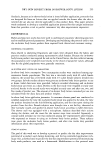
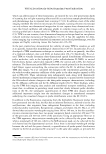
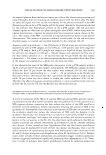
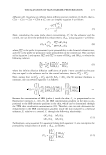
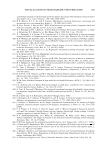
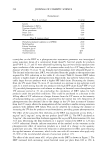
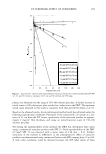
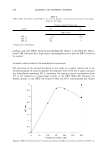
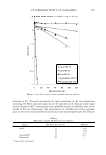
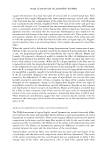
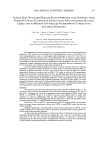
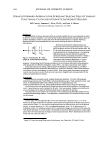
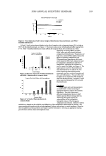
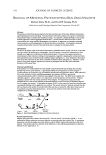
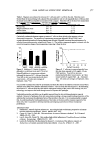
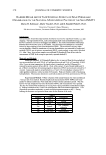
VISUALIZATION OF SKIN BARRIER PERTURBATION 273 diffusion cell. Assuming an infinite donor-infinite receiver condition (2,34,45), that is, Cf(t) - c (t) :::::: Cf(t) :::::: Cf(O) = cf, one can simplify equation 6 as follows: (de.) -u ore _1 1 dz pi= ___ C _d __ 1 (7) Next, considering the same probe donor concentration, cf, for the enhancer and the control, one can write the permeability enhancement, (E)p , using equation 7 as follows: (8) where o;;_ e is the probe (or permeant) i pore permeability in the chemical enhancer case, and 0 t ' is the probe (or permeant) i pore permeability in the control case. One can then utilize,equation 2 and express o;;, e and D 0 t in terms of H(A) E and H(A)c to obtain the following relation: ' ' (9) where the infinite dilution diffusion coefficients of probe i were canceled out because they are equal in the enhancer and in the control solutions, that is, D� E = D�c- Next, noting that: (a) D E = D';°c and (b) �X E :::::: �Xe (the SC intrinsic thickness is constant), one can rewrit� equati�n 5 as follows: Because the concentration of SRB (probe i) inside the skin, Ci, is proportional to its fluorescence intensity, I , (20-23), the SRB concentration gradient in the skin is pro portional to the SRB intensity gradient in the skin, which can be determined through the TPM skin visualization measurements (20). Therefore, one can now determine the enhancement in the SRB concentration gradient inside the skin induced by a chemical enhancer, E, relative to a control, C, through the following relationship: (dC/dz)E (dJ/dz)E (dC/ dz)c (dl/ dz)c (11) Furthermore, using equation 9 in equation 8 along with equation 11, one can express the permeability enhancement of probe i, (E)p, as follows: (12)

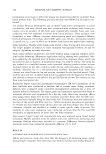
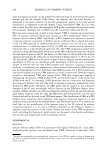
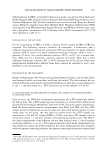
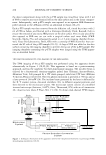
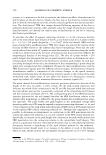
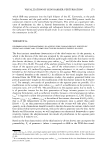
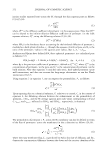
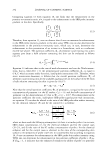
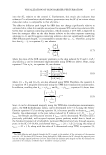
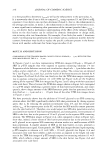
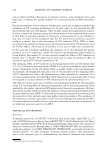
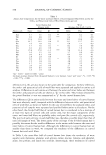
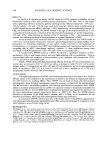
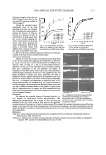
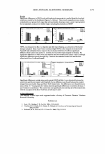
274 JOURNAL OF COSMETIC SCIENCE Comparing equation 12 with equation 10, one finds that the enhancement in the porosity-to-tortuosity ratio, e/'T, is equal to the enhancement in the SRB probe intensity gradient in the skin. Specifically, (13) Therefore, from equation 13, one can observe that if one can measure the enhancement in the SRB probe intensity gradient in the skin using TPM, one can also determine the enhancement in the porosity-to-tortuosity ratio, which can, in turn, determine the enhancement in skin penetration of an irritant in a formulation, such as a surfactant micelle (see above). The partition coefficient, p i , of permeant i partitioning into a skin aqueous pore from a bulk solution contacting the skin can be evaluated as follows (36,3 7): cpore p- = _i - = 2 f 1-X.iJ-E(r)lkT]rdr t C' Jo t (14) Equation 14 indicates that in the case of weak electrostatic and van der Waals interac tions, that is, when E( r) � 0, the permeant-pore partition coefficient, pi, is equal to (l-A./, which accounts solely for steric, hard-sphere interactions (36). Therefore, when steric interactions dominate, it follows that the overall partition coefficient, l\, of permeant i partitioning into all the available aqueous pores on the surface of the SC from a bulk solution contacting the skin is given by (36,3 7): (15) Note that the overall partition coefficient, li, of permeant i, is equal to the ratio of the concentration of permeant i at the SC surface, C/z = 0), and the bulk concentration of permeant i in the donor solution, cf, that is, l i = C/z = O)IC1, The enhancement in the partition coefficient (for steric, hard-sphere SRB probe-aqueous pore wall interactions, see equation 15) can then be related to the ratio of the SRB probe skin surface intensity, for the chemical enhancer (E) and for the control (C), as follows: [ Ch = o) ] e el i E [ Ch : o) ] Ci C (16) where we have made the following assumptions: (a) there is a similar probe i (in our case, SRB) donor concentration, cf, for the chemical enhancer and for the control cases (20-23), and (b) the ratio of the SC surface concentration of probe i for the chemical enhancer and for the control cases is identical to the ratio of the corresponding skin surface (z=0) intensities of probe i (20-23). It is noteworthy that according to equation 16, if one can measure the enhancement in the SRB probe skin surface intensity using TPM, one can determine the enhancement in the partition coefficient of probe i, (E)cP If (E)v 1, it indicates that the enhancer E enhances the ability of probe i to penetrate
Purchased for the exclusive use of nofirst nolast (unknown)
From: SCC Media Library & Resource Center (library.scconline.org)