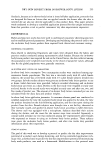
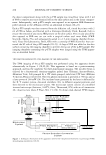
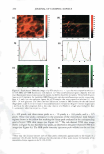
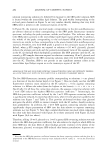
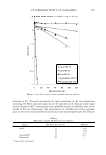
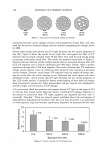
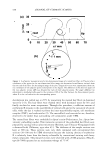
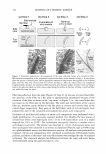
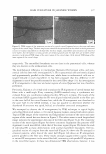
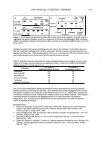
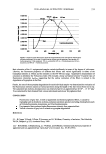
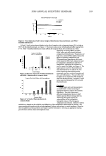
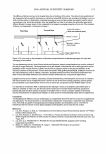
HAIR CURVATURE IN JAPANESE WOMEN 319 and then drop from the side of the head straight to the shoulders. The "slightly wavy" hair style shows one or two wave pitches between the top of the head to the shoulders, with few or no frizzy hairs. The "wavy" hair style shows more than three wave pitches from the top of the head to the shoulders, with few or no frizzy hairs. The "frizzy" hair style shows predominately disordered alignment of hair fibers. MEASUREMENT OF HAIR CURL RADIUS AND DIAMETER Hair fibers were relaxed by immersion in deionized water for 10 min at 25°C to recover the original shape of each hair fiber from the water-set shape. The fibers were air-dried at room temperature without tension to keep the original shape. A two-dimensional image of each hair fiber was obtained with an image scanner (Epson, Type GT-X800). The resolution of the image scanner was kept at 4200 dpi (ca. 6.0 µm/dot) to obtain a clear and continuous image of the hair fiber. A schematic representation of a two dimensional image of a curved hair fiber is shown in Figure 1. The x-y coordinates of the points on the two-dimensional fiber image were determined at millimeter intervals from the root end of the fiber (Figure la). Tangential vectors were approximated from the x-y coordinates of two adjacent points (solid arrows in Figure lb). The difference in the direction angles of the two adjacent vectors (Li8 in Figure lb) was obtained for each of three adjacent points. This angle difference (in radian/mm) is mathematically equal to the curl curvature (J/R) of the fiber between the three adjacent points, where R is the curl radius for the corresponding points. The average curl curvature for each hair fiber was calculated from the obtained curvature datum for each three adjacent points, and then the curl radius was calculated by inverting the average curvature. In this study, the curl radius for each fiber was obtained within the region from O up to 150 mm length from the root end of the hair fiber. When volunteers encountered hairs that had expe rienced perm treatments within one year, the permed segments were excluded from this measurement. The mean curl radius for each volunteer was calculated from the curl radii of ten hair fibers. In terms of accuracy, the curl radius obtained from the two-dimensional image does not equal the three-dimensional curl radius. The two-dimensional radius, however, reflects the three-dimensional shape of the hair fiber. We, therefore, used the two-dimensional radius as an approximate value to evaluate the hair shape quantitatively. Hair fiber diameter was measured on the transverse section of each fiber with a rotating fiber diameter measurement system equipped with a laser (Kato Tech Co.). In this manner, the maximum and minimum values of the fiber diameter, defined as major and minor axes, respectively, were determined. The ellipticity of each hair fiber was obtained from the ratio of major axis to minor axis. TRANSMISSION ELECTRON MICROSCOPIC OBSERVATION The internal structure of typical highly curved hairs was observed with a transmission electron microscope (TEM). We observed hair cross sections using two staining methods. One was to stain the hair with erythrosine B, which is a dye with a high electron density of iodide atoms (9), and the other was to stain with silver nitrate (10,11). In the former method, the hair fibers were immersed in an aqueous solution of 0.1 M erythrosine B at pH 8.5. Penetration of the dye was performed at 100°C for 1 h. Then

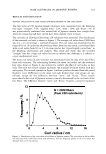
320 (a) 30 JOURNAL OF COSMETIC SCIENCE .......... . . .. . ........... .... · ·• . .. . . ··· ··.... E E 20 . . . . . . . : : --- a 10 0 . . . . - t f ·0··1 ... _roo .: ,..l \ • ..- .... • ••• · 0 . . . . . . . . . . . . · .... ... 1 I \ I 10 (b) I 40 x/mm I I 50 60 . . :. ...tip . ... 70 Figure 1. A schematic representation of a two-dimensional image of a curved hair fiber. (a) The plot of x-y coordinates of the points on the two-dimensional fiber image was determined at millimeter intervals from the root end of the fiber. (b) An enlarged image of the plot. Tangential vectors were approximated from the x-y coordinates of two adjacent points (solid arrows in this figure). The difference in the direction angles of the two adjacent vectors (�0) was obtained for each of three adjacent points. The angle difference (in radian/mm) is mathematically equal to the curvature (1 IR) of the fiber between the three adjacent points, where R is the curl radius for the corresponding points. decoloration was carried out at 2 5 ° C by immersing the stained hair fibers in deionized water for 24 h. The hair fibers were washed twice with deionized water for 30 s and finally air-dried at room temperature. Through this procedure, a sufficient amount of erythrosine B remains in the macrofibrils of cortical cells and in the exocuticle of cuticle cells, while the dye is washed out from the inter-macrofibrillar region, cell membrane complex (CMC), and endocuticles (9). The macrofibrils and exocuticles are, therefore, observed to be darker than surrounding cell components under TEM. The stained hair fibers were embedded in Spurr's resin (Polysciences, Inc. Spurr low viscosity embedding media). Thin transverse sections of the embedded hair fibers were prepared by cutting with an ultra-microtome (Reichert type Ultracut-N) equipped with a diamond knife (DiAtome type ultra 45°). The thickness of the sample sections was kept at 500 nm. These sections were very thick compared with conventional thin sections (50-100 nm) for TEM observation because the staining density of erythrosine B is relatively lower than the density achievable by conventional staining with heavy metal compounds. The prepared sections were observed with a TEM apparatus (Hitachi, type H-7000) operated at an acceleration voltage of 75 kV.
Purchased for the exclusive use of nofirst nolast (unknown)
From: SCC Media Library & Resource Center (library.scconline.org)