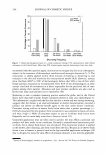
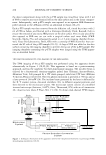
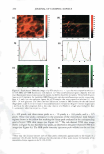
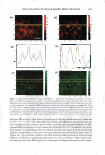
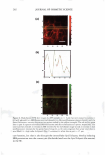
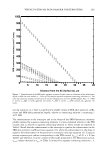
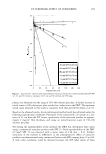
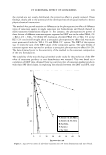
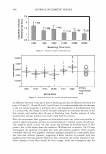
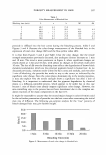
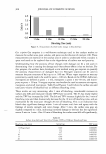
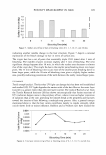
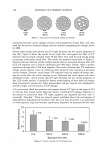
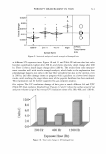
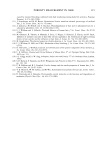
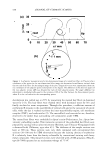
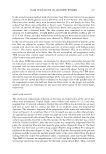
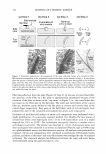
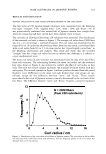
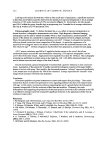
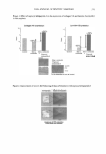
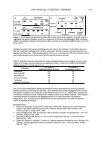
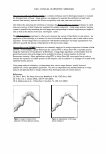
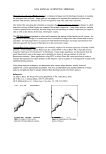
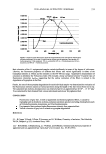
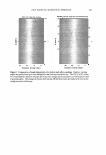
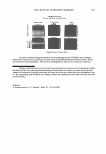
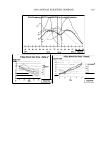
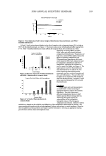
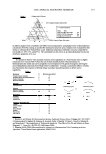
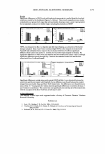
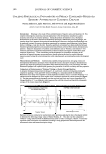
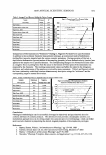
284 JOURNAL OF COSMETIC SCIENCE solution (contacting solution iv), followed by exposure to the SRB probe solution, SRB is located within the intercellular lipid bilayers. The peak widths corresponding to the red and green channels in Figure Se are very similar, thereby showing that very little SRB probe is present in the corneocyte regions of the SC. In Figure 66, the intensity spectrum peaks corresponding to the skin autofluorescence are almost identical to those corresponding to the SRB probe fluorescence intensity spectrum, including the peak positions, widths, and heights. This indicates that very little SRB probe is present in the intercellular lipid bilayer region of the SC. In addition, the widths of the peaks corresponding to the red-channel (SRB probe fluorescence) intensity are similar to those corresponding to the green-channel (skin autofluorescence) intensity. Therefore, very little SRB probe is present in the corneocyte region of the SC. Indeed, when p-FTS samples are exposed to solution v (10 wt% glycerol), glycerol reduces the average pore radii and the porosity-to-tortuosity ratio of the aqueous pores in the SC (2) through which hydrophilic permeants like SRB penetrate into the SC. As a result, p-FTS samples that were exposed to solution v containing 10 wt% glycerol, and subsequently exposed to the SRB contacting solution, show very little SRB penetration into the SC. Therefore, SRB is not present in any significant amount either in the intercellular lipid bilayer region or in the corneocyte region of the SC. ANALYSIS OF THE AQUEOUS PORE PATHWAY CHARACTERISTICS USING SRB INTENSITY PROFILES AS A FUNCTION OF SC DEPTH IN THE CONTEXT OF A HINDERED-TRANSPORT MODEL The five SRB fluorescence intensity profiles corresponding to solutions i - are plotted as a function of the skin barrier depth (z) in Figure 7. One can clearly see that the SRB fluorescence intensity count induced at the SC surface (z = O) by aqueous contacting solutions i-v follows the order (from the highest to the lowest): i ii iii iv v. Specifically, for all these five contacting solutions, the aqueous contacting solution with 1 wt% SDS induces the highest SRB-skin partition coefficient. 13 Interestingly, the SRB-skin partition coefficient induced by the 1 wt% SDS aqueous contacting solution is significantly reduced, by more than three times, when 10 wt% glycerol is added to the solution (see Figure 7 and Table I). This provides additional evidence that glycerol mitigates the ability of SDS to interact strongly with the SC surface, thereby reducing skin permeability. In addition, the 1 wt% SDS aqueous contacting solution induces significantly deeper penetration of SRB into the skin relative to aqueous contacting solutions ii-v (see Figure 7). Note that a similar observation was made when comparing the color scale bars associated with Figure 26 to those associated with Figure 2d,f and with Figure 36,d (see above). Therefore, adding 10 wt% glycerol to a 1 wt% aqueous SDS contacting solution not only reduces the SRB-skin partition coefficient, but also reduces the depth to which SDS can drive SRB into the skin. Both of these findings provide evidence of the ability of the humectant, glycerol, to mitigate SDS-induced skin barrier perturbation. Aqueous con- 13 Note that the SRB-skin partition coefficient between the donor contacting solution and the skin, q:, is proportional to the SRB fluorescence intensity count induced at the SC surface (z = 0) (see the Theoretical section).

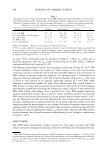
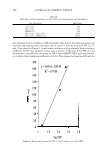
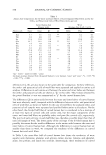
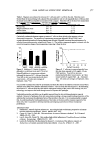
1000 900 800 r,;i = 700 = 0 u � 600 500 = QI QI 400 = QI r,;i ... 300 0 = � 200 00 100 0 VISUALIZATION OF SKIN BARRIER PERTURBATION 285 I I I I :! I I I I I I I I I I I I I I I I Ii: I I I I1I I !! III:: II nn I I I I I 5 10 .15 20 25 30 35 40 Distance from the SC Surface (z), µm Figure 7. Quantification of the SRB probe intensity in units of pixel counts as a function of the skin barrier depth (z) from the skin surface (z = 0) for p-FTS samples exposed to aqueous contacting solutions i-v. The error bars represent standard errors based on six skin imaging sites on seven p-FTS samples. Key: ◊-SDS (1 wt%) 0-SDS (1 wt%)+glycerol (10 wt%) *-SCI (1 wt%) x-PBS control □-glycerol (10 wt%). tacting solutions iii-v lead to significantly smaller values of SRB-skin partition coeffi cients and SRB-skin penetration depths, relative to contacting solution i containing 1 wt% SDS. The enhancements in the intercepts and in the slopes of the SRB fluorescence intensity profiles induced by aqueous contacting solutions i-v were evaluated relative to the PBS control, that is, relative to aqueous contacting solution iv. These results are reported in Table I. Recall that the enhancement in the intercept is equal to the enhancement in the SRB-skin partition coefficient (see equation 16), while the enhancement in the slope is equal to the enhancement in the porosity-to-tortuosity ratio (see equation 13). Using an average aqueous pore radius corresponding to the PBS control (r pore ,c) of 20 ± 3 A (see Table I and reference 2) in the context of the model presented in the Theoretical section, r por e,E values (denoted as r pore in Table I) induced by aqueous contacting solutions i, ii,
Purchased for the exclusive use of nofirst nolast (unknown)
From: SCC Media Library & Resource Center (library.scconline.org)