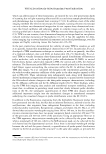
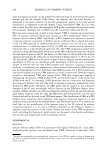
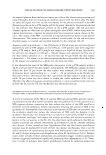
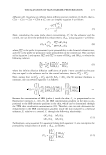
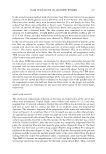
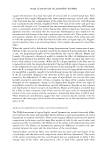
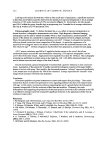
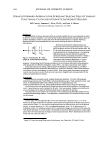
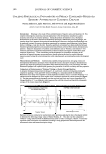
272 JOURNAL OF COSMETIC SCIENCE ization studies reported here) across the SC through the skin aqueous pores as follows (2 ,34,3 5 ,38): Dpore s i p-- i - TdX (1) where or e is the diffusion coefficient of permeant i in the aqueous pore. Note that D ore can be related to the infinite-dilution diffusion coefficient of permeant i in the bulk aqueous solution, D�, using the following relation (2,34-38): Dpore = D�H(A. .) t t t (2) where H(X.) is the hindrance factor accounting for the hindered diffusion of permeant iJ modeled as a hard sphere of radius, r iJ through the aqueous cylindrical pore, and X. is the ratio of the permeant i radius to the aqueous pore radius, that is, X. i = r/r pore · Anderson and Quinn have defined H(X.) for a spherical permeant i in a cylindrical pore as follows (3 7): H(X.J = cfll - 2.1044X.i + 2.089X.J - 0.948X. ), for X.i =S 0.4 (3) where cpi is the partition coefficient of permeant iJ defined as Cf°re c�, where cf0re is the concentration of permeant i in the pore, and C� is the concentration of permeant i in the bulk solution. Note that equation 3 considers only steric, hard-sphere permeant i-pore wall interactions, and does not account for long-range electrostatic or van der Waals interactions (36,3 7). Using equation 2 in equation 1, one can express the permeability, PiJ as follows: (4) Upon exposing skin to a chemical enhancer, BJ relative to a control, CJ in the context of equation 4, the following relation between the enhancement in the permeability of permeant, iJ (E) p , and the SC average aqueous pore radii values corresponding to E and CJ r 1JOre ,E and r 1J{)re ,o reflected in H(X. ) E and H(X.) c , respectively, is obtained: (E)p =' (P ) ,, = (�)n ( D�E )[ H(X.JE _ ]( dXc ) i (PJc ( � ) D�c H(X.J dXE T C (5) The permeability of permeant i, P , across the SC membrane can also be defined in terms of the flux of permeant i across the membrane (in the z direction) as follows (20,39): (6) where the trans-membrane flux,j i) is predicted by Fick's first law of diffusion, and dC denotes the concentration difference between the donor and the receiver chambers of the

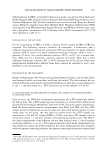
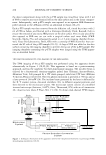
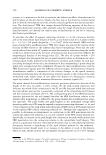
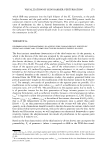
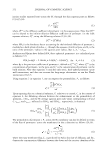
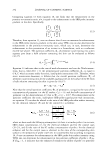
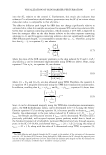
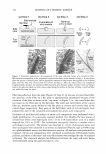
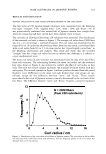
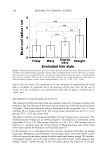
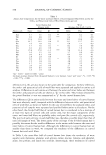
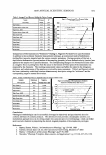
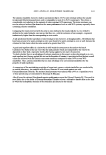
VISUALIZATION OF SKIN BARRIER PERTURBATION 273 diffusion cell. Assuming an infinite donor-infinite receiver condition (2,34,45), that is, Cf(t) - c (t) :::::: Cf(t) :::::: Cf(O) = cf, one can simplify equation 6 as follows: (de.) -u ore _1 1 dz pi= ___ C _d __ 1 (7) Next, considering the same probe donor concentration, cf, for the enhancer and the control, one can write the permeability enhancement, (E)p , using equation 7 as follows: (8) where o;;_ e is the probe (or permeant) i pore permeability in the chemical enhancer case, and 0 t ' is the probe (or permeant) i pore permeability in the control case. One can then utilize,equation 2 and express o;;, e and D 0 t in terms of H(A) E and H(A)c to obtain the following relation: ' ' (9) where the infinite dilution diffusion coefficients of probe i were canceled out because they are equal in the enhancer and in the control solutions, that is, D� E = D�c- Next, noting that: (a) D E = D';°c and (b) �X E :::::: �Xe (the SC intrinsic thickness is constant), one can rewrit� equati�n 5 as follows: Because the concentration of SRB (probe i) inside the skin, Ci, is proportional to its fluorescence intensity, I , (20-23), the SRB concentration gradient in the skin is pro portional to the SRB intensity gradient in the skin, which can be determined through the TPM skin visualization measurements (20). Therefore, one can now determine the enhancement in the SRB concentration gradient inside the skin induced by a chemical enhancer, E, relative to a control, C, through the following relationship: (dC/dz)E (dJ/dz)E (dC/ dz)c (dl/ dz)c (11) Furthermore, using equation 9 in equation 8 along with equation 11, one can express the permeability enhancement of probe i, (E)p, as follows: (12)
Purchased for the exclusive use of nofirst nolast (unknown)
From: SCC Media Library & Resource Center (library.scconline.org)