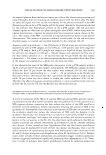
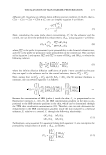
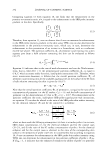
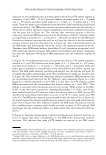
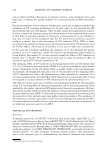
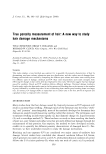
274 JOURNAL OF COSMETIC SCIENCE Comparing equation 12 with equation 10, one finds that the enhancement in the porosity-to-tortuosity ratio, e/'T, is equal to the enhancement in the SRB probe intensity gradient in the skin. Specifically, (13) Therefore, from equation 13, one can observe that if one can measure the enhancement in the SRB probe intensity gradient in the skin using TPM, one can also determine the enhancement in the porosity-to-tortuosity ratio, which can, in turn, determine the enhancement in skin penetration of an irritant in a formulation, such as a surfactant micelle (see above). The partition coefficient, p i , of permeant i partitioning into a skin aqueous pore from a bulk solution contacting the skin can be evaluated as follows (36,3 7): cpore p- = _i - = 2 f 1-X.iJ-E(r)lkT]rdr t C' Jo t (14) Equation 14 indicates that in the case of weak electrostatic and van der Waals interac tions, that is, when E( r) � 0, the permeant-pore partition coefficient, pi, is equal to (l-A./, which accounts solely for steric, hard-sphere interactions (36). Therefore, when steric interactions dominate, it follows that the overall partition coefficient, l\, of permeant i partitioning into all the available aqueous pores on the surface of the SC from a bulk solution contacting the skin is given by (36,3 7): (15) Note that the overall partition coefficient, li, of permeant i, is equal to the ratio of the concentration of permeant i at the SC surface, C/z = 0), and the bulk concentration of permeant i in the donor solution, cf, that is, l i = C/z = O)IC1, The enhancement in the partition coefficient (for steric, hard-sphere SRB probe-aqueous pore wall interactions, see equation 15) can then be related to the ratio of the SRB probe skin surface intensity, for the chemical enhancer (E) and for the control (C), as follows: [ Ch = o) ] e el i E [ Ch : o) ] Ci C (16) where we have made the following assumptions: (a) there is a similar probe i (in our case, SRB) donor concentration, cf, for the chemical enhancer and for the control cases (20-23), and (b) the ratio of the SC surface concentration of probe i for the chemical enhancer and for the control cases is identical to the ratio of the corresponding skin surface (z=0) intensities of probe i (20-23). It is noteworthy that according to equation 16, if one can measure the enhancement in the SRB probe skin surface intensity using TPM, one can determine the enhancement in the partition coefficient of probe i, (E)cP If (E)v 1, it indicates that the enhancer E enhances the ability of probe i to penetrate

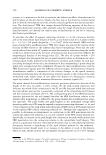
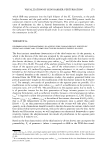
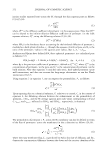
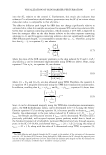
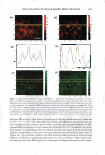
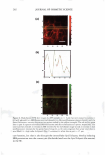
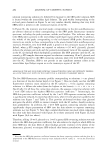
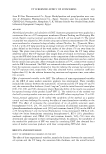
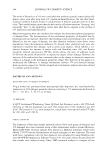
VISUALIZATION OF SKIN BARRIER PERTURBATION 275 into the SC, relative to the control C. Furthermore, this result also indicates that enhancer E in a formulation should enhance penetration into the SC of an irritant whose molecular radius is comparable to that of probe i. The effective diffusion path length for SRB does not change significantly relative to untreated skin, when skin samples are exposed to aqueous SDS contacting solutions (46). Given that: (a) aqueous contacting solution i, which contains 1 wt% SDS, is expected to have the strongest effect on the skin barrier relative to the other aqueous contacting solutions (ii-v), and (b) aqueous contacting solution i does not significantly modify the SRB diffusion path length, 9 it is reasonable to assume that 'TE = 'Tc- Therefore, using the fact that 'TE = 'Tc in equation 13, one obtains: ( dli ) dz E Be - ( dli ) dz c (17) where the ratio of the SRB intensity gradients in the skin induced by E and C, [( dl/ dz)E!(dl/dz)cJ, can be determined experimentally using TPM (see above). Next, using equation 17 for s E !s c in equation 16, one obtains: [ llz = O)E] (1 - X.JiI ---- - -----=A=c)0llz (1-X.J� - [ (df/dz)E ] - (df/dz) c (18) where flz = O)E and 1/z=0)c are also obtained using TPM. Therefore, the quantity A in equation 18 is uniquely determined using the TPM skin visualization measurements. In addition, recalling that Ai,E = r/r p or e,E and A i ,C = r/r pore ,C, equation 18 shows that: ( l -�) =A 112 (19) ( 1 __!j__) Ypore,C Since A can be determined uniquely using the TPM skin visualization measurements, and r i , the SRB hydrodynamic radius, can be determined to be 5.6 A using the Stokes Einstein equation (47), by solving equation 19, it becomes possible to obtain r p o re ,E and, thereby' the enhancement in the pore radius induced by E relative to C, E r p ore = r por e,E/ r p ore ,C (see Results and Discussion section) if r p ore,c can be determined. We have used a previously published, well-accepted aqueous porous pathway model that is based on the hindered-transport of a hydrophilic permeant (Mannitol) and ions through aqueous pores in the SC (34-38,40), and showed that r po re,c = 20 ± 3 A (2). Using this value of r p or e,c = 20 ± 3 A, along with the value of A determined using TPM, in equation 19, 9 The SRB diffusion path length through the SC is equal to the product of the tortuosity of the aqueous pores ('r) x SC thickness (�X), because, being hydrophilic, SRB traverses the SC through the aqueous pores and not through lipoidal pathways (34-38). Since both the diffusion path length and the SC thickness are assumed to be constant, it follows that ,- should be constant as well.
Purchased for the exclusive use of nofirst nolast (unknown)
From: SCC Media Library & Resource Center (library.scconline.org)