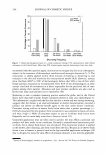
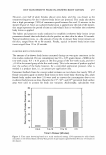
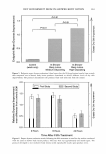
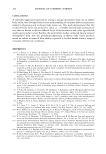
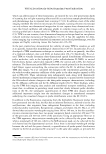
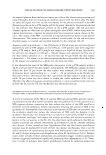
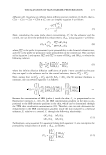
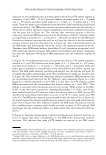
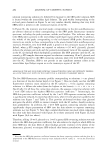
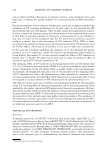
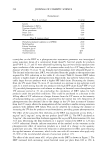
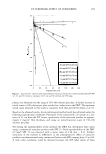
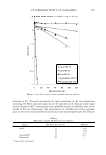
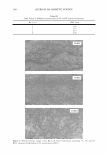
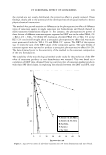
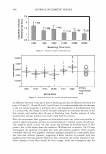
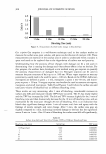
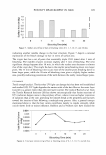
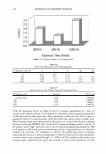
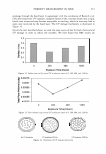
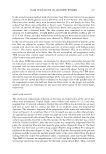
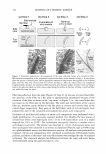
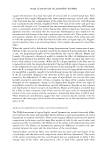
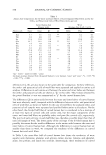
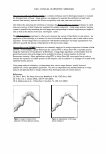
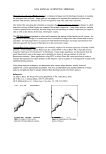
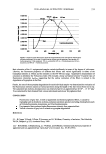
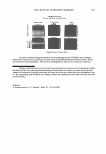
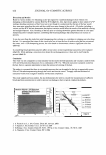
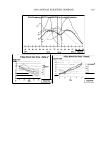
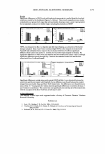
POROSITY MEASUREMENT IN HAIR Table I Color Measurement of Bleached Hair Bleaching time (min) L a b 0 38.2 6.1 15.9 1 45.2 7.2 20.1 5 48.8 7.2 21.3 10 53.8 7.1 23.1 15 57.8 6.2 23.0 20 58.8 6.1 23.2 dE 21.3 10.9 14.9 12.2 2.9 307 db 4.2 1.2 1.8 -0.1 0.2 peroxide is diffused into the hair cortex during the bleaching process. Table I and Figures 3 and 4 illustrate the color-change measurement of the bleached hair in the expression of total color change (LlE) and the blue-yellow index (.6.b). It is clear from Figures 3 and 4 and Table I that the color change, like the tensile strength measurement previously discussed, also undergoes distinct decreases at 1 min and 10 min. The trend is more prominent in Figure 4, where significant changes are clearly shown at 1 min and 10 min, with almost no changes in the yellow index after 10 min. The loss of L\b over the bleaching time reflects the degradation of brown-black melanins (eumelanins), which are the principal pigments found in human hair. As we discussed previously, melanins reside within the hair cortex and medulla, and even after 1 min of bleaching, the peroxide has made its way to the cortex, as indicated by the significant color change. Since the cortex plays a dominant role in the tensile properties, it may also explain why the tensile strength shows a significant loss after 1 min of bleaching. It is important to understand that the pigment degradation by chemical means is a diffusion-controlled process, which appears to be rather fast in this case because 1 min of bleach time already imparts significant color change. However, the rate-controlling step in the process has not been determined due to the complex oxi dation reactions of the many components in the hair (17). It might be reasonable to assume that the second major change in color (10 min) could be due to further penetration of peroxide into the hair cortex after overcoming the initial slow rate of diffusion. The following gas-sorption analysis for the "true" porosity of bleach-damaged hair may give further insight. 25.0 ------------------------------, 20.0 � 15.0 � 10.0 5.0 0.0 4---1i......---.....,..----...._____._ _ __. _ _,..._..____...____,___......_-----I 1 Min 5Min l0Min 15 Min 20Min Bleaching Time (min) Figure 3. Measurement of total color change in bleached hair.

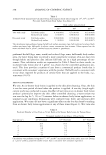
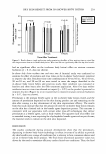
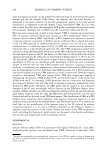
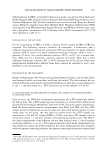
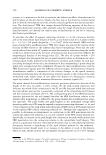
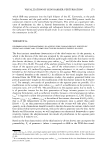
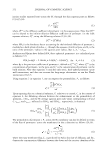
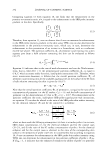
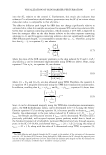
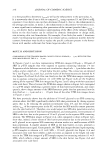
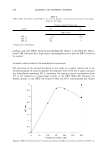
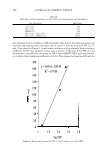
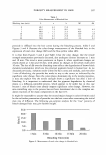
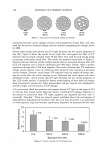
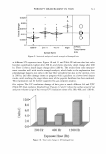
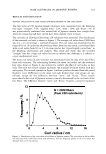
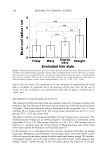
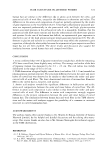
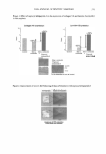
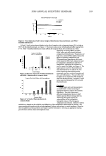
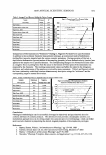
308 4.5 3.5 .L:J 2.5 1.5 0 0.5 -0.5 JOURNAL OF COSMETIC SCIENCE 1 Min 5 Min 10 Min 15 Min Bleaching Titre (min) Figure 4. Measurement of yellow-index change in bleached hair. 20Min Gas sorption. Gas sorption is a well-known technique used in the catalyst market to measure the surface area, pore volume, and pore size distribution of catalysts (18). These measurements are essential in the catalyst area in order to understand when a catalyst is spent and needs to be replaced due -ro the degradation of surface area and porosity. Understanding how the porosity of hair changes with damage can be a real asset in determining \Vhat is causing the damage and \ hat adverse effects it has on the hair. For this purpose, the authors have developed a new method using gas sorption to quantify the porosity characteristics of damaged hair (1). Nitrogen sorption can be used to measure the pore structure of hair up to ca. 100 nm. Water vapor sorption or mercury porosimetry would need to be used for pores 100 nm. Based on the IUPAC definition, micropores are defined as pores 2 nm, mesopores '· pores 2 nm-50 nm, and macro pores as pores 50 nm. Nitrogen sorption can therefore be used to measure micropores, mesopores, and small macropores. Table II and Figures 5 and 6 show the surface area and total pore volume of bleached hair at different bleaching times. These results are very interesting after 1 min of bleaching, considerable increases in surface area (SA) and total pore volume (TPV) have occurred. The SA has nearly tripled and the TPV has increased by 30%. The SA and TPV increase slightly for the 5 min of bleaching time _and then dramatically decrease for the 10 min of bleaching time, and are maintained for the most part through 20 min of bleaching. This is an indication that bleach does significant damage within 1 min of contact with hair and agrees with the findings of tensile strength and color change. After 5 min, the surface area goes up slightly compared to 1 min, indicating increased damage to the hair but less significant versus O min to 1 min. After 10 min of bleaching the surface area falls off significantly, Table II Surface Area (SA) and Total Pore Volume (TPV) at Different Bleaching Times Bleaching time (min) SA (m2/g) TPV (cc/g) 0 (Virgin hair) 0.40 0.000689 1 1.13 0.000991 5 1.17 0.001010 10 0.55 0.000785 15 0.49 0.000742 20 0.58 0.000778
Purchased for the exclusive use of nofirst nolast (unknown)
From: SCC Media Library & Resource Center (library.scconline.org)