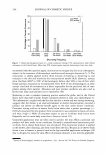
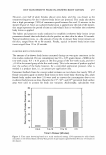
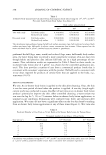
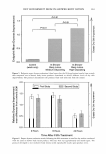
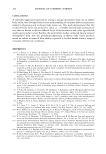
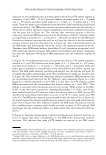
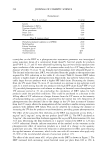
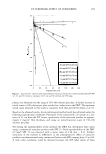
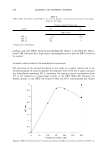
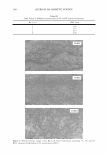
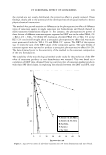
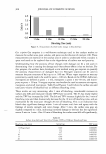
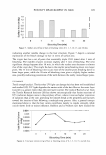
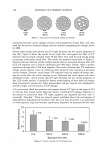
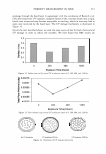
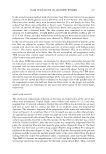
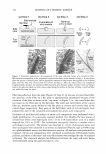
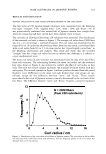
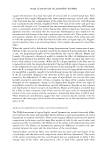
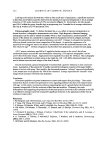
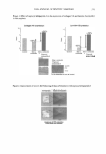
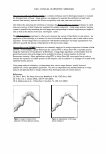
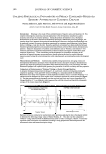
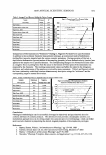
POROSITY MEASUREMENT IN HAIR 309 1.4 � 1.2 .s. 1 ca 0.8 .. c( 0.6 Cl 0.4 c., 0.2 .. :J fl') 0 0 5 10 15 20 Bleaching Time (min) Figure 5. Surface area (m2/g) of hair at bleaching times of 0, 1, 5, 10, 15, and 20 min. indicating another notable change in the hair structure. Figure 7 depicts a rational explanation of the bleach damage to hair in terms of surface area. The virgin hair has a set of pores that essentially triple (2.83 times) after 1 min of bleaching. The number of pores increases slightly after 5 min of bleaching. The next significant change happens after 10 min, in which the surface area decreases to almost that of the virgin hair. This might be due to the smaller pores breaking down into larger pores. The 15 min of bleaching time is just more of the smaller pores breaking down to form larger pores, while the 20 min of bleaching time gives a slightly higher surface area, possibly indicating penetration of the walls between the newly created larger pores. UV DAMAGE Tensile strength analysis. The fact that UV light can damage hair has been well established and studied (19). UV light degrades the amino acids of the hair fiber at the outer layer (cuticle) to a greater extent than the inter layer (cortex). The work of Ruetsch et al. from the Textile Research Institute (20) has shown microscopically that fusion reactions of UV irradiation happen more in the periphery of hair, where it receives higher intensities of radiation than at the core, providing the smooth break at the periphery and fractures toward the interior of hair following a multiple-step process. Also, a general concept mentioned above is that the hair cortex contributes largely to tensile strength, while cuticle shows little or minor influence. Robbins and co-workers (21) have studied the 0.0011 Cl e 0.001 :J o 0.0009 m f "ti 0.0008 � � 0.0007 0.0006 0 .... 0.0005 -----.-------.-----.---......---....----- 0 5 10 15 20 Bleaching Time (min) Figure 6. Total pore volume (cc/g) of hair at bleaching times of 0, 1, 5, 10, 15, and 20 min.

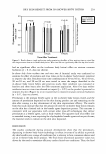
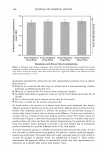
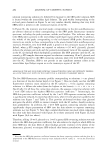
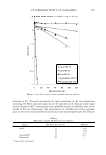
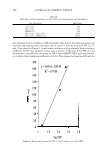
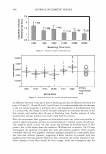
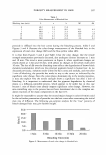
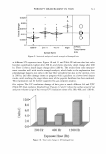
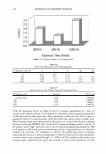
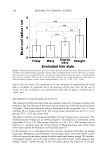
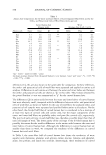
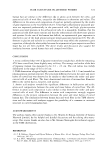
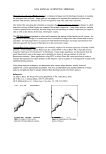
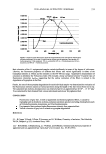
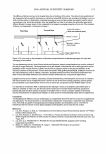
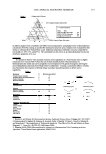
310 Virgin Hair JOURNAL OF COSMETIC SCIENCE 1 min Bleach Smin Bleach Figure 7. Illustration of bleaching damage mechanism. 10min Bleach correlation between cuticle damage and the tensile properties of hair fiber, and their work has focused on chemical damage and the resultant morphological changes shown by SEM. Several other studies have proven that UV light decreases the wet tensile properties of hair (22). Figure 8 shows the results of our study that investigated the effect of UV exposure time on tensile strength. Over 40 hair fibers were used for each testing group to generate statistically sound data. The results are analyzed statistically in Figure 9. Figure 8 indicates that the tensile strength already shows a noticeable decrease after 200 hr of UV exposure, and it remains unchanged after 400 hours. Finally, there is another significant decrease after 1200 hr of exposure. The results illustrate that UV irradiation already attacks the hair cortex in a relatively short period of time, resulting in decreased tensile strength. However, much longer UV exposure times are needed to further dam age the cortex after the initial damage occurs. Although the result agrees with other published studies-which proved that UV light decreases the wet tensile properties of hair {22)-more analysis is needed for further understanding of these physical changes from a mechanistic perspective. Color measurement and gas sorption were employed to provide insight into the process of UV damage. Color measurement. Both hair proteins and pigment absorb UV light in the range of 254 to 350 nm. This unique nature helps hair protect itself from UV damage. However, in the process of protection from UV light, pigments are degraded and hair color is eventually "bleached." There are research papers published about the mechanisms of photochemical degradation of emuelanin (23). Since our main focus here is to understand at which exposure stage hair becomes significantly degraded, we measured the hair color 2.5 2 1.5 C) 1 C - � ns 0.5 - o T 1.11a T 1.143 T 1.049 I I o Hr 200 Hr 400 Hr Exposure Hour (Hr) Figure 8. Tensile strength of UV-damaged hair. I T o.sa1 1200 Hr
Purchased for the exclusive use of nofirst nolast (unknown)
From: SCC Media Library & Resource Center (library.scconline.org)