J. Soc. Cosmet. Chem., 28, 485-496 (September 1977) Age related baldness. Effect of topical treatment J. H. HERNDON, JR., D. A. LEEBER, and C. B. READ Division of Dermatology, Department of Internal Medicine and the Department of Medical Computer Science, The University of Texas Health Science Center, 5323 Harry Hines Blvd., Dallas, TX 75235. Received November 8, 1976. Synopsis Twenty-nine subjects, 10 women and 19 men, took part in a trial in which THOROUGH CLEANSING of the SCALP was used as therapy for AGE-RELATED BALDNESS (ARB). We measured changes in rate of hair loss, number of hairs identifiable per unit area of scalp, telogen/anagen ratio, and numbers of superficial squames removable per unit area of scalp skin. The subjects completed a two-month control period consist- ing of infrequent low intensity shampooing (no more often than every 3 to 7 days), then a three-month treat- ment period consisting of rigorous daily cleansing of hair and scalp. Following treatment, we noted a highly significant reduction in squames per unit area, but only trends toward improvement in rates of hair loss and in numbers of hairs counted per unit area of scalp. There was no observable change in telogen/anagen ratio in hair roots. We concluded that rigorous cleansing of hair and scalp could not be shown to affect significantly the course of ARB. INTRODUCTION As early as the 4th Century B.C. Aristotle noted that baldness affected men but not women, children, and eunuchs. Beginning with Sabouraud, numerous observers have remarked on the frequent concurrence of oily seborrhea with age-related baldness (ARB) (1-3). Although current teaching has abandoned the hypothesis that accumula- tion of sebum causes hair loss and accepted instead the notion that age-related hair loss develops due to an interplay between androgenic hormones and a dominantly- inherited trait (4), still the idea has persisted that excessive or qualitatively altered secretion of sebum may affect the development of ARB (5-7). Available evidence sug- gests that human sebaceous secretion falls with age (3). Older peoples' sebaceous glands also seem to be smaller and fewer in number (8). Despite these data, the proponents of a role for sebum-mediated injury can point to several studies that show toxic affects when human sebum is applied to animal skin. One group showed that whole human sebum and some of its unsaturated components caused noninflammatory depilation in rats, mice, and rabbits, though not in human children (9-12). Peroxide- rich fatty acids seemed most potent, although the paraffinic hydrocarbon fraction of sebum also caused hair loss in animals (14-15). Other analyses showed that human 485

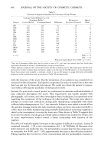
486 JOURNAL OF THE SOCIETY OF COSMETIC CHEMISTS sebum is unique among mammalian products in containing large amounts of triglyc- eride fatty acid, squalene, and mono-ester waxes (16), and that these components are produced maximally at the time of onset of ARB (! 7). Despite its potential importance, we could not find published accounts of controlled trials of the influence of thorough removal of sebum on ARB in either sex. We were given an opportunity to examine this problem in the course of a study involving a group of men and women referred for excessive hair fall in whom other causes of alo- pecia had been excluded. METHODS: POPULATION We interviewed 73 men and women between ages 16 and 50 on referral from practic- ing dermatologists in the community. All complained of severe and continuous hair loss. A thorough history and dermatologic exam, including hematologic, serologic, X-ray, general physical, and other studies where indicated, was completed during the first visit. The subjects were questioned closely concerning drugs, vitamins, prior medical and lay therapy for hair loss, personal and family history of skin disease, recent febrile illness, pregnancy, endocrine disturbance, or hematologic disorder. Other possible causes of alopecia including infection with dermatophytes, treponema pallidurn, or symptoms of connective tissue disease, alopecia areata, or trichotillomania were excluded by appropriate means. The degree of baldness was graded by the investigator for all subjects. None of the women had temporal-crown thinning resembling the pattern often seen in men or in pathologically virilized women. Instead, all had diffuse loss beginning behind the frontal hairline and extending throughout the top of the scalp. This distribution has been termed female-pattern alopecia (18) and common female baldness (19), and has been blamed on thyroid deficiency (20) as well as inherited influences. All of our patients displayed normal thyroid and other endocrine function during evaluation, however. In accepting female subjects, we ignored a history of taking birth control pills if two conditions were satisfied: (1) if the patient consistently adhered to ! oral agent and schedule for a minimum of 6 months before beginning treatment and (2) if her history of excessive hair loss extended a minimum of 6 months before beginning oral contraceptives, and her hair loss had not changed in severity while using the drug. Such agents have been shown to influence hair growth in animals (21), as has human preg- nancy (22), but aside from a scattering of case reports (23), recent investigators have discovered no causal relationship between human ARB and estrogenic medication (24). It is true that some women have responded to withdrawal of estrogen supple- ments by developing hair loss for short periods (25). This phenomenon should not have affected our results, however, since all medications of this type were continued. Using a mean value of 50 hairs lost per day as a threshold for entrance to the project, we studied 29 of the 73 subjects interviewed, 10 women and 19 men. Sixteen of the original 73 were excluded when they demonstrated hair loss of less than 50 per day, another 21 became drop-outs or displayed unreliability during the control period, one became pregnant, and one developed alopecia areata. Five subjects, 2 men and 3 women, withdrew from participation during the treatment period. In order to avoid biasing the results these 5 were assumed for statistical purposes to have experienced
Purchased for the exclusive use of nofirst nolast (unknown)
From: SCC Media Library & Resource Center (library.scconline.org)