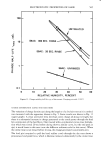
J. Soc. Cosmet, Chem., 28, 601-609 (September 1977) The optical properties of human hair II. The luster of hair fibers ROBERT F. STAMM, MARLO L. GARCIA, and JUDITH J. FUCHS, Clairol Research Laboratories, 2 Blachley Road, Stamford, Ct. O69O2 Received June 22, 1976. Presented Ninth IFSCC Congress, June 1976, Boston, MA. Synopsis Part I of this paper contains the results obtained with regard to the SPECULAR REFLECTION and DIF- FUSE SCATTERING of LIGHT by HUMAN HAIR FIBERS as studied by means of GONIOPHOTOMETRY. Such data provide a means of measuring the luster of hair fibers. For evaluating the LUSTER of HAIR, the method chosen employs white light polarized perpendicular to the plane of inci- dence and incident at 30 ø with observations being made from 0 ø to - 75 ø through an analyzer which is aligned with the polarizer. The integral of the trace of intensity versus the angle of observation yields the specular reflection (S) and diffase scattering (D). The luster (contrast gloss) value is (S-D)/S. Numerical values extend from zero for bleached hair in very poor condition to - 0.85 for dark hair in excellent condition. Us- ing 3 evaluations per sample, luster values have a 90 per cent confidence limit of -+2.5 per cent of the mean value. THE LUSTER OF HAIR FIBERS DEFINITION AND TERMINOLOGY The word luster (or lustre) is defined as: "a glow from reflected light," or as "natural or artificial brilliancy or sheen " synonyms are gloss, refulgence, or sheen. Artists, novelists, and poets have used and misused the word for describing optical effects, sensations, and human character so that most people are confused about its meaning because of the mystique surrounding it. A book by Harrison (1) gives a survey of the literature on gloss and related subjects published prior to 1945. Today, this book is of value mostly in an historical sense, but it does contain references to articles, which would be very difficult to find otherwise. A paper (2) (by J. S. Christie of the Hunter- labs) contains a useful appendix, which gives accepted definitions of terms related to geometric attributes of reflectance, i.e., those attributes related to the geometrical dis- tribution of reflected light rather than to its color characteristics. From (2) we quote the definitions for gloss and luster. "Specular gloss (shininess).' The appearance attribute cor- responding to the intensity with which lights are seen to be specularly reflected." Luster.' The appearance characteristic of a specimen associated with a change in intensity of reflected light when the angle of view is changed." In order to reduce experimental evaluations to numbers, terms such as gloss and luster need to be defined in terms of measurable parameters. This was done by R. S. Hunter (3), and a useful synopsis of his recommendations appeared in a paper (4) by Dorothy Nickerson. Referring to Figure 2, in Part I of this paper, if Io is the incident intensity and if we assume that the intensity(s) of the light specularly reflected at the interface is 601

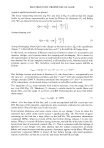
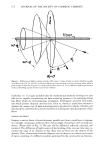
602 JOURNAL OF THE SOCIETY OF COSMETIC CHEMISTS measured at an angle equal to that of the angle of incidence and on the other side of the normal to the interface, the specular gloss would be Gs = s/I0 (1) For low-gloss surfaces, the sheen would be given by the same ratio when the beams are used at grazing incidence and grazing reflection. The term contrast gloss applies to the contrast existing between the intensity of the specularly reflected light (s), measured at the angle of direct specular reflection, and that of the diffusely scattered light (d), measured at an angle of emergence of 0 ø, i.e., along the normal to the interface. Thus, for Hunter's contrast gloss, we have Gc = s/d (2) However, as pointed out by Nickerson (4), this function goes to infinity as d ap- proaches zero. For this reason, she suggested, and put into use, an alternative form of this expression, namely G•. = (s - d)/s or (1 - d/s) (3) which has limiting values of 0 when d equals s, and 1 when d equals 0. (The value of Gc could be negative if d s but such cases are excluded from consideration.) The func- tion in eq. (3) was employed (4) to evaluate the luster of cotton fibers and fabrics and was found to correlate well with estimates of relative luster values made visually. A similar type of expression, used in an inverse sense, was employed by Jeffries (5) who made a relatively thorough analysis of the optical elements involved in making measurements of the extent of delustering of textile fibers and fabrics by means of goniophotometry. In the third paper, noted in (5) , he stressed the advantages of employing polarized light in making such measurements. Both Nickerson and Jeffries employed white light and measured spot values of s and d at their respective individual angles. In evaluating the luster values of single fibers, Holboke and Berriman (6) oriented the fiber vertically, illuminated it with an hori- zontal beam of monochromatic light linearly polarized vertically and, using a Po- laroid ©* also in the exit beam, made two scans from 0 to 180 ø, one with the Polaroids aligned, the other with the Polaroids crossed. Letting a be the degree of coherency of the scattered light (i.e., the degree to which the original direction of polarization of the incident beam was retained after scattering by the fiber) they obtained an expression for a • = (IA -- Ic)/(IA + I•) (4) where IA and Ic are the integrated intensities for the angular interval 0 to 180 ø when the Polaroids were aligned and crossed, respectively. They demonstrated that values of • correlated well with relative values of luster estimated visually. (The limits for • would be 0 and 1.) We attempted to use this method employing oblique incidence with a planar array of oriented, parallel hair fibers (as depicted in Fig. 5 of Part I). The range of values obtained for c• was very small, and the method was deemed to be unre- liable when using oblique incidence because the direction of polarization of the in- cident light is altered by the curved walls of the fibers, whereas this problem is not en- *Polaroid Corporation, Cambridge, MA.
Purchased for the exclusive use of nofirst nolast (unknown)
From: SCC Media Library & Resource Center (library.scconline.org)