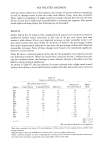
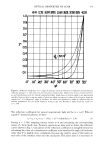
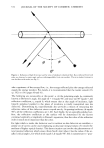
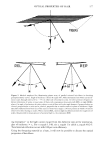
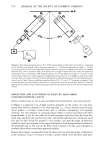
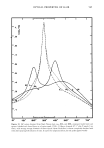
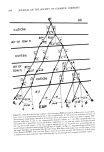
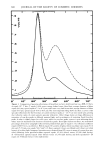
LUSTER OF HAIR FIBERS 607 peak decreases as the extent of the color increases. Thus, the specular reflectivity of the near-side peak is altered very little by the color of the hair, whereas the apparent specular reflectivity of the far-side peak, judged by its intensity on the GP curve, actually vanishes for black hair (see Fig. 9 in Part I). The inclusion of both specular reflections in S simplifies the evaluation of S and will not affect the values of L so long as S D, which is generally the case. In unusual cases, where D -• S, the values of L actually will be kept from going negative by including the far-side specular reflections in S. In the textile field, S always includes the near-side and far-side reflections because, except in the case of oriented wool fibers (a remote possibility), both peaks will be ob- served at the same angle. This probably is the reason why the specular reflectivities of textile fibers change markedly with the color of the fibers. DIFFUSE SCATTERING FROM THE SURFACE AND FROM THE INTERIOR Scattering of light can be anticipated from optical discontinuities which are on the sur- face or in the interior. In the case of the outer surface, such discontinuities would in- clude the edges of the scales themselves, dust particles and the like, damaged scales, scalp secretions and debris, and split hairs. In the case of the interior, scattering would occur because of the medulla, granules of melanin, fibrillar polymer molecules, any naturally occurring glue or pasty material used for maintaining the integrities of the fibers or filling in the interstices, and from voids or inclusions very marked scattering would occur from certain kinds of gray hair fibers in which gray pigment particles or voids are situated in a chain along the axis of the fiber. In general, for particles which are spherical and whose diameters are less than one- tenth the wavelength of the light employed, the intensity of scattering is proportional to the third power of the diameter of the particle and to the inverse fourth power of the wavelength. Thus, if we halve the wavelength, the intensity of scattering is increased by 24 equals 16 fold. Likewise the scattering is proportional ro the number of particles per cubic centimeter and to the volume of the individual particle. If unpolarized incident light is used, the angular dependence of the scattering is symmetrically disposed rela- tive to the 90 ø direction and is twice as great in the forward and backward directions as it is at 90 ø . In addition, for purposes of orientation, it is well to recall that the scattering is proportional to (An/Ac) 2 for a solution of polymer particles in a liquid medium or to (N•/N0) 2 for a suspension of particles in a matrix. If a change is made in the shape of the particles from spherical to ellipsoidal, if the volume of each individual particle remains the same as the spherical particle, and if the volume concentration remains the same, then the total amount of light scattered for the ellipsoids will be greater than that of the spheres. As the particles increase in size so that they have gross dimensions equal to or greater than the wavelength, the intensity of the light scattered in the forward direction increases at the expense of the backward scattering, and the scattering envelopes be- come progressively more unsymmetrical as the size increases. For melanin granules, ir would be anticipated that the light-scattering envelope would be unsymmetrical. The same would hold for the roughness on the surfaces of the hair fibers attributable to the ends of the scales.

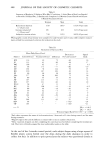
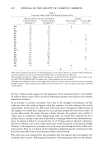
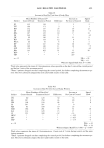
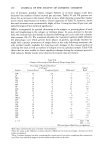
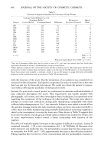
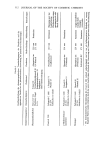
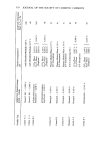
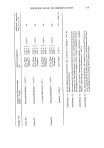
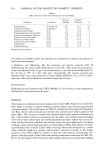
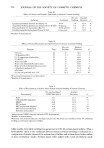
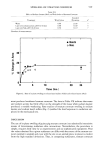
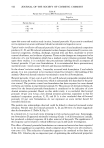
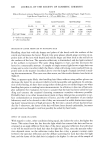
608 JOURNAL OF THE SOCIETY OF COSMETIC CHEMISTS Table II Effects Produced on Luster Parameters by Touching Strung Hair Fibers with the Fingers. Single Source, Light Brown Virgin Hair 0 = 30 ø, ese•, RER, Slits = 1 ø, 21 Fibers Counts Luster Functions Spot Readings (Volts) (S+D) S D S/D (S-D)/S s d (s-d)/s b 8677 6796 1881 3.613 0.7232 3.537 0.206 0.9418 a 8703 6759 1944 3.477 0.7124 2.858 0.218 0.9237 Per Cent Change +0.30 -0.54 +7.34 -3.76 -1.45 -19.2 +5.83 -1.92 b = before touching hair. a = after touching hair. DECREASE OF LUSTER PRODUCED BY HANDLING HAIR Handling clean hair with the fingers and palms of the hands soils the surfaces of the cuticle and decreases the luster. People who wear glasses should grasp one lens on op- posite sides of the lens with thumb and middle finger and then look at the soil left on the surfaces of the lens. The specular reflectivity is diminished, and the light scattered at the surfaces is increased. The same thing happens to hair, and this decreases the luster by a measurable amount. A sample of single-source light brown virgin hair was strung and a curve run after which the fibers, while still strung, were touched from op- posite sides in the manner described above over the length of sample involved in mak- ing the measurements. The curve was then rerun, and the results obtained are shown in Table II. Thus, it appears quite likely that handling hair fibers without using rubber gloves can decrease the luster by an amount which is both measurable and significant. In anticipa- tion of this finding, we have been using either rubber gloves or rubber finger cots when handling hair prior to making luster measurements. In addition, in the case of hair sam- ples submitted for evaluation we have to assume that the hair has been soiled by han- dling and execute the required cleansing treatments ourselves whenever possible. Probably there is no other measurement made in these laboratories as sensitive to sur- face contamination as measurements of luster, and the staff members of any similar laboratory need to be alerted to this if they are interested in subtle distinctions requir- ing luster measurements of high precision. By the time a swatch of hair has been han- dled by 5 observers, the luster of the hair will have been altered undeniably, but most people treat is as though it could not possibly be soiled by their hands. EFFECT OF COLOR ON LUSTER With regard to color, other conditions being equal, the darker the color, the higher the luster. This arises from the fact that the light which has entered the hair and has re- emerged at an angle different from that of the direct specular reflection (but still close to it) will be much less for dark hair than for light hair. Thus, since the specular reflec- tion depends more on the refractive index than the color, a greater contrast exists between the specular reflection and the diffuse scattering for dark hair than for light hair, and the luster of the dark hair is judged to be higher. In the case of the sample of
Purchased for the exclusive use of nofirst nolast (unknown)
From: SCC Media Library & Resource Center (library.scconline.org)