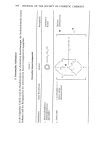
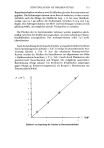
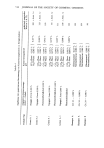
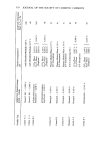
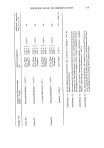
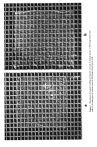
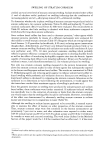
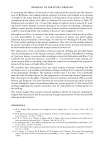
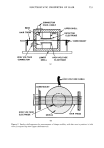
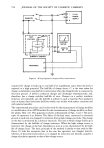
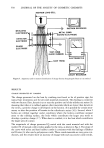
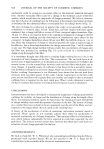
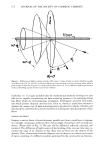
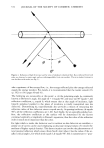
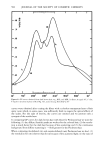
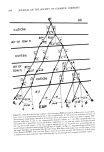
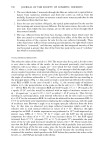
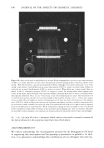
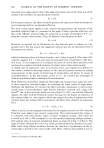
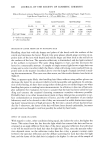
588 JOURNAL OF THE SOCIETY OF COSMETIC CHEMISTS air cuticle air or low n cortex air or low n ,r, cuticle • • '1 ! ,,• .,• :• Figure 12. Optical model For hair: number 2. For orientation RER and arig]e ooeincJdence •0, have been traced in principal plane which bisects fiber longitudinally. In this model we postulate existenc discontinuous wedge-shaped sheath o• air between cuticle and cortex in order to be able Specular reflections S• and Sr are symmetrically disposed relative to (-•). (The perpendicareEAP.o•raysexplain•ashe•-•othatperformerayscases,2o•both1•anyinrs.tomeaningwas6andmodels represente• •y: a •otte• line (•0, For •is o• fi•er), •ashed line (•, •or near si•e scales), line (•, •or •ar side scales).) At •ar side, angle o• emergence into air would be • rs. •0 ray woul• remain undevJate• a•ter passing through hair (eL model • in Fig. 1 •.). Experiment us- ing single hair ,fiber a•d horizontal He-Ne laser beam. With fi•er vertical an• root en• Up, were •evJate• DOWN with root end Down, many o• rays were •evJated U•. However, a number o• rays were undeviate• thus indicating that true model might be Composite o• and

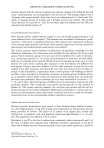
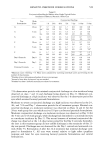
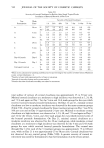
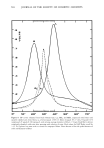
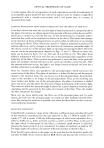
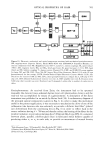
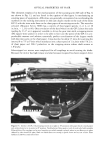
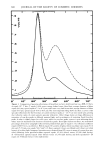
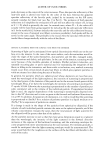
OPTICAL PROPERTIES OF HAIR 589 OPTICAL MODEL NUMBER 2 This model is relatively more complex and is shown in Fig. 12 the caption explains the ray tracing depicted. In order to explain the EAP, it appears necessary to postulate the existence of a discontinuous wedge-shaped sheath of air (or material of low index) between the cortex and the cuticle. In addition it is necessary that 0, the angle of incli- nation of the scales to the axis of the fiber should be retained all the way to the inner end of each scale. In order to ascertain whether or not this was so, fibers were placed under slight tension along the axis of a tube, potted, and then sliced longitudinally until a section was obtained which indicted that the section exposed was a slice which very nearly bisected the fiber longitudinally and parallel to the axis of the fiber. From SEM pictures (4700 X) it was possible to measure the angle of inclination of the cuticle rela- tive to the axis as -3 ø and to see that this angle was retained throughout the entire length of each scale. In Fig. 12 we indulge in artistic license and show the air films and cuticle layers having radial thicknesses comparable to the diameter of the cortex. This was done in order to trace the rays. (The radial thickness of the air film need be only -1/am.) In this model it is postulated that the near and far side reflections may occur from both the inner and outer layers of the cuticle. With the orientation RER, the specular reflec- tions nearside (4)-20) and far-side (4)+20) are predicted to be disposed symmetrically relative to (-4)). For the orientation REL, they would be (4)+20) and (4)-20), respec- tively. The angles of emergence for rays reflected from the cuticle-air interfaces at the far side would be predicted to occur at 35 ø (REL) which is low by 4 from 39 ø, observed and at 25 ø (RER) which is high by 3 from 22 ø, observed. Thus, the errors made by the 2 models in predicting the locations of the farside peaks are comparable and opposite in direction (high versus low and vice-versa) but, of the 2 models, only the second one predicts the EAP. Since these optical parameters of hair are variable, we encounter samples where the locations of the maxima for the farside peaks are predicted to within 0.5 to 1 ø by optical model 2, and occasionally we run a sample where this is true for optical model 1. THE EXTREME BREADTHS OF THE FAR-SIDE PEAKS Without taking note of the extent of medullation, 21 Piedmont hair fibers were selected at random and strung on the sample rack after which GP curves were obtained (•s) using the orientations R_EL and KER. The background lines were drawn in from 0 to 75 ø for each curve, and the peak signals above background noted. After this, the full widths of each peak at half-peak height (AW•/2) were calculated, and the ratios of the AW•/2 values (rear/front) were computed. The values found were 17.4/10.5 ø equals 1.66 (REL) and 24.60/9.4 ø equals 2.62 (RER). These ratios change from sample to sample but, on the average, the half-width of the far side peak is about twice that of the near-side peak for noncolored hair. Also, since the maximum signals for the far side peaks are more than one-half those for their rear-side companions, this means that the integrated intensity values (far side) are somewhat greater. (In this treatment, we did not correct the intensity of each peak for the contribution of the underlying shoulder of its companion.) In seeking an explanation for these observations, the most obvious reasons are as follows:
Purchased for the exclusive use of nofirst nolast (unknown)
From: SCC Media Library & Resource Center (library.scconline.org)