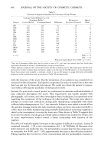
586 JOURNAL OF THE SOCIETY OF COSMETIC CHEMISTS treatment generally will be different, and this will alter 0. (Increasing the tension lowers 0.) Consequently, we string the fibers, record the GP curves, measure the 0 values by hand cranking the detector telescope instead of using the motor drive, un- string all the fibers at one end leaving the root ends still mounted, carry out the treat- ment with the fibers between glass and a plastic film, wash the fibers, dry them for 30 min with room air using only a blower and no heat, restring the tip ends, record the GP curves, and measure the 0 values by hand cranking. From the chart paper, values of an- gles are good only to ---0.1 ø because of the uncertainty in coordinating the zero points of the GP and the recorder. However, by hand cranking the GP and reading the scale with a 4 X eyepiece, we can find values of A0 good to +0.02 ø at a 90 per cent confidence level if we perform 5 repetitive experiments. Instead of reading the angle at the peak, it is better to read the angles corresponding to equal signal values each side of the peak but still close to the peak so that any effects from the asymmetry of the peak will not be important. When typical, mild treatments are applied to the hair, values of A0 ranging from 0.1 to 0.2 ø are obtained, but 0.2 ø would be considered a large change. AN OPTICAL MODEL FOR HAIR THE REFRACTIVE INDEX AND BIREFRINGENCE In attempting to understand the significance of the experimental results described in the foregoing material it is necessary to resort to ray tracing to verify that the light should emerge at the angle where it is observed. The act of ray tracing requires an optical model plus knowledge of the refractive indices and birefringence of the exocuticle and of the cortex. Employing a microscope, light from a sodium vapor lamp, and the Becke line method, we have measured the value ofn equals 1.548 (_+.001) us- ing several different types of human hair (whole hair fibers) as well as cuticle scraped from hair and free from the cortex. We find the cuticle in this condition to be free from birefringence. With regard to the birefringence for human hair, we have noted the value of (np- ns) equals 0.007 reported by Fraser (16). When the fibers have a low moisture content, this is believed to be the so-called intrinsic birefringence, and is at- tributed to the helical molecules in the cortex. For wool fibers, a value of equals 0.0114 at 65 per cent RH (12. 7 per cent regain), corrected for swelling, can be interpolated from Fig. 2 of the paper by Haly and Swanepoel (17). (The uncorrected value would be - 0.0103.) Using a fiber of Navajo hair which was devoid of cuticle over a short length, but was not split or damaged, the birefringence ]7 n equals 0.0068 (-- 1.5 per cent) was measured directly at 22øC. For the same fiber which had cuticle closer to the root end, the value ]7D equals 0.0076 (+ 1 per cent) was measured for cortex plus cuticle at the same temperature. From these data, we infer t•hat, /, sit•, the cuticle has a weak birefrin- gence of -0.001. In all probability, this is attributable to the strain imposed on the scales during growth. When devoid of cuticle, the hair was swollen by the immersion liquid which surrounded it. The diameter increased 6 per cent in -2 h at 22øC this was 10 times the rate of swelling observed for the same fiber with cuticle. For the sheath of the cortex, the values n, equals 1.548 and ns equals 1.541 were measured. The difference (n, - ns) yields an inferred value of FD = 0.007 to be compared with 0.0068, the one measured directly. (The relative humidity was 65 per cent which produces -12.7 per cent regain in wool see (17): The low value of birefringence, ap- proximately that of crystalline quartz, should not produce significant effects except in

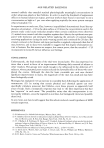
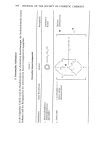
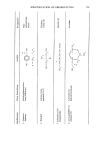
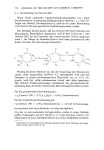
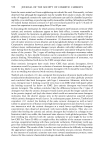
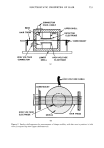
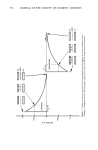
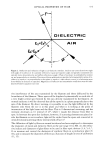
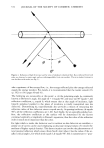
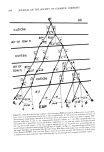
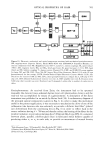
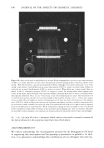
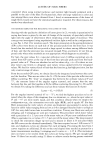
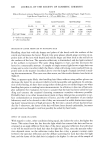
OPTICAL PROPERTIES OF HAIR 587 CUTICLE t'= si-' [ n.sin(-+ZO -8 CORTEX D ß -I sin (½- e) Sr ß ii .sin( ,' D Figure 11. Optical model for hair: number 1. For orientation RER and angle of incidence of 0 vs. •r0 or (½5 - 0) vs. •rl, rays have been traced in principal plane which bisects fiber longitudinally. Indices of cuticle and cortex have been assumed to be equal. Specularly reflected rays (Sf, front face, and S,., rear face) do not appear at equal and opposite angles vs. (- ½5). At far side, the internal angle of incidence is (r + 20) vs. •rz, and angle of emergence would be {sin-l[n sin (r + 20)] - 0} vs. •r0 which is not equal to (h- Thus, either for oblique incidence, or for normal incidence (½5 = 0% the ray which emerges on far side would be deviated relative to incident ray because of prism effect of hair fiber in this model (cf. model 2 in Fig. 12.). Rays denoted by D on both near and far sides represent diffuse scattering from ends of scales. For orientation REL, angles become: ½5, (½5 + 0), r equals sin -• [sin (½5 + 0)/n], (r - 20), (r - 40), e' equals {sin -1 In sin (r - 40)] + 0}, and {sin -• [n sin (r - 20)] + 0} vs. •r0 for angle of emergence on far side experiments conducted with crossed Polaroids, and even in that case, other effects will probably be of greater significance. OPTICAL MODEL NUMBER ONE This model is shown in Fig. 11 in the configuration RER. An explanation is presented in the caption. This model can predict the angular location of the light specularly reflected from the air-cuticle interface on the front face but not that from the rear face. Thus, with 4) equals 30 ø, 0 equals 2.5 ø, n equals 1.548, and with no Polaroids or with eses, for the orientation REL, we calculate r equals 20.3 ø and from this e equals 18.6 ø versus 22 ø observed the calculated value is low by 3.4 ø (15 per cent). For the orienta- tion RER, we calculate r equals 17.4 ø and from this e equals 42.8 ø versus 39 ø observed the calculated value is high by 3.8 ø (10 per cent). Making reasonable adjustments of 0 and n did not permit agreement to be achieved. In addition, this model is incapable of explaining the EAP, vide s•pra.
Purchased for the exclusive use of nofirst nolast (unknown)
From: SCC Media Library & Resource Center (library.scconline.org)