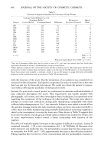
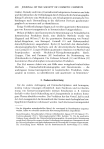
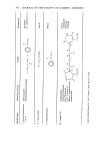
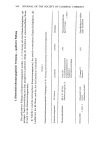
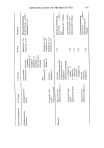
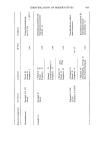
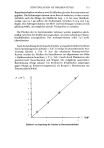
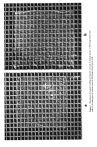
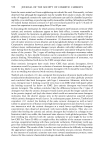
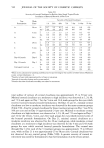
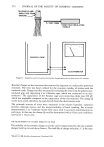
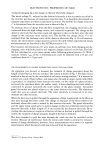
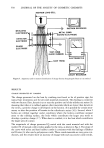
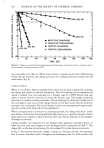
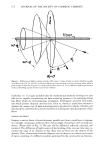
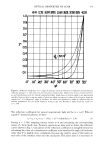
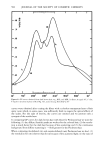
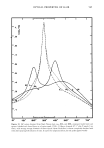
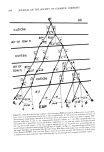
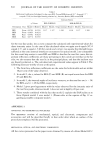
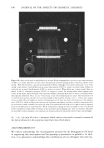
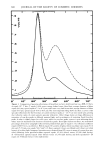
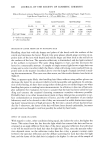
582 JOURNAL OF THE SOCIETY OF COSMETIC CHEMISTS R .6 .5 .4 ,3 .2 R I I,,,,,,,,,I,,,,,,,,,I I I I 0 ø 10 • 20 ø 30 ø 40 ø 50 ø 60 ø 0 • Figure 8. GP curves obtained from dark brown hair Es%, REL, and RER, 21 fibers, (3 equals 30 ø, 1 ø slits, T equals 1 (air alone in place ofF., of Fig. 5(b), center strung. Note EAP at 30 ø curves were obtained after coating the fibers with a colorless transparent layer of hair spray resin which, in some cases, was sufficiently thick to negate the optical effects of the scales. For the sake of brevity, the curves are omitted and we present only a synopsis of the results here. In comparing GP curves for dark brown hair with those for Piedmont hair we note the following: (1) the diffuse (farside) peaks are weaker for the colored hair (2) the resolu- tion is much better for the dark hair because of less scattering and (3) the continuous background from diffuse scattering is -4 fold greater for the Piedmont hair. When comparing medullated (m) and nonmedullated (nm) Piedmont hair we find: (1) the resolution for nm is better than for m because of less scattered light (2) the ratio of

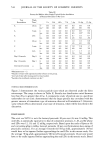
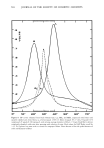
OPTICAL PROPERTIES OF HAIR 583 the intensities of the specular peaks (far side/near side) is -50 per cent greater for nm than for m because a relatively large fraction of the inward and outward bound rays in question suffer omnidirectional scattering by the medulla (3) the asymmetry of scat- tering (75/0 ø) is about 30 per cent greater for the nm fibers probably because the medulla diminishes the scattering from the scales on the far side and (4) the ratio of the scattering (0 and 75 ø) relative to the signal for the front specular peak is larger for the m fiber, -15 per cent at 0 ø, and -15 per cent at 75 ø . This extra scattering is as- cribed to the medulla. With regard to resolution, the order is blond (highest), gray, piedmont (nm), and pied- mont (m). The progressive loss is attributed to a progressive increase in scattering from the interiors of the fibers since a considerable degree of scattering persists even after the fibers are coated. It had been anticipated that the experiments performed with un- coated versus coated fibers would permit an evaluation of the relative amounts of scat- tering from the scales and from the interior. Unfortunately, only in the case of the gray fibers was the degree of encapsulation good enough to make such a determination. In the case of gray hair (& equals 30 ø, •s•s), 30 per cent of the scattering observed at 0 ø came from the scales (RER) and 44 per cent from the scales (REL). Thus, with gray hair fibers, more than 50 per cent of the scattering comes from the interiors of the fibers, and the same thing is true of blond hair and nonmedullated Piedmont hair. In the case of medullated Piedmont hair, it is estimated semi-quantitatively that -90 per cent of the diffusely scattered light comes from the interiors of the fibers! As will be seen in Part II of this paper, all fibers which have this large amount of diffuse scattering from the interior have lower values of luster. BLACK NAVAJO HAIR GP curves obtained from the hair of a young Navajo female (age 21) appear in Figs. 9 and 10. These fibers have an average diameter of 94/am, -50 per cent greater than any of the other fibers studied many of them are medullated some have a deep red- dish/brown color the scales are quite tight to the cortex, but the value of 0 is 4.75 ø, the largest we have ever measured. In the configuration eses (Fig. 9), only the front face peaks are seen because the deep color and greater path length essentially obliterate the rear-face peaks which do appear weakly in Fig. 10 (e•%). For fibers this dark, the mag- nitude of the diffuse scattering is high it was estimated that this arose from damage to the cuticle, and this was confirmed by SEM photographs. This diffuse scattering also lowered the luster value (see Table I, Part II) from the value (-0.9) which would be an- ticipated for hair of this color if the cuticle were in excellent condition. VALUES It is sometimes desirable to measure small changes in 0 (the angle of the scales relative to the axis of the fiber) produced by various hair treatments. As yet we have not at- tempted to make such measurements while the treatments were in progress but have been content to measure A0, the change in 0 before and after treatment with the hair being in equilibrium with our room conditions, 70( + 1)øF, 65( + 1) per cent RH. Be- cause of the hysteresis effect encountered in the wetting and drying of hair, it is not possible to have the hair taut during treatment since the tension values before and after
Purchased for the exclusive use of nofirst nolast (unknown)
From: SCC Media Library & Resource Center (library.scconline.org)