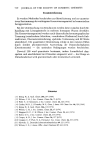
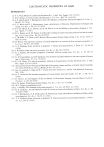
ELECTROSTATIC PROPERTIES OF HAIR 569 REFERENCES (1) F. A. Vick, Theory of contact electrification, Brit. J. Appl. Phys. Suppl. 2, S1-5 (1953). (2) D. F. Arthur, A review of static electrification, J. Text. Inst., 46, T721-34 (1955). (3) S. P. Hersh and D. J. Montgomery, Static electrification of filaments: Theoretical aspects, Text. Res. J., 26, 903-13 (1956). (4) S. P. Hersh and D. J. Montgomery, Static electrification of filaments: Experimental techniques and results, Text. Res. J., 25,279-95 (1955). (5) P.S. H. Henry, R. G. Livesey, and A.M. Wood, A test for liability to electrostatic charging, J. Text. Inst., 58, 55-77 (1967). (6) R. G. Barber and A.M. Posner, A method for studying the static electricity produced on hair by comb- ing, J. Soc. Cosmet. Chem., 10,236-46 (1959). (7) C. M. Mills, V. C. Ester, and H. Henkin, Measurement of static charge on hair, J. Soc. CoJmet. Chem., 7, 466-75 (1956). (8) D. Wilson, The electrical resistance of textile materials as a measure of their anti-static properties, J. Text. Inst., 54, T97-105 (1963). (9) V. E. Shashoua, Static electricity in polymers: I. Theory and measurement, J. Polym. Sci., 33, 65-85 (1958). 10) J. W. Ballou, Static electricity in textiles, Text. Res. J., 24, 146-5 (1954). 11) G. J. Sprokel, Electrostatic properties of finished cellulose acetate yarn, Text. Res. J., 27, 501-15 (1957). 12) N.H. Chamberlain andJ. B. Speakman, On the hysteresis phenomenon in the water uptake of human hair, Z. Elektrochem., 37, 374-75 (1931). (13) P.S. H. Henry, The role of asymmetric rubbing in the generation of static electricity, Brit. J. Appl. Phys. Suppl. 2, S31-6 (1953). (14) American Society for Testing and Materials, Electrostatic charge mobility on flexible barrier materials, Ann. Book ASTM Stand., Part 21, Method F 365-75T (1975). (15) See, for example, L. Page and N. I. Adams, Principles of Electricity, 3rd Ed., Van Nostrand, Princeton, N.J., 1958. (16) R. C. Landwehr, Electrostatic properties of corona-treated wool and mohair, Text. ReJ. J., 39, 792-3 (1969). (17) H. Gruner, An investigation of the mechanism of electrostatic charging of textile fibers, Faserforsch. Textiltech., 4, 249-60 (1953). (18) F. H. Steiger, Evaluating antistatic finishes, Text. Res. J., 27,721-33 (1958). (19) W. S. Tolgyesi, unpublished work. (20) J. A. Medley, The discharge of electrified textiles, J. Test. Inst., 45, T123-41 (1954). (21) D. A. Zaukelies, An instrument for study of friction and static electrification of yarns, Text. Res. J., 29, 794-801 (1959). (22) D.J. Montgomery, A. E. Smith, and E. H. Wintermute, Static electrification of filaments: Effect of fila- ment diameter, Text. Res. J., 31, 25-31 (1961). (23) V. E. Shashoua, Static electricity in polymers: II. Chemical structure and antistatic behavior, J. Polym. Sci., A, 1,169-87 (1963).

J. Soc. Cosmet. Chem., 28, 571-599 (September 1977) The optical properties of human hair I. Fundamental considerations and goniophotometer curves ROBERT F. STAMM, MARIO L. GARCIA, and JUDITH J. FUCHS Clairol Research Laboratories, 2 Blachley Road, Stamford, CT Received November 17, 1976. Presented Ninth IFSCC Congress, June 1976, Boston, MA. Synopsis By using a GONIOPHOTOMETER and linearly polarized parallel white light incident obliquely on planar arrays of parallel oriented taut HAIR FIBERS, the light scattered and specularly reflected from the fibers has been recorded as a function of the angle of observation and direction of polarization in the exit beam. It can be categorized as being: (a) reflected from the air-cuticle interfaces on the near side (white light), from the cuticle-air interfaces on the far side (colored light), and from an interface probably consisting of a discon- tinous wedge-shaped sheath of air parallel to the axis of the fiber or (b) scattered from optical imperfections which are principally on the surfaces of the fibers. Specular reflection from the front air-cuticle interfaces is independent of hair color and permits an evaluation of O (-3ø), the angle of inclination of the scales to the axis of the fiber. INTRODUCTION The optical properties of hair would include the refractive indices and birefringence of its various components, the color (hue, saturation, and brightness), diffuse reflectance, characteristic light-scattering patterns observed under various conditions of illumina- tion, luster, spectroscopic properties •electronic and vibrational), and more specialized data on surface properties obtained via ellipsometry and internal reflection spectroscopy. Structural data obtained by means of X-ray diffraction, electron mi- croscopy (EM), and NMR should be included, even though such techniques are nonoptical per se. In this paper, we are concerned primarily with studying the factors which determine the luster of hair. The topics to be discussed will be: scattering of light by infinite cylinders, reflection of light by dielectrics, and reflection and scattering of light by hair fibers. SCATTERING OF LIGHT BY INFINITE CYLINDERS An infinite cylinder is one whose length is infinite compared to its diameter. A dis- cussion of solutions to some of the problems already studied will be found in the text 571
Purchased for the exclusive use of nofirst nolast (unknown)
From: SCC Media Library & Resource Center (library.scconline.org)