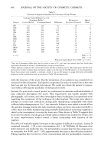
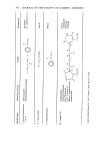
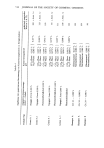
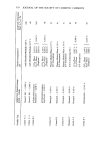
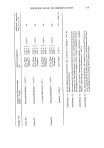
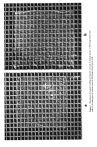
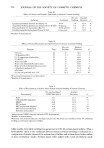
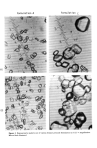
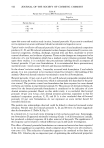
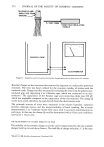
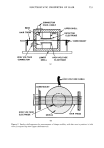
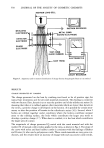
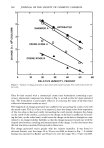
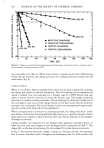
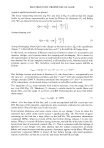
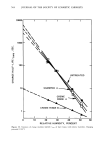
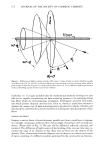
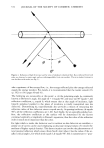
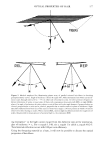
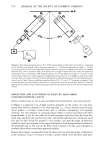
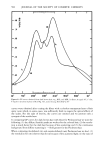
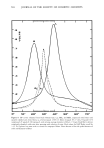
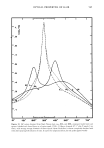
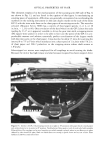
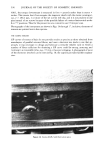
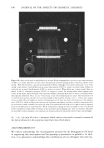
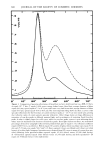
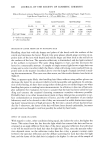
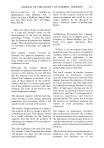
598 JOURNAL OF THE SOCIETY OF COSMETIC CHEMISTS Figure 18. One end of rack on which fibers are strung. While stringing fibers, this side is up when mounted on GP-2 it is down. Grooves in brass screw (foreground) establish spacing of fibers which are shown "wide strung." With 60 threads/in., rack can accommodate 63 fibers, although, we normally string only 21. In "wide strung" array shown, 9 central fibers are in every other groove (0.033 in. center-to-center) while 6 fibers on each side are in every fourth groove (0.067 in. center to center). When fibers are "center strung" they are placed in the 21 centermost grooves (0.0167 in. center to center). By placing fibers close together near center of the beam, signal strength is increased but diffuse scattering (from fiber to fiber) is increased more than specular reflection. Thus, we use "wide strung" array when obtaining luster values. The horizontal 3/16 in. shaft to rear has key-way slot over its entire length so that washers, having a 1/16 x 1/16 in. key, cannot rotate on shaft. One of washers is shown in foreground to left they are made of full hard no. 302 stainless steel (0.0125 in. thick) and have been ground on both faces at periphery and then tumbled so that when they are mounted on shaft, assembly has saw-tooth edge. Polycarbonate knife edge tool at right is used to separate adjacent washers prior to inserting fiber. Weak compression springs of equal strength on each end of each washer assembly provide sufficient friction to prevent fibers from slipping once they are mounted. Should it be desirable to relieve tension, each end piece can be moved inward to provide relief of 1 per cent of length (d0 o + d7so) in units of (volts x minutes) which can be converted to counts by means of the factor obtained in the separate experiment described above. ACKNOWLEDGMENTS We wish to acknowledge the encouragement provided by the Management of Clairol in supporting this investigation and for granting us permission to publish it. In addi- tion, it is a pleasure to acknowledge the contributions of our colleagues who aided us,

OPTICAL PROPERTIES OF HAIR 599 namely, N. Silver (electronics) R. Gleason, J. Del Bene, G. Boos, J. De Naples, and L. Labella (mechanical aspects) J. Epps (SEM) and E. Marsh (typist). REFERENCES (1) (2) (3) (4) (5) (6) (7) (8) (9) (10) (11) (12) (13) (14) (15) (16) (17) (18) Milton Kerker, The Scattering of Light and other Electromagnetic Radiation, Academic Press, New York, 1969, Pp. 255-310. J. L. Lundberg, Light scattering from large fibers at normal incidence,J. Colloid Interface Sci, 29, 565-85 (1969), cf. P. H. Harris, Ref. (10). H. M. Presby, Refractive index and diameter measurements of uriclad optical fibers, J. Opt. Soc. Amer., 64, 280-84 (1974). J. W. Y. Lit, Radius of uncladded optical fiber from back-scattered radiation pattern,J. Opt. Soc. Amer., 65, 1311-15 (1975). D. Marcuse, Light scattering from elliptical fibers, Appl. Opt. 13, 1903-4 (1974). D. Marcuse, Light scattering from uriclad fibers: ray theory, Appl. Opt., 14, 1528-32 (1975). H. M. Presby, and D. Marcuse, Refractive index and diameter determinations of step index optical fibers and preforms,Appl. Opt., 13, 2882-5 (1974). L. S. Watkins, Scattering from side-illuminated clad glass fibers for determination of fiber parameters, J. Opt. Soc. Amer., 64, 767-72 (1974). R. G. G. Goodson and D. M. Jones, British Patent Number 1,094,297 (1967) 10 claims. P. H. Harris, Comment on light scattering from large fibers at normal incidence, J. Colloid Interface Sci., 32,371 (1970). L. J. Lynch, and N. Thomas, Optical diffraction profiles of single fibers. Text. Res. J., 41, 568-72 (1971). L. J. Lynch, A study of the relationship between geometry and light scattering profiles of single wool fibers, Text. Res. J., 44,446-8 (1974) 203-5 (1974). F. A. Jenkins and H. E. White, Fundamentah of Physical Optics, McGraw-Hill New York, 1937 (4th ed., 1975). Max Born, and Emil Wolf, Principles of Optics, Macmillan Co., New York, 1959. Marion Den Beste and Alan Moyer, An Instrumental description and classification of natural hair color, J. Soc. Cosmet. Chem. 19, 594-609 (1968). R. D. B. Fraser, Birefringence and elasticity in keratin fibers, Nature, 172,675-6 (1953). A. R. Haly and O. A. Swanepoel, The physical properties of wool fibers at various regains, Part V: The nature of birefringence, Textile Res. J, 31,966-72 ( 1961). Heinz Loof, Goniophotometry with the Zeiss GP-2,J. Paint Technol., 38,632-9 (1966).
Purchased for the exclusive use of nofirst nolast (unknown)
From: SCC Media Library & Resource Center (library.scconline.org)