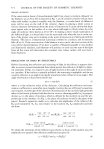
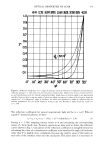
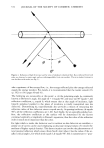
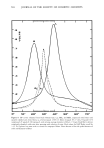
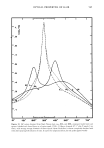
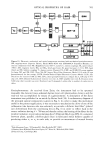
LUSTER OF HAIR FIBERS 603 countered when using normal incidence and incident light linearly polarized with parallel to the axis of the fiber. For human hair, there are large variations in color and size among fibers even when obtained from 1 head, so measurements of the luster of single fibers would not have the statistical significance required. For these reasons, the method was abandoned. THE METHODS EMPLOYED FOR MEASURING THE LUSTER OF HAIR Starting with the qualitative definition of luster given in (2), we make it quantitative by saying that luster is given by the rate of change of the intensity of specularly reflected light with the angle of observation when employing a fixed angle of incidence. This concept was investigated using unpolarized incident light as well as the configuration • • (see Fig. 2, Part I for notations used). The slopes measured on the goniophotometer (GP) curves were those on each side of the specular peak from the front face. It was found that the method did not provide a large spread in values among different kinds of hair, and that the precision was not good enough. Thus, at present, we use this ap- proach only when other methods are not appropriate (which happens occasionally). For hair, the spot values for s (specular reflection) and d (diffuse scattering) are ob- tained from GP curves at the top of the front-face specular peak and from the back- ground value at 0 ø. These are tabulated as well as values of gc =(s-d)/s where we em- ploy lower case letters to designate spot values versus capital letters for integrated values. We find for various kinds of hair that the function gc has high precision, but has only a narrow range of values. From the recorded GP curve, we obtain directly the integrated area between the curve and the baseline. This area we take to be (S + D) the sum of the specular reflection and diffuse scattering. We "draw" an imaginary line between the ordinate values at 0 ø and 75 ø , the extreme limits of the angular region scanned, and assume that the area between this line and the baseline is D, the diffuse scattering. Knowing (S + D) and D, we obtain S by taking the difference and can then evaluate the function for luster Luster = G• = (S-D)/S (5) For the angular interval scanned (0 ø to -75ø), we find the highest precision to be ob- tained when the slope of this imaginary line is a minimum, i.e., when the spot values at 0 ø and -75 ø are most nearly equal, and this condition obtains when we employ the configuration •s•s, the orientation root ends right (RER), and 4) equals 30 ø. For hair fibers possessing the wide variety of colors and diameters encountered in nature, this function yields values ranging from as low as 0 for damaged bleached hair to as high as 0.85 for very dark brown hair in excellent condition. Twenty-one fibers are used per stringing, and 3 stringings are used per evaluation. This procedure yields luster values with a precision of - 2.5 per cent of the mean value at a 90 per cent confidence level. (This is equivalent to a o- value of _ 1.5 per cent of the mean value.) The time required to check the orientation (finger tip test) and to mount 21 fibers is 15 rain after which the GP curves can be obtained immediately. The time required to run 1 GP curve is 15 rain, and duplicate curves are obtained for each stringing. Processing the data from 2 curves requires an additional 20 min so the total elapsed time needed at present for a luster measurement involving 3 stringings and 6 curves is - 3.25 h. (The instrument does not have to be tended while the curves are being traced.) We get enough light from 15 fibers but actually string 21 fibers to achieve results having greater statistical

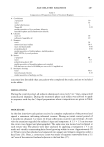
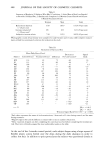
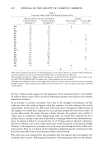
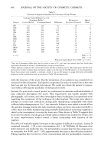
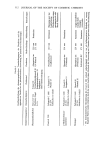
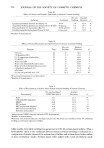
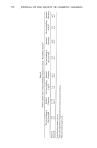
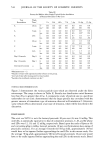
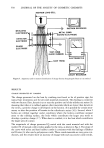
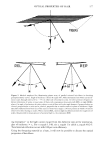
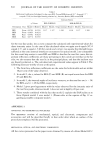
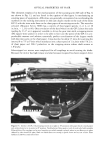
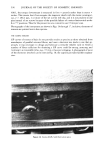
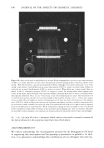
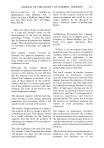
604 JOURNAL OF THE SOCIETY OF COSMETIC CHEMISTS Table I Values Found for 3 Different Luster Functions Pertaining to Various Types of Hair and Precision Achieved at the 90 Per Cent Confidence Level Expressed as a Per Cent of the Mean Value. (All Luster Measurements made from Wide Strung Fibers.) (S - D)/S (s - d)/s S/D Very dark brown 0.85 0.97 6.7 Medium brown 0.80 0.96 5.0 Light brown 0.74 0.93 3.8 Blond 0.73 0.94 3.7 Nonmedullated piedmont 0.70 0.90 3.4 Ash blond 0.68 0.91 3.1 Gray 0.60 0.89 2.5 Navajo, black a 0.56 0.89 2.3 Medullated piedmont 0.25 0.76 1.3 Excessively bleached b --0 -0.75 - 1.0 L(90) -+2.5% -+0.7% -+7.5% allair fibers had diameters -90/-tm and were damaged if in good condition (S - D)/S should be -0.90 (estimated). t'Also damaged. significance. Also, the GP curves could be obtained in half the time, but there are certain mechanical problems which preclude this at present. In addition to the functions (S-D)/S and (s-d)/s, we also tabulate values for the ratio S/D from integrated values and find this to be of interest. The range of values for these functions found for several different colors of hair are given in Table I. The values in Table I show that (s-d)/s has high precision but poor sensitivity S/D has a fairly good range of values but poor precision (S-D)/S has a good range of values and a precision that is high enough for the method to be valuable in making assess- ments of the luster of hair by an objective instrumental method. VISUAL ESTIMATES OF LUSTER It is both desirable and necessary to demonstrate that significant changes in luster, which are detectable instrumentally, can also be detected visually even by unskilled ob- servers. For making visual estimates of luster we employ a 150 W xenon arc 0• in a lamp house provided with condensing lenses having apertures of 3 in. The lamp is placed near the ceiling on a shelf on 1 wall so that the optic axis is about 12 in. below the ceil- ing. The beam is slightly divergent, and after traveling horizontally a distance of- 12 feet is intercepted by a fiat mirror, which directs the beam downward vertically. At a distance of 2.5 ft below the center of the mirror, the beam encounters the sample which is at eye level for an individual (5 ft-10 in.) who is standing. (The vertical height of the sample can be adjusted to suit the height of the viewer.) The angle of incidence relative to the perpendicular to the plane of the sample is adjustable and normally is set at 60 ø. Samples are mounted in pairs side-by-side separated only by a narrow strip of dull black paper, and are viewed from a distance of 10 ft. The fibers are mounted with their root ends up, and at the viewing distance employed, only diffuse scattering is vlsi- •Type X 150S-2008. Illumination Industries, Sunnyvale, CA.
Purchased for the exclusive use of nofirst nolast (unknown)
From: SCC Media Library & Resource Center (library.scconline.org)