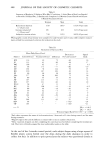
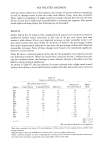
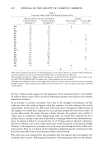
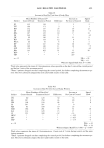
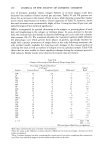
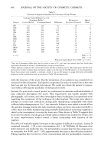
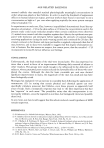
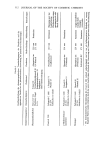
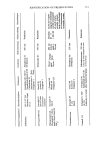
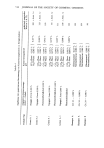
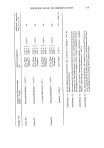
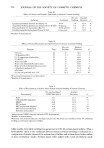
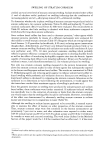
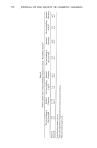
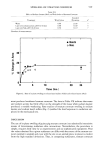
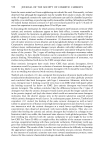
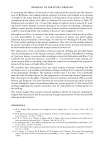
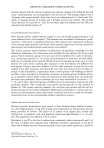
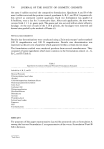
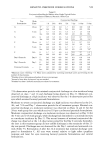
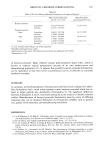
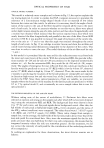
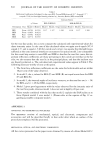
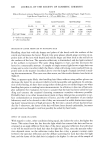
BENZOYL PEROXIDE FORMULATIONS Table XI Effect of Per Cent Benzoyl Peroxide Treatment on Cutaneous Bacteria d 547 Mean Number Bacteria/ cm 2(N = 16 to 19) Mean Free Fatty Acid Control Per Cent Before treatment Anaerobes a 6.6123b-+0.1107 • Aerobes 4.8751 +0.1392 Treatment period 3 days Anaerobes 4.8813 +0.1768 Aerobes 3.8308 -+0.2010 7 days Anaerobes 4.8476 +0.2046 Aerobes 3.7820 -+0.2661 14 days Anaerobes 4.2918 +0.2649 Aerobes 3.5116 -+0.2455 27.25-+1.60 16.73-+0.99 14.30+1.16 11.62+1.72 aC. acnes comprise about 98 per cent of the anaerobes. bNumbers expressed as log•0 values. %tandard error of the mean. All treatment period vlaues are significant at P 0.001. dAnderson et al. (10). of benzoyl peroxide. Many vehicles contain polyoxethylene lauryl ether, which is known to enhance topical preparations because of its own surface-active and desquamating properties (11). It appears that possibly benzoyl peroxide formulations can be optimized so that even lower concentrations can be as effective as currently marketed strengths. SUMMARY In summary, several formulations of benzoyl peroxide have been evaluated for safety. One formulation had a trend toward greater ocular irritation potential which was re- lated to larger particle size distribution (formulation C). No significant difference between formulation A and C was found among the acute toxicity or dermal irritation studies. Manufacturers of benzoyl peroxide formulation must be aware of differing responses that can be obtained dependent on formulation variables such as particle size, quality of raw materials, and manufacturing conditions. REFERENCES (1) A.M. Kligman, O. H. Mills, K. J. McGinley, and J. J. Leyden, Acne therapy with retinoin in combina- tion with antibiotics, Acta Dermat vereo/. (Stockholm) SuppL, 74, 111-5 (1975). (2) R. Carruthers, Acne vulgaris: pathogenisis and treatment. Drugs, , 217-23 (1974). (3) O.J. Lorenzetti, T. Wernet, S. Gregg, B. Britton, T. McDonald, M. Ready, and R. Puckett, Biological profits of benzoyl peroxide formulations, Pres. Int. Fed. Soc. Cosmet. Chem., June 6, Boston, MA (1976). (4) R. Puckett, O. J. Lorenzetti, and M. Wrinkle. The determination of benzoyl peroxide in a cream formulation, SCC/AOAC Syrup. Cosmetic Analytical Techniques, Oct. 18, Washington, D.C. (1976). (5) D.J. Finney, Probit Analysis, 3rd ed., University Press, Cambridge, England, (1971).

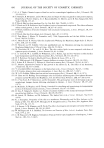
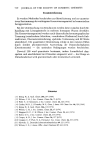
548 JOURNAL OF THE SOCIETY OF COSMETIC CHEMISTS (6) J. H. Draize, Dermal toxicity, Food-Drug-Cosmet. LawJ., 10, 722-32 (1955). (7) H. A. Baldwin, T. O. McDonald, and C. H. Beasley, Slit-lamp examination of experimental animal eyes II. Grading scales of photographic evaluation of induced pathological conditions. J. Soc. Cosmet. Chem., 24, 181-95 (1973). (8) W. S. Spector, Handbook of Toxicology, Vol. I, Acute Toxicities, W. B. Saunders Co. Philadelphia, 1956 (9) C. S. Weil and R. A. Scala, Study ofintra- and interlaboratory variability in the results of rabbit eye and skin irritation tests, Toxicol. Appl. Pharmacol., 19, 276-360 (1971). (10) A. S. Anderson, G. J. Goldye, R. C. Green, D. W. Hohisel, and E. P. Brown. Improved reduction of cutaneous bacteria and free fatty acids with new be nzoyl peroxide gel, Cutis, 16, 307-! 0, (! 975). (11) W. A. Ritschel, Sorption promoters in biopharmaceutics, Angew. Chem. Internat. Edit., 8, 699-710 (1969).
Purchased for the exclusive use of nofirst nolast (unknown)
From: SCC Media Library & Resource Center (library.scconline.org)