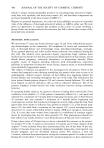
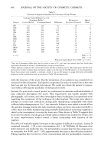
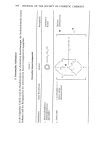
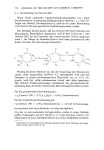
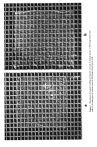
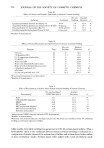
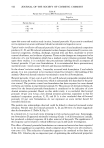
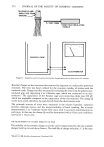
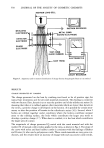
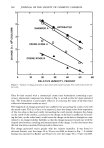
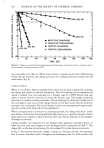
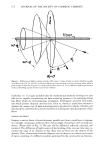
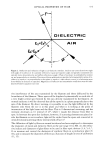
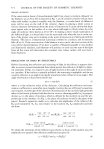
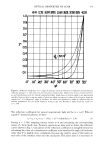
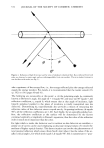
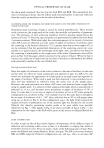
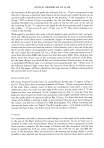
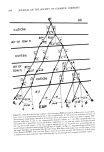
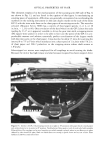
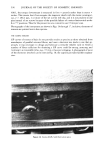
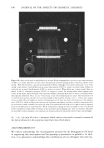
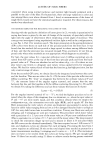
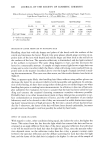
576 JOURNAL OF THE SOCIETY OF COSMETIC CHEMISTS i o Figure 4. Reflection of light from near and far sides of idealized cylindrical fiber. Rays reflected from both sides are observed at same angle and are indistinguishable from one another. This is in marked contrast to case for fibers with scales (see Fig. 5.) take cognizance of the energy flow, i.e., the energy reflected plus the energy refracted equals the energy incident. For details, it is recommended that the reader consult (13) (p. 392) or (14) (pages 40 and 41). The following are noteworthy at this point: a. At the polarizing angle 0B commonly known as Brewster's angle, the angle (0 + r) equals 90 ø, and since tan 90 ø equals % the reflection coefficient, rp equals 0, which means that at that angle of incidence, light linearly polarized parallel to the plane of incidence is totally transmitted into the dielectric. Determining 0B experimentally also provides a means of measuring the refractive index of the dielectric since n equals tan 0•. At grazing incidence (0 equals 90ø), all the reflection coefficients are 1.00. And finally, for an optically polished sur- face, the reflection coefficient at the surface will be determined by the factors contained explicitly or implicitly in Fresnel's equations thus the value of the refractive index is much more important than the color. For light which is inside the dielectric and is incident on the dielectric-air interface, a similar set of curves can be used employing as abscissae integral values of r (inside the medium of higher optical density). This latter situation can involve the phenomenon of total internal reflection which arises (from Snell's law) when r has the value of the so- called critical angle rc for which sin0 equals 1,0 equals 90ø this is tantamount to "graz-

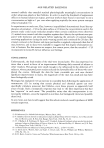
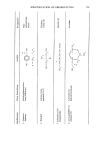
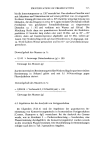
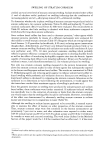
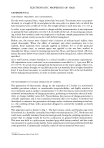
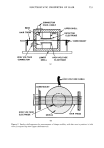
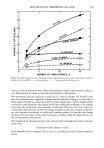
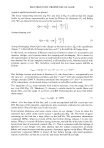
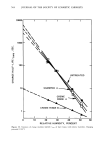
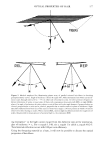
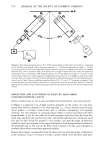
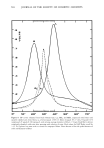
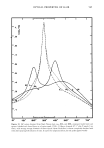
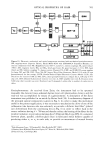
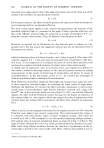
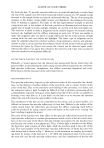
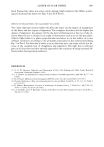
OPTICAL PROPERTIES OF HAIR 577 FIBERS' REL .......... 'f ................ Figure 5. Method employed for illuminating planar array of parallel oriented hair fibers in obtaining goniophotometer curves. Angle of incidence is fixed (0 equals 30ø), while mechanized arm which carries de- tector scans through interval (0 to -75 ø) on other side of normal to array. In lower portions of figure are shown inclinations of scales on near sides of fibers with orientations [root-ends-left (REL) or right (RER)], where 0 is angle of inclination of scales relative to axis of fiber and is also angle between 2 perpendiculars, •r0 (dotted, perpendicular to axis) and •r• (dashed, perpendicular to cuticle surface in plane of incidence). Light specularly reflected from front face of the cuticle is observed at angle --- 2 0 from position at which it would be observed for fiber having no scales. When oriented REL, incident light rays illuminate directly rough ends of scales this generally increases amount of scattered light vs. the orientation RER ing emergence" so the light cannot escape from the dielectric into air for internal an- gles of incidence • re. For n equals 1.548, sin rc equals 1/n yields r• equals 40.24 ø. Total internal reflection occurs with 100 per cent efficiency. Using the foregoing material as a base, it will now be possible to discuss the optical properties of hair fibers.
Purchased for the exclusive use of nofirst nolast (unknown)
From: SCC Media Library & Resource Center (library.scconline.org)