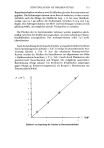
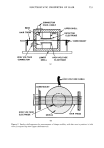
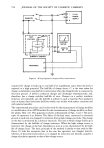
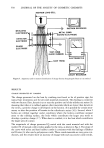
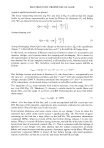
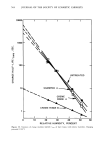
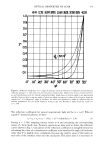
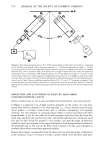
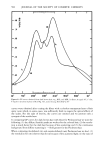
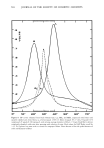
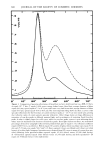
LUSTER OF HAIR FIBERS 605 ble from the hair. To provide specular reflection, an artificial high-light is created near the top of the sample over the entire horizontal width by means of a 10 ø angular wedge fastened to the sample holder and placed underneath the hair. The act of mounting the samples on the holder creates slight tension and alignment this enhances the possi- bility of making a judgment. The light on the hair approximates sunlight in spectral composition and, at the surface of the hair, provides an illumination level about one- eighth that of bright noonday sunlight. Samples are viewed with the room lights out. The observer is asked to make a judgment on the relative degrees of contrast existing between the highlight and the diffuse scattering on each side. If they are unable to make this judgment they are asked to judge which side has the lesser amount of light coming from the dark area below the highlight. The latter type of judgment can be made by unskilled observers (clerical workers, shop mechanics, visitors, and adminis- trators) so that it can be said that the enhanced luster of hair treated with an agent that increases the luster by 20-per cent versus the control can be detected quite easily, whereas the effect of an agent that enhances the luster by only 5 per cent can also be detected visually but with greater difficulty. FACTORS WHICH INFLUENCE THE LUSTER OF HAIR Optically, it would appear that the physical and geometrical factors which have the greatest effect in determining the luster rating of unmodified human hair are as follows: high specular reflectivity, straightness, low diffuse scattering, alignment and color. These factors will be discussed in the order listed above. SPECULAR REFLECTIVITY The specular reflectivity depends on the refractive index of the exocuticle, the cleanli- ness, on the absence of surface defects of the exocuticle, and to a lesser extent on the color of the hair. Due to the extensive cross-linking of the exocuticle, it is dense, and the refractive index is high. It might be difficult to find a substance possessing all the compatabilities required, having an index higher than that of the cuticle, yet capable of forming a very thin film (• 0.1 /zm thick) on the hair so as to increase the specular reflectivity and still retain the optical effect of the scales. The cleanliness of the hair can be controlled by the owner, and, as stated earlier, it is difficult to increase the specular reflectivity of clean hair. Defects in the surface of the cuticle would lower the reflectivity and increase the diffuse scattering. Such defects could be produced by using a metal comb with burrs on the teeth or by "teasing" the hair (combing it against the grain). The color of the hair has very little effect on the specular reflectivity because the prin- cipal specular reflection is a surface phenomenon which occurs at the air-cuticle inter- face on the near side of the fibers (the side initially encountered by the incident rays) and because the cuticle is not pigmented. Thus, if white light is incident on the fibers, the front-face peak consists of white light, while the rear-face peak is the color of the hair. The near equality of the front-face specular refiectivities of blond hair and very dark brown hair is shown in Fig. 1. However, in the treatment we employ for evaluat- ing luster by means of the function L = (S-D)/S, the integrated value $ is the sum of the near-side and far-side specular refiectivities, and the contribution of the far-side

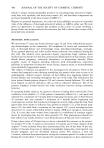
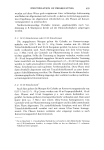
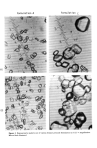
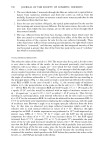
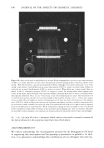
6O6 JOURNAL OF THE SOCIETY OF COSMETIC CHEMISTS I I''""'"1'" '""'1 I I --.9 -- --.7 --.6 I ! \ % ! \ -.5 I / \ ! \ --.4 --.3 --.2 0 ø 10* 20* 30* 40* 50* 60 ø 70 ø Figure 1. Comparison of specular reflectivities of blond hair and very dark brown hair. •, RER, 21 fibers, & equals 30 ø, 1 ø slits, T equals 0.168, center strung dashed curve: blond hair, average diameter of fibers equals 64.0 •m, spread equals 47.2 to 87.6 •m solid curve: very dark brown hair, average diameter of fibers equals 65.8/•m, spread equals 49.9 to 89.4 Fm. The most important thing shown by these 2 curves is that specular reflectivities for the front-face air-cuticle interfaces (peaks at - 24.5 ø) are very nearly same, proving that refractive index of cuticle governs specular reflectivity. Other things shown are large differences in intensities of rear-face peaks in diffusely scattered light, and in asymmetry of scattering. From front-face peaks, 0 value is slightly larger for solid curve, while for rear-face peaks, reverse is true indicating that 0 values must be measured from locations of front-face peaks. From light incident on fibers, we ascertained percentage detected by using light reflected from polished black glass (, equals 1.515, reflection coefficient equals 0.06035 for •) as reference. With & equals 30 ø, pattern of light at fibers was ellipse (axes equal 29.16 mm and 25.53 mm, area equals 584.7 mm=). 21 fibers captured 6.6 per cent (blond) and 6.8 per cent (dark brown) of incident light. Integrated intensities were obtained from GP curves in terms of counts these pro- vided following: front specular/incident captured equals 1/2,564 (blond) versus 1/2,500 (dark brown) (S + D)/incident captured equals 1/923 (blond) versus 1/1,544 (dark brown) and front specular/(S + D) equals 1/2.78 (blond) versus 1/1.62 (dark brown)
Purchased for the exclusive use of nofirst nolast (unknown)
From: SCC Media Library & Resource Center (library.scconline.org)