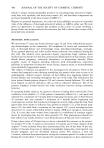
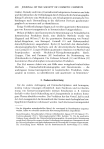
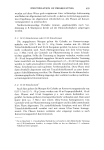
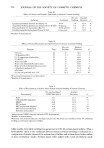
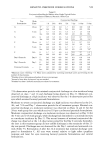
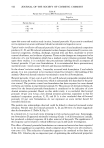
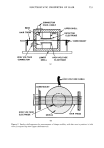
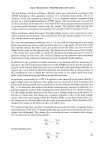
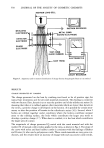
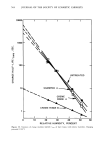
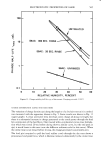
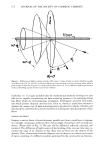
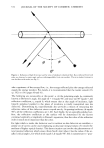
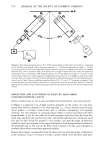
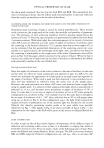
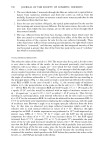
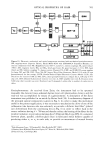
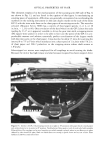
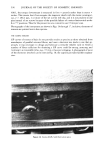
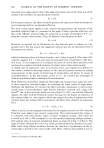
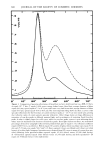
ELECTROSTATIC PROPERTIES OF HAIR 553 CONNECTOR COAX-CABLE WIRE UPPER SHELL :TOR •)DE COMB MOUNT HIGH VOLTAGE LOWER HIGH VOLTAGE CONNECTOR SHELL EL ECTRODE (a) VOLTAGE CABLE HIGH VOLTAGE ELECTRODE (b) Figure 2. Faraday shell apparatus for measurement of charge mobility, with hair tress in position: (a) side view (b) exposed top view (upper shell removed)

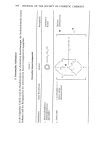
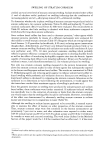
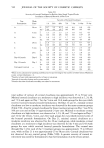
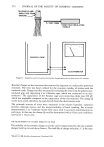
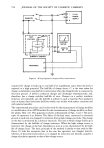
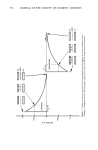
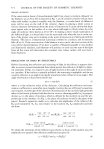
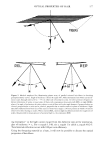
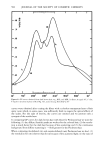
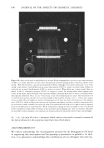
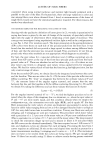
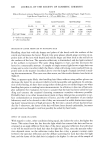
554 JOURNAL OF THE SOCIETY OF COSMETIC CHEMISTS 20 MEG • TEST .i.•..•,,,• --I I I i __ I I_- I HUMIDITY CABINET RECORDER • + ELECTRO- METER ZERO (•) O- SW. 0 2.1 KV POWER SUPPLY Figure 3. Wiring diagram for charge mobility measurements required for charge to build up to one-half of its equilibrium value when the body is exposed to a high potential. The half-life of charge decay, r I•, is the time taken for charge to diminish to one-half of its initial value when the charged body is connected to electrical ground. A perfect conductor charges and discharges instantaneously, and, therefore, has a charge mobility half-life of zero. Charges on a perfect insulator, however, are immobile, and the half-life is infinite in such a material. Poor insulators such as human hair have finite half-lives which vary widely with surface condition and with relative humidity. The experimental procedure used in this work for the measurement of charge mobility is a modification of an ASTM method for the determination of charge mobility on flexi- ble plastic films (14). The apparatus is shown schematically in Figs. 2 and 3. The prin- ciple of operation is as follows. The fibers of the hair tress, connected to electrical ground at each end, are charged by induction from a high voltage electrode. The charge on the hair is monitored by a detector electrode. The rate at which charge builds up is characterized by the half-life of charge induction. When the high voltage source is removed, the charge on the hair diminishes to zero at a rate characterized by the half- life of charge decay. The basic principle of the method is similar to that used by Sha- shoua (9) with the exception that in his case the specimen was charged directly, whereas, in the present procedure, it is charged by induction and thereby, acquires a charge of polarity opposite to that of the voltage source.
Purchased for the exclusive use of nofirst nolast (unknown)
From: SCC Media Library & Resource Center (library.scconline.org)