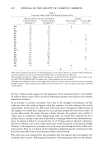
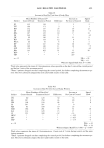
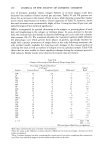
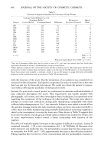
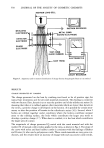
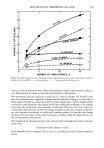
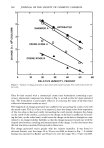
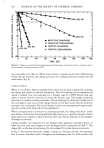
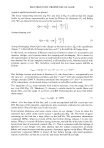
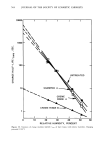
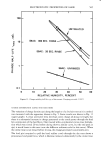
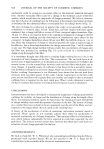
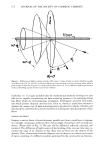
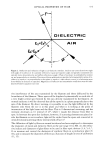
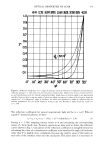
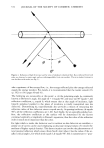
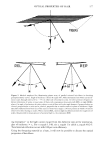
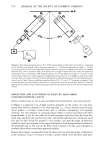
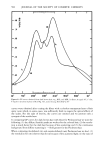
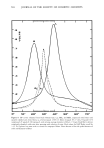
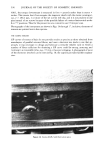
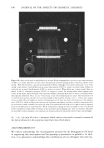
LUSTER OF HAIR FIBERS 609 black Navajo hair, there was some cuticle damage which enhanced the diffuse scatter- ing and decreased the luster (see Figs. 9 and ! 0 of Part I). EFFECTS OF STRAIGHTNESS AND ALIGNMENT ON LUSTER Two other important factors which will affect the luster are the degree of straightness of the fibers and the degree of alignment. The straighter the fibers and the higher the degree of alignment, the greater will be the level of illumination at the eye of the ob- server when the eye is situated at an angle of observation such as to see the specularly- reflected light either in a plane (perpendicular incidence) or on the surface of a cone (oblique incidence) according to the principles enunciated in the material describing Fig. 1 in Part I. For hair that is kinky as in an Afro hair style, the luster will be low be- cause of the complete lack of straightness and alignment. The light that is reflected goes in all directions and thus virtually approaches the condition of being scattered dif- fusely rather than specularly-refiected. REFERENCES (1) V. G. W. Harrison. Definition and Measurement of Gloss, The Printing and Allied Trades Research Association, Cambridge, England, (1945). (2) J. S. Christie. An instrument for the geometric attributes of metallic appearance, Appl. Opt., 8, 1777-85 (1969). (3) R. S. Hunter. Methods of determining gloss (RP958),J. Res. Nat. Bur. Stand. 18, 19-39 (1937). (4) Dorothy Nickerson. a New cotton lustermeter for yarns and fibers. Textile Res. J., 27, 111-23, Table I, p. 112 (1957). (5) R. Jeffries. Measurement of extent of delustering of filament fabrics, J. Textile Inst., 46, T391-99. T759-77 (1955) 47, T319-28 (1956). (6) L. E. Holboke and L. P. Berriman. A study of the effect of cotton fiber structure on luster, Textile Res. J., 33,205-17 (1963).

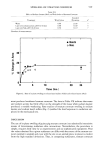
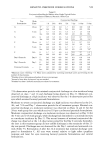
Letters to the Editor Sir: Yin et al. (1) have provided an interesting and useful contribution describing the role of fiber diameter in various "use" properties of hair masses. This letter suggests that certain morphological or physical considerations, also diameter related, might help to extend the understanding of their results. The authors assume their hair fibers to be uniformly circular in cross-section having "no reason to assume that the sized fiber groups separated from a homogeneous hair mass had widely different cross-sectional shapes." It is possible to explain the unex- pected combing test results--coarser hair being found harder to comb than finer--if it is assumed that the coarser fibers are more elliptical and the finer ones rounder. With this picture, the thicker elliptical fibers pack more densely into the spaces between the comb teeth, since the preferred orientation of the hairs would be with the major axis parallel to the comb teeth. Accordingly, the frictional forces would be greater, consistent with the reported combing data. That cross-sectional ellipticity increases with hair diameter is supported by the observations of Fourt (2) who found coarse hairs to exhibit major:minor axis ratios roughly 20 per cent smaller than fine fibers from the same head. Additionally, one of the authors suggests (3) that with the ellipticity pattern suggested above, the bending moment of the hair would depend on the minor-axis dimension, rather than on the average diameter. Thus, the expected differences in the facility of separation of crossed-over entangled fibers ahead of the comb would be minimized as between coarse and fine hair. The superior set holding reported for coarse hair versus fine hair shows a diameter relationship, although, not one comfortably in the range of a fourth power dependency with diameter, as implied. The ratio of set retentions of the coarsest to finest tresses (at 100 min) is approximately 1.6, while the fourth power diameter ratios are ap- proximately 3.5. Furthermore, while bending and torsional forces are involved in set- holding, implying a fourth power dependency with diameter is not appropriate, since the deformations are not elastic in character. For viscous behavior in a time-dependent process like set relaxation, creep compliance is more likely the relevant kind of physical deformation. Interestingly, the rate of creep in torsion has been shown (4) to be roughly twice as great in fine hair fibers as in coarse hairs from the same head. Herman Bogaty Herman Bogaty Consulting 22 Glen Brook Crest Drive Short Hills, New Jersey 07078
Purchased for the exclusive use of nofirst nolast (unknown)
From: SCC Media Library & Resource Center (library.scconline.org)