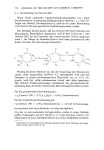
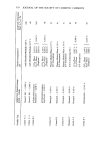
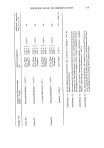
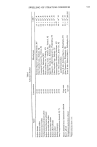
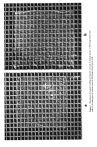
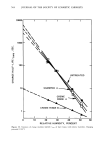
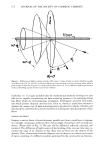
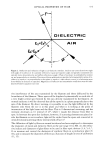
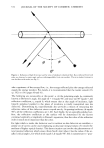
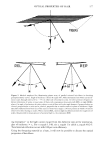
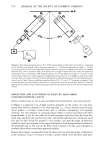
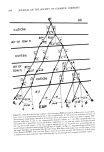
59O 1. JOURNAL OF THE SOCIETY OF COSMETIC CHEMISTS The rays which make 2 traversals through the fiber are subjected to optical distur- bances from numerous interfaces and from the cortex (as well as from the medulla, if present) and have to traverse a much more tortuous path than do the rays reflected from the front face. Since the rays are incident obliquely, the optical paths employed by the rays for the incoming and return trips are different. For the same reason, the scales on the near side, from which the rays emerge, are not the same as those through which they entered initially. The rays reflected from the front face diverge, whereas those which enter the fiber are caused to converge by the cylindricaMens effect of the fiber and by the focusing action of the concave far side for the rays reflected internally. Thus, other than losses suffered from scattering and absorption, the light which enters the fiber is "conserved," and this may explain why the integrated intensity of the rear face peak is greater than that of the front face peak in the case of "colorless" hair which is nonmedullated. TOTAL INTERNAL REFLECTION The refractive index of the cuticle is 1.548. The mean value for np and ns for the cortex is very close to the index of the cuticle. As was discussed previously, total internal reflection will occur when rc equals sin -• (I/n) which for hair would yield rc equals 40.24 ø, where rc is the critical angle. Using Fig. 12 we attempt to find the angle of inci- dence required to produce total internal reflection at an interface leading to a ray which could emerge and be observed. In the case of the Zeiss GP-2, the maximum value for the angle of incidence achievable is 75 ø , and it can be shown that for rays traveling in the principal plane of Fig. 12, this could not lead to total internal reflection for orienta- tions P_EL or tLER. In the case of model 1 in Fig. 11, the internal angle of incidence relative to •'2 (the perpendicular to the scales on the far side) is (r + 2 0) for tLER and (r - 20) for P_EL For the orientation tLER and with 0 equals 2.5 ø, (r + 20) equals r• for r equals 35.24 ø, and this would be achieved with an angle of incidence versus •'• of (0 - 0) equals sin -• (n sin 35.24 ø) = 63.3 ø or with 0 = 65 .80 versus •'0. Thus, for rays traveling in a principal plane, total internal reflection at the far side could occur with 0 4:65.8 ø for the orientation tLER. It could not be achieved for the orientation REL. In 1973 we performed some experiments employing the configuration %% with the angle of incidence near Brewster's angle so as to negate specular reflection from the front face. At that time we observed very large reflected intensities which could be at- tributed only to total internal reflection at values of 0 • 61ø. However, this light emerged as an EAP. A similar experiment was performed in 1975 with improved ap- paratus (%%, tLER, 0 = 50 to 70 ø by 1 ø steps), and the EAP was the principal component for values of 0 • 55 ø. As 0 was increased above 55 ø, the EAP signal increased from 0.74 V (0 equals 55 ø) to 5.1 V (0 equals 70ø) meanwhile, the peak value of the fa side peak decreased steadily for'values of 0 • 58 ø- These results indi- cate that the EAP orginates from internal reflection which probably does not involve the external faces of the far side scales, since the far side peak became progressively weaker as the EAP became stronger. This occurred because the incoming rays en- countered the interface which produces the EAP before they reached the scales on the far side, i.e., the EAP got its hand in the till first.

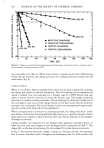
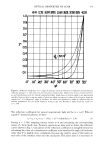
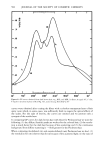
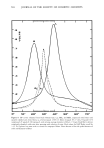
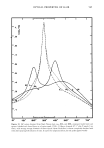
OPTICAL PROPERTIES OF HAIR 591 It would appear that the interpretation of such experiments and the determination of an acceptable optical model for hair will not be gained until we employ a single fiber (preselected) with a circular cross-section, and a low power laser as a source of monochromatic light. ELLIPTICAL POLARIZATION FROM INTERNAL REFLECTION AND THE EFFECTS OF SKEW RAYS It has been shown that when the incident light is linearly polarized (•s) perpendicular to the plane of incidence we obtain signals from specular reflections when the second Po- laroid disc is crossed (%) with the first one. (It was demonstrated in a separate experi- ment that this could not be attributed to defects in the discs.) This means that changes in the direction of linear polarization have occurred either on reflection or on entering and leaving the fibers. These effects are caused by: elliptical polarization produced by internal reflection, and by changes in the direction of orientation (azimuthal angle) of the electric vector (•s) of the incident light on entering and leaving the fibers when the rays are not in the principal plane depicted in Figs. 11 and 12. (Details on these two items can be found in Sects. 18.3 (p. 394) and 18.4 (p.396) of (13). The effect from elliptical polarization will occur even for rays in the principal plane regardless of the diameters of the fibers. Thus, incident rays polarized •s enter the fiber in the principal plane and undergo internal reflection at the cuticle-air interface on the far side. After the internal reflection occurs, the light is not longer linearly polarized and now has a sizeable component % at right angles to •s. Next we consider those rays (parallel to the principal plane) which encounter the curved sides of the fibers. The plane of incidence is defined by the ray and the perpen- dicular to the interface. Once the ray moves out of the principal plane, the perpendi- cular to the interface is no longer in the principal plane. Thus, as the incoming rays move farther and farther out of the principal plane, the plane of incidence is shifted more and more, and this alters the direction of linear polarization of the incident light. The extent to which the azimuthal angle is altered by a given departure from the prin- cipal plane will be governed by the radius of curvature of the fiber. Thus, the smaller the fiber, the greater the change. Skew rays are those which enter the fiber out of the principal plane and, by some means, get back into the principal plane (or nearly so) after multiple internal reflec- tions. Ray tracing for such rays is possible only when the fibers have circular cross-sec- tions and known diameters. REFLECTION COEFFICIENTS Using Fresnel's equations, values of the reflection coefficients were calculated for each of the interfaces encountered by the rays depicted in Fig. 12. With 0 equals 30 ø, 0 equals 2.5 ø, and n equals 1.548, the following ranges of values were calculated: for rs, 0.062 to 0.081 for to, 0.021 to 0.032, and for ru, 0.047 to 0.051. Thus, in the case of the light which is intercepted by the fibers, a relatively small amount is reflected, whereas the major portion of it is transmitted for angles of incidence as small as 30 ø . For larger angles of incidence, the amount reflected increases as shown in Fig. 3. From the GP curves shown in this paper can be seen that for the front face peaks, the intensity for R_EL (front) exceeds that for RER (front) and that just the reverse is true
Purchased for the exclusive use of nofirst nolast (unknown)
From: SCC Media Library & Resource Center (library.scconline.org)