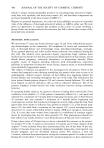
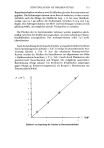
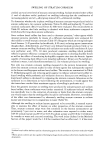
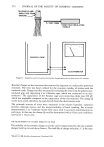
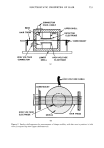
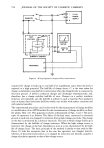
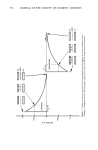
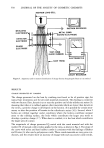
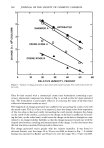
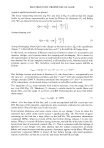
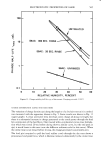
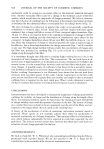
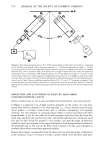
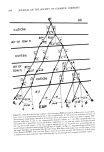
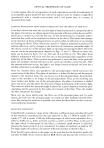
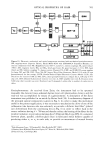
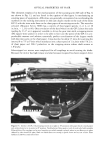
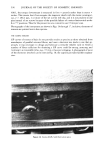
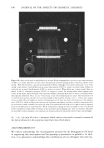
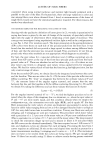
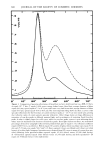
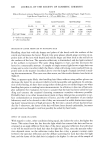
ELECTROSTATIC PROPERTIES OF HAIR 557 during discharging. Q0 is the charge on the hair when fully charged. The initial voltage V0 induced on the detector electrode is not accurately recorded by the recorder pen because of inadequate response time. V0 is therefore determined in a separate experiment in which no specimen is present. The half-life for charge induction r c is determined from the recorder trace as shown in Fig. 4. To measure decay of charge from the fully charged hair, the charging electrode is dis- connected from the high voltage source, and connected to ground. The charge on the detector electrode then becomes equal and opposite to that on the hair, since the total charge in the enclosure must remain zero. The half-life for charge decay r D is de- termined from the discharge curve of the detector electrode (Fig. 4). For all measure- ments, the electrometer output must be corrected for drift. Other experimental details and precautions are described in the ASTM procedure (14). Four separate determinations of r were made on each hair tress: both charging and dis- charging, each with both positive and negative charges induced on the hair. The half- life was calculated as a root mean square value, following general practice (9). With 3 replicate tresses, raMS of the 4 determinations could be obtained with a 95 per cent confidence limit of -+ 25 per cent. THE MEASUREMENT or CHARGE DISTRIBUTION ALONG THE HAIR FIBERS An apparatus was devised to measure the variation of charge generated along the length of hair fibers as they are combed. The system is shown in Fig. 5. The hair tress is attached at the tab end to the cross-head of an Instron testing machine. • It is inserted in a lower test comb of hard rubber, and passes also through an upper metal comb which is grounded. A cylindrical brass detector electrode, on the inside of a glass cylinder, surrounds the specimen above the rubber comb. A brass shielding electrode which is connected to ground surrounds the outer surface of the glass cylinder. Grounded guard electrodes are placed adjacent to the inner detector electrode. The aluminum comb also acts as a guard electrode. The inner electrode is connected to an elec- trometer and chart recorder. When the hair tress is pulled through the apparatus, charge is generated on the fibers as they pass through the lower comb. The charge on that part of the fibers which is im- mediately above this comb is sensed by the detector electrode. The guard electrodes and the upper metal comb serve to screen charges on the rest of the hair tress from the detector electrode. A fiber length of 1.9 cm is sensed by the detector electrode. By re- cording the electrometer output as a function of time as the hair is pulled through the combs, the variation of charge along the length of the hair is obtained. The force required to pull the tress through the comb can also be recorded on the Instron. Because of interference from the metal comb which is present for measure- ments of charge distribution, however, force measurements were made in a separate experiment in which the metal comb was removed from the apparatus. *Model 1125, Instron Corp., Canton, MA.

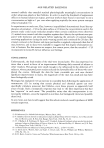
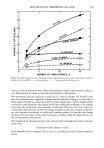
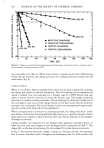
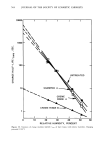
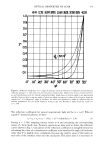
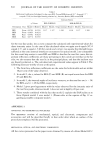
558 JOURNAL OF THE SOCIETY OF COSMETIC CHEMISTS SHIELDING ELECTRODElhi J DETECTOR ---L.J ELECTRODE INSTRON LOAD CELL INSTRON RECORDER METAL COMB (GUARD ELECTRODE) TEST COMB (HARD RUBBER) HAl R TRESS CHART RECORDER Figure 5. Apparatus used to measure distribution of charge density along length of hair as it is combed RESULTS CHARGE GENERATED BY COMBING The charge generated on the hair by combing was found to be of positive sign, for typical hair treatments and for all comb materials examined. This finding is consistent with two factors. First, keratin is at or near the positive end of the tribolectric series (9), meaning that when it is rubbed against other materials which are lower than keratin in the series, a positive charge is developed on the keratin. (It is possible by certain treat- ments to alter the position of keratin in the tribolectric series (16)). Second, when 2 bodies are rubbed together under conditions where the bodies contribute unequal areas to the rubbing surface, the body which contributes the larger area tends to develop a positive charge (17). When hair is combed, it is the hair which contributes the larger area of contact. The magnitude of charge generated Q varied with the comb material and with the number N of manual comb strokes applied to the tress, as shown in Fig. 6. The slope of the curve with nylon and hard rubber combs is consistent with the findings of Barber and Posner (6) who used a polystyrene comb. These comb materials are very poor con- ductors, and the results show an increase of charge with each successive comb stroke,
Purchased for the exclusive use of nofirst nolast (unknown)
From: SCC Media Library & Resource Center (library.scconline.org)