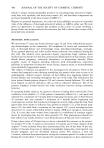
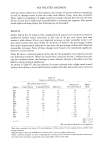
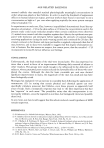
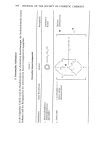
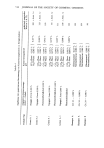
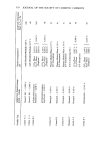
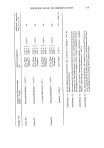
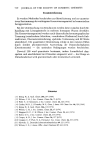
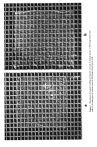
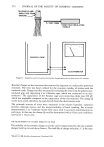
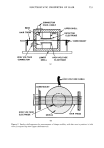
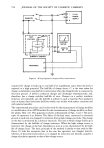
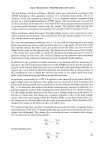
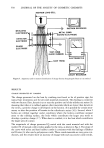
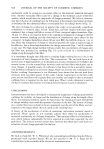
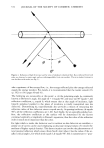
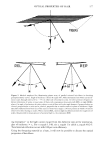
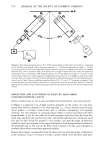
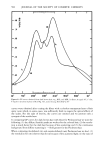
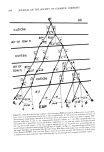
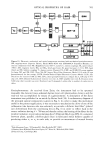
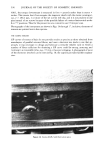
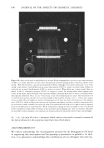
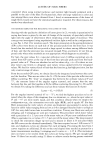
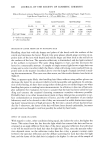
ELECTROSTATIC PROPERTIES OF HAIR 551 EXPERIMENTAL HAIR TRESSES: TREATMENT AND CONDITIONING For the work reported here, virgin brown hair*was used. Test tresses were cut perpen- dicularly to a length of 20 cm and glued at the root ends to a plastic tab, on which the hair was spread over a width of 3.8 cm. The weight of hair in each tress was 1.3 +- 0. ! g. In order to get reproducible results in charge mobility measurements, it was important to spread the hair uniformly over the 3.8 cm width of the tab. A mounting jig contain- ing a fixed fine-toothed comb was employed to facilitate sample preparation the hair fibers were spread evenly across the comb before being glued. Before use, the tresses were cleaned with a solution of sodium lauryl sulfate, then rinsed thoroughly. When the effect of antistatic and other treatments was to be studied, these materials were typically applied as follows: 0.6 cc of the particular shampoo, creme rinse, or antistat agent was applied to the wet hair, worked in manually for 40 sec, rinsed in running tap water for 20 sec, and then air dried. All treat- ments discussed below were rinsed in this manner before being dried, unless otherwise specified. As is well known, relative humidity is a critical variable in electrostatic experiments. All experiments were conducted in an environment controlled to + ! per cent RH at 23 + 0.5øC. To avoid errors arising from the hysteresis in the water uptake of hair (12), tresses were always brought to equilibrium at the test humidity from a higher humidity level. It was found necessary to condition the hair for at least 40 h at the test humidity before making measurements, in order to obtain consistent results. THE MEASUREMENT OF CHARGE GENERATED BY COMBING The generation of electrostatic charge by the separation of 2 bodies is a notoriously variable procedure subject to considerable irreproducibility, and highly sensitive to test conditions such as surface contamination (•[ 3). For this reason, many workers have eschewed measurements of charge generation, preferring to determine electrical resis- tivity or charge mobility rates (8,9). Nevertheless, the process of charge generation is critically important, and it was considered essential that it be studied. A method was developed to measure the generation of charge under conditions simulating actual use, i.e., the combing of hair, with a procedure designed to control the variables as closely as possible. The apparatus used is shown in Fig. •[. The hair tresses, comb, and Faraday cage were all enclosed in a humidity controlled box which was maintained at 23øC. Both tress and comb were carefully insulated from electrical ground during the combing operation, to ensure that no charge would be lost by conduction to ground before measurement. The tress was held in a polystyrene insulated grip while being combed, and the comb was mounted in a polystyrene handle. Some experiments were also performed with the comb grounded. Commercially available combs of various materials were used. *DeMeo Brothers, New York, N.Y.

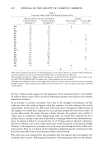
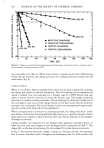
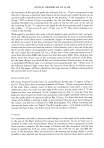
552 JOURNAL OF THE SOCIETY OF COSMETIC CHEMISTS RELEASE CLAMP- INSULATED FROM GROUND HAND HELD INSULATING HANDLE FARADAY CAGE % ß ELECTROMETER I Figure 1. Apparatus used to measure electrostatic charges generated on hair tresses by combing Residual charges on the tress were first removed by exposure to a radioactive polonium deionizer. The tress was hand combed for the requisite number of strokes with the insulated comb. Charge was then measured by releasing the tress from the polystyrene- insulated grip and depositing it in a Faraday cage, which was connected to an elec- trometer. • The capacitance of the Faraday cage and connecting cables was 100 pF, which was negligible compared to the capacitance of the electrometer. The charge Q on the tress could, therefore, be read directly from the electrometer scale. The principle sources of error were variations in the relative humidity, variations between replicate tresses, and the irreproducibility of hand combing. For accurate measurements, 3 to 5 replicate tresses were used, with 5 successive determinations on each tress. In this way the charge Q could be determined with a 95 per cent confidence interval of -+ 15 per cent. THE MEASUREMENT OF CHARGE MOBILITY ON HAIR The mobility of electrostatic charge on a body can be characterized by the rate at which charges build up on and decay from it. The half-life of charge induction, r c, is the time *Model 610 BR, Keithley Instruments, Cleveland, OH.
Purchased for the exclusive use of nofirst nolast (unknown)
From: SCC Media Library & Resource Center (library.scconline.org)