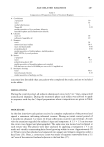
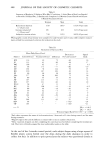
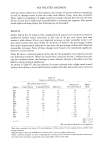
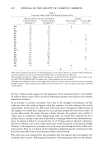
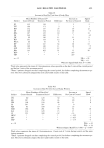
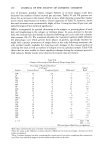
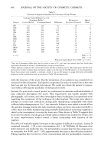
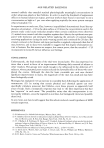
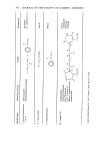
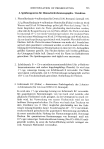
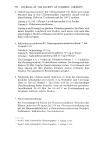
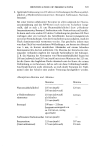
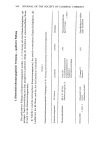
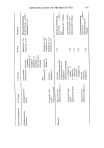
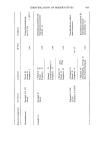
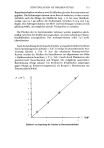
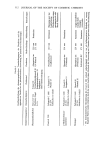
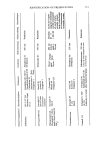
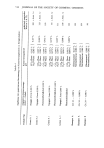
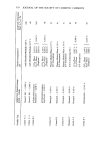
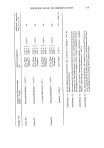
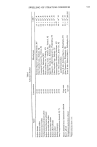
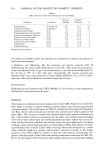
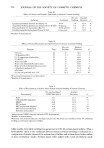
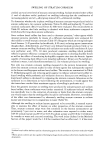
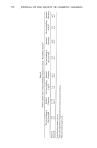
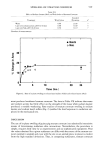
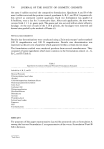
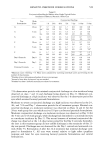
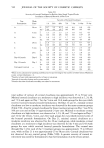
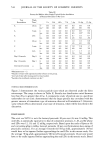
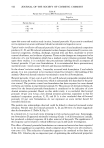
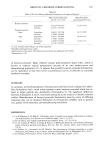
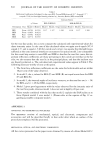
SWELLING OF STRATUM CORNEUM 527 yielded an even lower level of stratum corneum swelling. Sodium myristyl ether sulfate (1 mol of ethylene oxide) produced no swelling indicating that the combination of increasing polarity and a C•4 alkyl group instead of C•2 eliminated swelling. To determine whether the in-plane swelling of stratum corneum was produced only by anionic surfactants, two cationic surfactants (Triton X-400) and Isothan Q-75) and two nonionic surfactants (Brij 35 and Triton X-100) were evaluated. The results shown in Table III indicate that little swelling is obtained with these surfactants compared to levels found for long chain anionic surfactants. Since sodium lauryl sulfate has been used to denature proteins, © other agents which denature proteins (probably by means of a different mechanism) were evaluated for their ability to swell stratum corneum (Table IV). Reagents which are strong hydrogen bond formers (5 M guanidine hydrochloride, 8 M urea), reducing agents (ammonium thioglycollate, dithiothreitol), and 50 per cent lithium bromide produced little or no stratum corneum swelling. Performic acid oxidation run under mild conditions (0.3 per cent performic acid, 15øC, 30 min) produced extensive swelling which probably reflects its greater efficiency (compared to reducing agents) in cleaving disulfide bonds as well as the effect of introducing hydrophilic negative sites into the keratin. Agents capable of removing lipid (80 per cent dimethyl sulfoxide,ñ 80 per cent N-methyl pyr- rolidone in water,ñ and chloroform:methanol (2:1 by volume) produced no swelling. Not only was stratum corneum swelling measured in the protein denaturants cited above but stratum corneum soaked in some of these agents was subsequently exposed to the known swelling agent sodium lauryl sulfate. The results are summarized in Table V. Delipidizing agents and reducing agents appear to enhance sodium lauryl sulfate in- duced swelling while performic acid oxidation does not. Since per cent swelling in so- dium lauryl sulfate is calculated by comparing the stratum corneum dimensions in the surfactant to its dimensions in water following the pretreatment, it would appear that the tissues have reached their maximum capacity of swelling in performic acid. Since the greatest increases in swelling were produced by sodium laurate and sodium lauryl sulfate, these surfactants were further examined. If surfactant-induced swelling was specifically due to the extraction of proteins or lipids from the stratum corneum, one would expect that the swelling effect would be irreversible. However, reversibility of the effect was demonstrated by alternately swelling stratum corneum in sodium laurate and returning it to its original size in water (Table VI). Although the swelling in sodium laurate appeared to be reversible, it seemed reason- able to examine the effect of laurate on other properties of the stratum corneum. Thus, stratum corneum strips were first stretched on the Instron extensometer ap- proximately 5 per cent in water, and after relaxation were exposed to either water, 0.05 M sodium laurate at pH 9.8 or 0.05 M sodium acetate at pH 9.8 for 1 h followed by transfer to water and a second stretching. The work index (defined in the Methods Section of this paper) would be 1.0 if the treatment had no effect and 1 if the treat- *Sodium lauryl sulfate has been used as a denaturing agent in the determination of protein molecular weights (8). ñThese aprotic solvents are also capable of forming hydrogen bonds and have often been classified as protein denaturants.

528 JOURNAL OF THE SOCIETY OF COSMETIC CHEMISTS
Purchased for the exclusive use of nofirst nolast (unknown)
From: SCC Media Library & Resource Center (library.scconline.org)