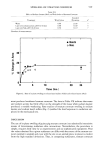
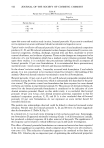
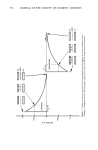
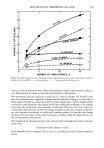
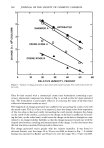
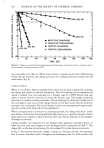
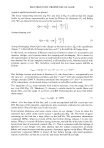
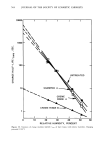
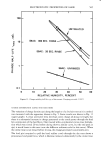
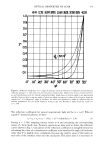
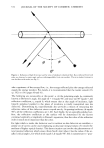
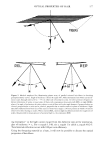
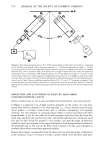
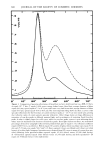
ELECTROSTATIC PROPERTIES OF HAIR 567 contact with normal force the charge generated depends on the real area of contact. Now the combing force increases in the last few centimeters of the hair tress, because of tangling. The normal contact force between hair and comb is, therefore, increased, and so the amount of charge generated in this region of the hair fibers is increased. THE MECHANISM OF ANTISTATIC AGENTS By an examination of the available experimental evidence for the 3 properties measured--the magnitude of charge generated by combing, the mobility of charge on the fibers, and the distribution of charge along their length--we can now consider the mechanisms of static electrification of hair, and of the action of antistatic agents. The charge generated by combing and the half-life of charge mobility both decrease with increasing relative humidity (Figs. 7, 8, 10, 11). The increased charge mobility is clearly a consequence of the greater water content at higher humidities, although the exact relationship is not well understood and other factors are also involved (23). Increased mobility of charges on the fiber leads to a decrease in the charge generated by combing, because of charge conduction along the fibers as they are rubbed, and this mechanism has been postulated to explain the decrease of generated charge with increasing relative humidity (3). When a large concentration of a quaternary ammonium compound is present on the hair fiber, the surface conductivity is substantially increased, as evidenced by the very low half-life of charge (Fig. 11, SBAC, unrinsed). The negligible charge generated under such circumstances (Fig. 8) can be explained by this high conductivity, by the mechanism of charge conduction along the fibers. However, when the quaternary is rinsed off with water before drying, so that only small quantities remain on the fiber, the charge generated by combing remains relatively low (Fig. 8), even though the charge half-life increases substantially and is comparable to that of untreated fibers (Fig. 11). The commercial creme rinse A also has relatively low generated charge (Fig. 7) in spite of a high half-life (Fig. 10). The reduced charge generated with these ma- terials, therefore, cannot be explained by a mechanism of enhanced surface conduc- tivity. An alternative mechanism must be sought. We hypothesize that the reduction of charge generated by combing, when hair is treated with quaternary ammonium compounds, is primarily due to the lubricating properties of these compounds on the dry hair, rather than to enhanced conductivity. The quaternary acts as a lubricant and reduces tangling, so that the force required to pull a comb through the hair is substantially reduced, especially the end peak force (work in these laboratories not reported here). A creme rinse containing the qua- ternary SBAC and other ingredients has a similar effect (Fig. 12, lower graph). The reduced normal contact force between hair and comb leads to a reduced charge on the hair (Fig. 12, upper graph) because of a smaller true area of contact between comb and hair. Medley (20) has postulated that an antistatic agent need not be present as a continuous film in order to be effective. A discontinuous film would not give long-range conduc- tivity and, therefore, the half-life of charge mobility would remain high. Medley proposed a mechanism requiring only localized conductivity at the contact site. This

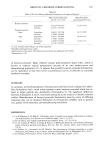
568 JOURNAL OF THE SOCIETY OF COSMETIC CHEMISTS mechanism could be acting as a secondary effect in the antistatic materials discussed here. Another secondary effect could be a change in the chemical nature of the fiber surface, which would alter the magnitude of charge generated. We believe, however, that the reduction of combing force by lubrication is the primary mechanism involved, as evidenced by the substantial effects on end-peak force and charge shown in Fig. 12. The loss of charge by conduction to ground (the scalp) is not generally a significant contributor to reduced static in hair. Clean hair, and hair treated with most agents examined, has a charge half-life in excess of 10 sec, except at higher humidities (Figs. 10 and 11). This is too long for there to be a significant dissipation of charge in the few seconds between combing and the observation of troublesome static effects by the consumer. At higher humidities (above 60 per cent RH) the half-life drops to 1 sec or less. Here the dissipation of charge to electrical ground (the scalp) is rapid enough to be effective, but at these high humidities the charge generated (Figs. 7 and 8) is smaller in any case. The high charge mobility will also enable the concentration of charges near the fiber tips, produced by combing (Fig. 12), to be reduced by a redistribution of charge along the length of the fiber. It is sometimes thought that difficulty in combing (high combing forces) is due to the generation of static charges on the hair. This is erroneous. The end peak force is ob- served even at high humidities or in the presence of static eliminators (19). Rather, the reverse is true it is the normal force between comb and hair fibers which gives rise to static charges. A possible source of confusion is that there can be a secondary interac- tion between combing force and static charge, which can increase the combing force on further combing. Experiments in our laboratory have shown that the end peak force increases with successive passes of the comb. Charge is generated on the first comb pass, and the hair fibers will separate from one another and tangle so that an increased combing force is required on the next comb pass. When a static eliminator is used as the hair is combed, this increase in end peak force from pass to pass is eliminated. CONCLUSIONS Instrumentation has been developed to measure the magnitude of charge generated by combing, the mobility of charge and the distribution of charge along the length of hair fibers. Conventional antistatic agents for hair reduce the charge generated the half:life of charge mobility varies with the quantity of antistat on the hair. The density of charge on a combed hair tress is shown to be at a maximum near the end of the fibers, and cor- responds to the region where there is a peak in the combing force. A theory of the mechanism of action of quaternary ammonium antistatic agents is proposed. These agents do not normally achieve their effect by mechanisms of increased conductivity or of charge dissipation. Their primary effect is a lubricating ac- tion, which reduces substantially the force required to comb hair, especially the end peak force. The reduced normal contact force between hair fibers and comb leads to a reduction of static charge generated on the hair. ACKNOWLEDGMENTS We wish to thank Mr. W. C. Wikstrand, who painstakingly performed much of the ex- perimental work reported herein. We are also grateful to Mr. P. L. Fagan for his contributions to the assembly of the electronic instrumentation.
Purchased for the exclusive use of nofirst nolast (unknown)
From: SCC Media Library & Resource Center (library.scconline.org)