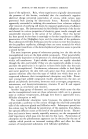
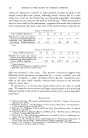
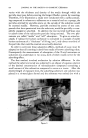
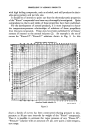
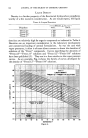
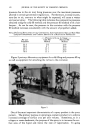
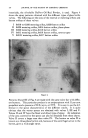
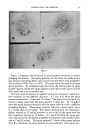
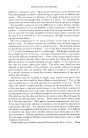
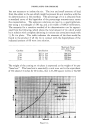
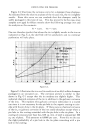
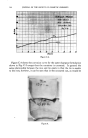
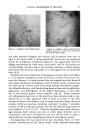
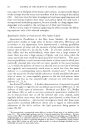
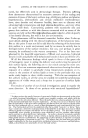
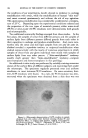
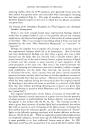
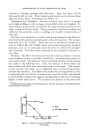
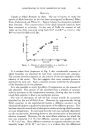
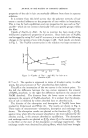
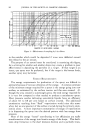
202 JOURNAL OF THE SOCIETY OF COSMETIC CHEMISTS properties of the salt in hair are markedly different from those in aqueous solutions. It is evident from this brief survey that the polymer network of hair exerts a marked influence on the properties of ions within its boundaries. This is true for both equilibrium and rate properties for ions such as Na + and Br- which do not interact chemically with any specific groups within the fiber. Uptake of Na2S04 by Hair. So far no mention has been made of the well-known amphoteric properties of proteins. Since both ions of Na2SO4 can be tagged by using Na =• and S 35 as tracers, it is an ideal salt for following changes in the uptake.of ions with changes in pH. Such results are shown in Fig. 3. The Na•SO4 concentration in the solution was kept constant at r• Na2 ++ .06 0 SO[& = 6 •o ? .'0 810 • .'o pH Figure &--Uptake of Nag *•- and SO4 = by hair as a function of pH. 0.77 m./1. The uptake is expressed in terms of divalent units in other words, the actual amount of Na + absorbed has been halved. The pH at the intersection of the two curves is the isoionic point. To the left the difference between the two curves represents the amount of H2SOi absorbed to the right the difference represents the amount of NaOH absorbed. The distance from the lower curve to the abscissa represents the amount of Na2SO4 absorbed. It is evident that the absorp- tion of salt is inhibited by either absorbed base or absorbed acid. The kinetics of the absorption and desorption of Na=SO4 have been studied by Underwood and White (2). The results are shown in Fig. 4. Three types of measurement--absorption, desorption and exchange--are shown. The absorption results are plotted as the function (•o -- •)/•o against time, where • is the amount absorbed at the time indicated by the abscissa and •o is the amount absorbed at equilibrium. The desorption and exchange results are plotted as •/•0, where 40 is the amount present in the fiber at the start of the desorption or exchange experiment. The exchange results were obtained by placing fibers, which had been brought

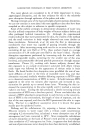
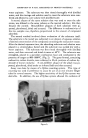
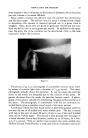
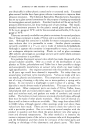
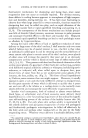
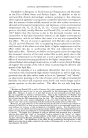
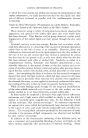
RADIOTRACERS TO STUDY ABSORPTION BY HAIR 203 to equilibrium with a radioactive solution and then washed, in a nonradio- active solution of the same composition and concentration. The rate of loss of radioactive salt by the fiber was then followed. In every case the gain or loss of SO4= by the fiber was followed. Certain features of these experiments should be emphasized. In every case the external bath was enough larger than the fibrous sample that it was effectively unchanged in concentration throughout the experiment. For a sample following Fick's Law with these boundary conditions, absorp- tions, and desorption results should coincide when plotted as in Fig. 4. If the diffusion of the SOj ion is the rate controlling factor, the exchange results should nearly coincide with the others because the exchange experi- ment measures the rate of diffusion of the SO•= ion alone. o,•o 0 • O0 O0 0 0 Absorption Decorpriori •ch•ge --Fiok's Law i • •0 •000 Figure 4.--Rates of absorption, desorption, and exchange of Na2SO4 by hair. It is evident from Fig. 4 that the absorption and exchange results coincide with each other, and they also coincide moderately well with the solid line which was obtained by using Fick's Law. The desorption results are dif- ferent. Complete desorption is very slowly attained, and the shape of the curve cannot be explained in terms of Fick's Law. Desorption is thus probably a composite process. The following mechanism can be suggested to account for the slow desorption. When desorption starts, the water desorption bath contains a few H + ions. Two processes are thus possible, desorption of salt and exchange of Na + ions for H + ions. The second process would mean that part of the SO4= ions would be desorbed as H2SO4 rather than Na2SO4, and the desorp- tion of H=SO4 is known to be very slow. CONCLUSIONS Absorption by hair may be studied using radioactive tracer techniques with a facility and accuracy unattainable using more conventional chemical
Purchased for the exclusive use of nofirst nolast (unknown)
From: SCC Media Library & Resource Center (library.scconline.org)