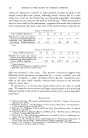
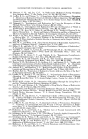
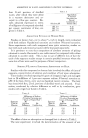
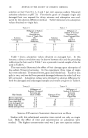
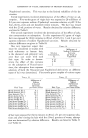
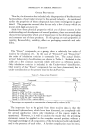
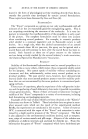
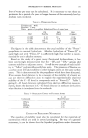
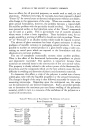
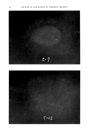
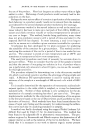
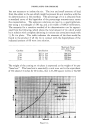
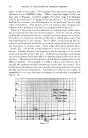
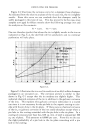
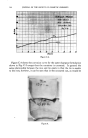
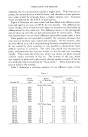
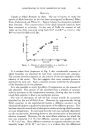
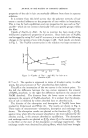
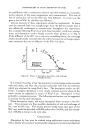
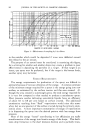
ADSORPTION OF N-ACYL SARCOSINES ON PROTEIN MATERIALS 131 In general, the results show that within the limits tested, a decrease in pH causes an increase in adsorption of the substituted sarcosines on all the substrates tested. In the case of hair, an increase in solution concentration generally causes an increase in adsorption of the compounds up to a max- imum. As might be predicted, adsorption on the substrates can be increased by increasing the length of exposure time. However, each of the substituted sarcosines seems to possess its own characteristic adsorption, with the N- palmitoyl derivative showing much more adsorption at longer exposure times on hair than does the N-lauroyl derivative. An interesting factor brought out by the studies is illustrated by com- parison of the two sarcosines on various substrates. The N-lauroyl com- pound appears to adsorb better on casein than does the N-palmitoyl deriv- ative, whereas the N-palmitoyl derivative usually adsorbs better than the N-lauroyl on hair. Studies with various types of human hair demonstrate the variance in adsorption of the N-acyl sarcosines, probably due to variance in the chem- ical and physical properties of the hair. This illustrates the necessity for using homogeneous samples of substrates when undertaking studies of this type. SUMMA KY The use of isotopes in the field of cosmetic chemistry is demonstrated. Adsorption studies of sodium N-lauroyl and N-palmitoyl sarcosines on protein substances, casein, gelatin discs and human hair are described. The effect of pH, solution concentration and time of exposure on specified substrates is illustrated for the substituted sarcosines. The effect of variation among different types of hair on the adsorption of the substituted sarcosines is reported. BIBLIOGRAPHY (1) Fosdick, L. S., Calandra, J. C., Blackwell, R. Q., and Burrell, J. H., 7. Dental Research, 32,486 (1953). (2) King, W. J., Manahan, R. D., and Russell, K. L., Abstracts Thirty-third General Meeting International Association for Dental Research, 40 (March, 1955). (3) Snyder, M. L., .•. Dental Research, 19• 349 (1940). (4) Allison, J. B., Nelson, M. F., and Hilf, R., Unpublished results by the Bureau of Biological Research, Rutgers University.

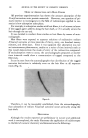
PRINCIPLES AND TECHNIQUES OF RADIOISOTOPE APPLICATIONS* By R•:CHAP,.D E. O'Too•,•: Tracerlab, Inc., Boston, Mass. A QUESTION FREQUENTLY heard in this field is, "Have the promising predictions for radioactivity begun to materialize?" Yes, although it has been the few dramatic applications that have been publicized, radioisotopes are quietly performing many useful functions in both industry and science. Industry in general has been rather slow to embrace this new tool and as far as the chemist and engineer are concerned, it is nothing more than a tool but one that frequently can be called upon to accomplish things that could not be done using conventional techniques. The reason for this rather delayed acceptance of radioisotope technique is a combination of a shortage of trained personnel and vague fears of health hazards. Today, however, there are excellent facilities for acquiring this knowhow and with this knowledge, the hazards--and there are hazards-- need be no real obstacle to having a radioisotope program. Radioisotopes are produced in several ways. Mainly, an element is subjected to intense neutron bombardment in an atomic pile which causes changes to occur within the nuclei of the atoms in question and induces instability. They also result as a by-product in the fusion reaction of uranium or plutonium. Once in this unstable state, they strive to return to a stable state through the emission of radiation in the form of alpha, beta or gamma rays. Unlike neutron radiation, these rays in themselves cannot make other materials radioactive. The time required for the radio- isotope to return to a stable state may vary from a fraction of a second to millions of years depending upon the element. Meanwhile, it continues to give off radiation but cannot be distinguished from its stable counterpart by any chemical means. These forms of radiation, namely the alpha, beta and gamma rays, should be explained a little more in detail. The alpha ray is a positively charged particle emitted from a nucleus and composed of two protons and two neutrons. Alpha particles are expelled from their parent atoms at speeds * Presented at the September 15-16, 19•5, Seminar, New York City. 132
Purchased for the exclusive use of nofirst nolast (unknown)
From: SCC Media Library & Resource Center (library.scconline.org)