MEASUREMENT OF PARTICLE SIZE DISTRIBUTION IN AEROSOLS 79 scattering ability and susceptibility to impaction. A large number of methods for indirect particle size measurements have been developed, and they are often preferred for determinations on specific aerosol systems be- cause of their relative speed and convenience. The interpretation of in- direct particle size measurements is, however, complicated by the above mentioned need for auxiliary data on the physical properties of the par- ticles. SAMPLING OF AEROSOLS Every measurement of particle size distribution begins with a sampling operation in which a portion of the aerosol must be withdrawn or isolated for the measurement. Because aerosols are inherently unstable systems, considerable care must be exercised in order to obtain representative samples. The basic cause of instability in aerosol systems is gravitational settling. A suspended particle is subject to a gravitational force Fg, which may be expressed as follows: Fg= m.g 1 = g •(p - p')d3g where m is the mass of the particle, g is the acceleration of gravity, o is the density of the particle, o' is the density of the suspending medium, and d is the particle diameter, all in cgs units. For spherical particles, d is the actual diameter, while for particles of other shapes d must be taken as an appropriate "equivalent" diameter. In the particle size range of interest here, the motion of a spherical particle through a fluid is opposed by a resistive force, Fr, given by the well-known Stokes' Law expression Fr = 3•r•dv where • is the viscosity of the fluid, and v is the particle velocity relative to the fluid, in cgs units. Equilibrium is reached when the gravitational force on a particle is just balanced by the fluid resistance, and the particle then falls at con- stant velocity. By equating the expressions shown above for the two op- posing forces, it is found that this terminal settling velocity,//, is given by: i/_g(o-- o')d 2 18/• The settling velocity of aerosol particles is proportional to the squares of their diameters. Thus, in a confined space, the larger particles will settle out quickly, producing a marked change in the size distribution of suspended particles. The situation is further complicated in actual spray aerosols by motions of the suspending medium as well as the initial

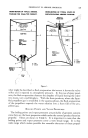
80 JOURNAL OF THE SOCIETY OF COSMETIC CHEMISTS velocities of the particles imparted in the process of spray formation. Ad- ditional complications are introduced by the evaporation and consequent size change of some aerosol particles. Self-propelled aerosols also show a marked variation in particle size across the spray cone, with the coarser particles concentrated near the center and finer particles at the edges. This has been observed by Fulton(l) and others. Consideration of the complicated dynamics of spray aerosol particles is beyond the scope of this discussion. However, the importance of con- sidering this factor in connection with sampling for particle size measure- ment cannot be overemphasized. The simple Stokes' Law relation can often be extended to serve as a guide to particle dynamics, introducing the additional forces acting on particles in spray systems. Moving aerosol systems are sampled isokinetically as far as possible, that is with a mini- mum change in aerosol stream velocity at the entrance to the sampling instrument. Any marked change of air speed or direction at the entrance to a sampling device is likely to lead to either an appreciable excess or loss of the coarser particles in the aerosol being sampled. The most widely used methods of aerosol sampling for size determina- tion are sedimentation and inertial separations. Sedimentation sampling involves simply the collection of particles which settle under the influence of gravity to the bottom of a chamber containing an aerosol. Sufficient time must of course be allowed for the smallest of the particles to settle to the sampling surface from the top of the body of aerosol. Meanwhile, convection currents or other air movements in the settling chamber can lead to excessive losses of particles on the walls of the chamber. This method thus becomes impractical for the accurate sampling of aerosols which con- tain particles smaller than several microns in diameter along with a signi- ficant proportion of coarse particles. When a settling chamber is used to sample liquid aerosols, it is also necessary to restrict the aerosol concentra- tion so as to avoid the overlapping of drops on the sampling surface. Drops falling on top of each other will coalesce, resulting in a change of apparent particle size. It can be shown statistically that this error becomes appreciable if more than 5 to 10 per cent of the area of the sampling sur- face is covered by particles. Inertial methods of particle separation include cyclone and centrifuge methods as wel'l as a variety of impingement or impaction procedures. For sampling spray aerosols, surface impaction is most widely used. A moving stream of aerosol is directed at a sampling surface such as a slide placed at right angles to the stream. The aerosol particles, because of their inertia, do not follow the gas streamlines around the obstacle but deposit on the slide and adhere to it. The efficiency of impaction, or per- centage of particles which deposit on the slide is a function of the size and density of the particles, the stream velocity and the dimensions of the
Purchased for the exclusive use of nofirst nolast (unknown)
From: SCC Media Library & Resource Center (library.scconline.org)