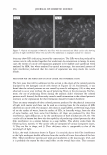
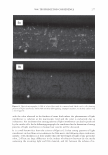
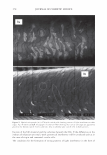
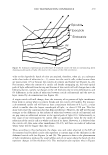
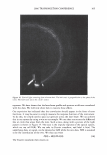
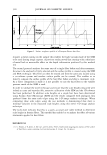
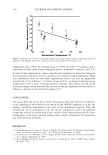
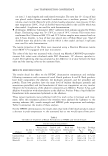
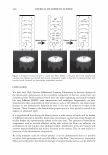
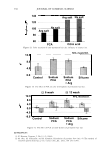
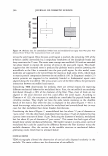
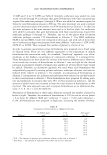
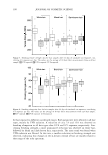
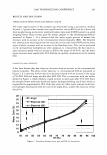
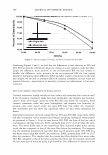
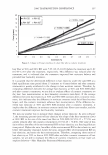
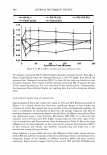
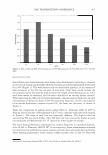
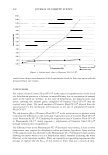
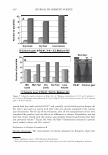
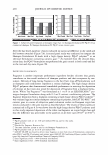
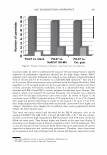
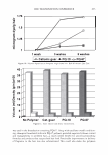
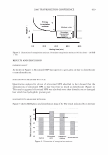
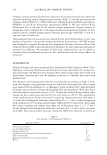
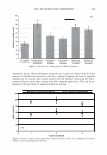
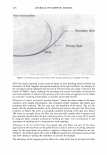
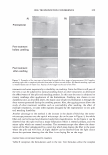
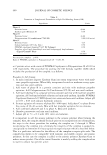
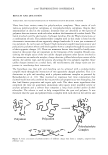
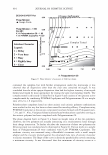
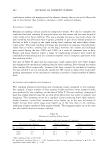
316 JOURNAL OF COSMETIC SCIENCE 3.4 '":'".,, ., 3.2 0 � 3.0 -..... 2.8 C 2.6 8 s 2.4 t! C 2.2 2.0 I 1.8 135 140 145 150 155 160 Denaturation Temperature, 0 c Figure 5. Reaction rate constants at the peak temperatures, k(T 0), for hair samples, repeatedly treated by oxidation. The whiskers denote the standard deviations for fivefold determinations (15). temperature from l 58 ° C for untreated hair to l 38 ° C after the 7 th treatment and a concurrent decrease of the relative amount of native, denaturable a-helix by 40% (13). In view of this compensation, a more comprehensive parameter to assess the changes of the denaturation process is the rate constant at the respective peak temperatures. These were determined from the individual experimental curves ( 15) and are graphically summarized vs. T v in Figure 5. A slight increase of k(T 0) is observed with decreasing temperatures, that is with increasing oxidative changes. This reflects the fall of the activation energy, which overrides the decrease of the pre-exponential factor, which is linked to a decrease of the activation entropy (15 ). CONCLUSIONS The results from the various facets of the investigation show that the kinetic hindrance of the unfolding of the a-helix by the matrix in the IF/IFAP-composite is in fact the primary controlling mechanism of the onset of the denaturation process. Once the temperature rise in combination with the natural composition and/or the chemical change has induced a suitable drop of the viscosity of the matrix around the IFs, their denaturation occurs along a process pathway that is largely independent of temperature and of the previous treatment. REFERENCES (1) A. Schwan-Jonczyk, G. Lang, T. Clausen, J. Koehler, W. Schuh, and K. D. Liebscher, "Hair Prepara- tions," in Ullmann's Encyd. Ind. Chern., 3.Ed. (Wiley-VCH, Weinheim, D, 1998). (2) R. D. B. Fraser, T. P. MacRae, and G. E. Rogers, Keratins: Their Composition, Structure, and Biosynthesis (C. C. Thomas, Springfield, 11, 1982). (3) M. Feughelman, Mechanical Properties and Structure of Alpha-Keratin Fibres (UNSW Press, Sydney, Australia, 1997).

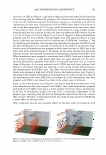
2006 TRI/PRINCETON CONFERENCE 317 (4) H. Zahn, F.-J. Wortmann, G. Wortmann, K. Schaefer, R. Hoffman, and R. Finch, "Wool," in Ull- mann's Encycl. Ind. Chem., 6.Ed. (Wiley-VCH, Weinheim, D, 2003). (5) M. Feughelman, A two-phase structure for keratin fibers, Text. Res.]., 29, 223-228 (1959). (6) D. A. D. Parry and P. Steinert, Intermediate filaments: Molecular architecture, assembly, dynamics and polymorphism, Quarterly Rev. Biophys., 32(2), 99-187 (1999). (7) F.-J. Wortmann and H. Deutz, Characterizing keratins using high-pressure differential scanning calorimetry,]. Appl. Polym. Sci., 48, 137-150 (1993). (8) M. Spei and R. Holzem, Thermoanalytical determination of the relative helix content of keratins, Colloid Polym. Sci., 267, 549-551 (1989). (9) V. F. Monteiro, A. P. Maciel, and E. Longo, Thermal analysis of Caucasian human hair,]. Thermal Anal. Calorim. 79, 289-293 (2005). (10) A. R. Haly and J. W. Snaith, Differential thermal analysis of wool-The phase transition endotherm under various conditions, Text. Res.]., 37, 898-907 (1967). (11) F. -J. Wortmann and H. Deutz, Thermal analysis of ortho- and para-cortical cells isolated from wool fibers,]. Appl. Polym. Sci., 68, 1991-1995 (1998). (12) H. Deutz, Thermische und mikroskopische Charakterisierung von Keratinen, PhD-thesis, DWI at RWTH Aachen University of Technology, Aachen, Germany, 1993. (13) F.-J. Wortmann, C. Springob, and G. Sendelbach, Investigations of cosmetically treated human hair by differential scanning calorimetry in water,]. Cosmet. Sci., 53, 219-228 (2002). (14) M. E. Brown, Introduction to Thermal Analysis (Chapman and Hall, New York, 1988). (15) F.-J. Wortmann, C. Popescu, and G. Sendelbach, Nonisothermal denaturation kinetics of human hair and the effects of oxidation, Biopolymers 83, 630-635 (2006). (16) K. Sharp, Entropy-enthalpy compensation: Fact or artefact?, Prat. Sci., 10, 661-667 (2001).
Purchased for the exclusive use of nofirst nolast (unknown)
From: SCC Media Library & Resource Center (library.scconline.org)